By Elena Marsh
How to Track Marketing ROI with Multi-Touch Attribution
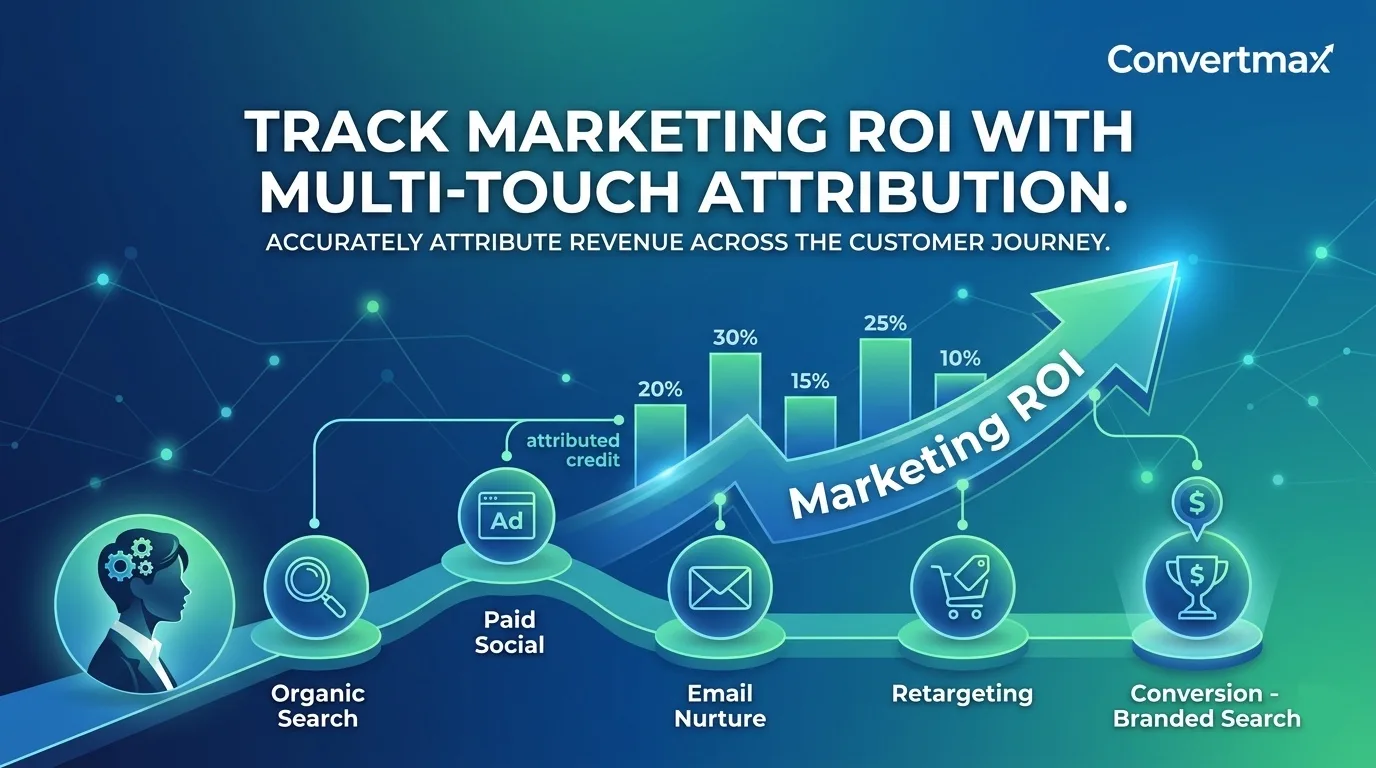
Tracking marketing ROI should be simple in theory: compare what you spent against the revenue your marketing generated. In practice, it is rarely that clean. A customer may discover your brand through organic search, return after seeing a paid social ad, read a product comparison, click a retargeting campaign, and finally convert through branded search. If your reporting gives all the credit to the last click, your team may scale the channel that closed the sale while cutting the channels that created demand in the first place.
That is why teams that want to track marketing ROI accurately need more than campaign-level spend reports. They need a way to connect channels, campaigns, touchpoints, and conversions across the full customer journey. Multi-touch attribution helps solve this problem by distributing credit across the interactions that contributed to a conversion, rather than assigning all value to a single touchpoint.
For growth teams, this is not just an analytics upgrade. It is a better way to decide where to invest the next dollar.
What marketing ROI actually measures
Marketing ROI is the return generated from marketing investment. A simple version of the formula is:
Marketing ROI = (Sales Revenue Attributed to Marketing - Marketing Cost) / Marketing Cost
This formula is useful, but it depends on one critical input: which revenue should be attributed to marketing, and to which marketing activities? If attribution is incomplete, ROI calculations become misleading. A channel may look profitable because it captures high-intent demand at the end of the journey. Another may look inefficient because it influences prospects earlier, before they are ready to buy.
The challenge is not only calculating ROI. The challenge is calculating ROI in a way that reflects how buyers actually behave.
Why tracking marketing ROI is difficult
Modern customer journeys are fragmented across paid ads, organic search, email, social media, review sites, referrals, webinars, sales conversations, and repeat website visits. Customers often conduct several searches and click several ads before completing an important action. That raises a simple question: does the last ad or last click really deserve all the credit?
This is where last-click attribution creates a blind spot. Last-click reporting is easy to understand, but it often rewards the final interaction rather than the full set of interactions that moved a prospect from awareness to purchase. As a result, teams may over-invest in bottom-of-funnel channels and under-invest in the activities that build demand, educate customers, and shorten the path to conversion.
Privacy changes also make measurement harder. As media complexity grows and fewer shared identifiers are available, first-party data becomes more important because it is collected directly from owned channels and can support more durable customer journey tracking.
What is multi-touch attribution?
Multi-touch attribution is the practice of assigning conversion or revenue credit across multiple marketing touchpoints in a customer journey. Instead of asking which channel gets all the credit, multi-touch attribution asks how each meaningful touchpoint contributed.
This distinction matters because most marketing programs are designed to work together. Content creates awareness. Paid campaigns generate traffic. Email nurtures interest. Retargeting brings people back. Sales outreach or demo pages may help close the deal. A single-touch model compresses this entire system into one winner. A multi-touch model gives teams a fuller view of how revenue is created. If you want a deeper breakdown of the model shift, see moving beyond last-click attribution.
The benefits of multi-touch attribution
The benefits of multi-touch attribution are strongest when marketing teams need to make budget decisions across multiple channels. It helps transform campaign reporting from a channel scorecard into a revenue decision system. We cover that in more detail in Benefits of Multi-Touch Attribution for B2B Marketing.
- More accurate ROI reporting by connecting revenue to multiple touchpoints instead of only the last click
- Better budget allocation by showing which channels assist, introduce, nurture, and close customers
- Stronger full-funnel visibility so top-of-funnel and mid-funnel campaigns are not undervalued
- Faster optimization while campaigns are still active
- Better stakeholder confidence because performance can be explained with revenue data rather than vanity metrics
- More resilient measurement built on first-party behavioral and conversion data
The broader lesson is simple: better measurement enables better optimization.
How to track marketing ROI with multi-touch attribution
The best way to track marketing ROI is to build a measurement process that connects cost, customer behavior, conversion events, and revenue outcomes. Multi-touch attribution is the framework that turns those signals into decisions.
1. Define the revenue outcome you want to measure
Start by deciding what return means for your business. For ecommerce teams, the primary outcome may be purchase revenue, average order value, repeat purchase rate, or customer lifetime value. For SaaS and B2B teams, it may be demo requests, free trials, qualified pipeline, closed-won revenue, expansion revenue, or payback period.
This step matters because ROI is not always a single metric. The right outcome depends on your business model and sales cycle.
2. Capture first-party customer journey data
To attribute revenue accurately, you need reliable data about how visitors interact with your website and campaigns. That includes traffic source, campaign parameters, landing pages, content engagement, form submissions, purchases, pipeline stages, and offline conversions when relevant.
Convertmax is built around this first-party analytics foundation. The platform combines first-party analytics, visitor identification, customer journey tracking, conversion tracking, and multi-touch attribution so teams can connect channels and touchpoints to the revenue they create.
3. Connect marketing data to revenue data
Marketing ROI becomes much more useful when analytics data is connected to CRM, ecommerce, or conversion systems. Without that connection, teams may know which campaigns generate clicks or leads but not which campaigns generate revenue.
This is especially important for B2B and high-consideration purchases, where a visitor may convert into a lead long before revenue is realized. If marketing data stops at the form fill, ROI reporting will miss the difference between low-quality volume and high-value pipeline.
4. Choose the right attribution model
No attribution model is perfect. The goal is to choose a model that matches your customer journey and decision-making needs. Convertmax supports several major attribution models, including first-touch, last-touch, linear, U-shaped, time-decay, and data-driven attribution. You can also see how these models work together in our overview of how attribution reveals what actually drives revenue.
- First-touch helps you understand which channels create initial awareness
- Last-touch highlights which channels most often close conversions
- Linear gives equal credit to all tracked touchpoints
- U-shaped emphasizes the first and last touch while still recognizing the middle
- Time-decay gives more weight to touchpoints closer to conversion
- Data-driven attribution assigns credit based on observed conversion patterns
For many teams, the most useful approach is not choosing one model forever. It is comparing models to understand how different assumptions change the perceived value of each channel.
5. Analyze ROI by channel, campaign, and journey stage
Once attribution is in place, analyze performance at multiple levels. Channel-level ROI can show whether paid search, paid social, organic search, email, referral, or direct traffic is contributing revenue. Campaign-level ROI can show which offers, audiences, or creatives deserve more investment. Journey-stage analysis can show whether a channel is better at creating awareness, nurturing consideration, or closing demand.
This is where multi-touch attribution becomes operational. Instead of simply reporting that one channel drove the final conversion, your team can see which channels assist conversions, which combinations of campaigns produce high-value customers, and which paths are associated with faster sales cycles or higher order values.
6. Reallocate budget based on attributed revenue
Tracking marketing ROI is only valuable if it changes decisions. Use attribution insights to shift budget away from campaigns that consume spend without contributing meaningful revenue and toward campaigns that consistently influence profitable conversions.
The goal is not to chase the lowest cost per click or the highest last-click ROAS. The goal is to scale the marketing mix that produces the best revenue outcome across the full customer journey.
Common mistakes to avoid
The most common mistake is treating attribution as exact truth rather than a decision framework. Attribution models estimate contribution based on available data and assumptions. They are extremely useful, but they should be interpreted alongside testing, customer research, sales feedback, and margin data.
Another mistake is optimizing only for the final conversion event. If your team ignores assisted touchpoints, you may cut the campaigns that educate buyers and create future demand. This often makes short-term ROI look cleaner while weakening long-term growth.
A third mistake is failing to standardize campaign tracking. Inconsistent UTM parameters, disconnected CRM fields, duplicate conversion events, and missing offline revenue data can all reduce attribution quality. Good attribution depends on disciplined data collection.
Finally, many teams wait too long to review performance. Frequent in-flight optimization is one of the biggest advantages of better attribution.
How Convertmax helps teams track marketing ROI
Convertmax helps teams move from fragmented marketing reports to a clearer view of revenue performance. It is a revenue intelligence platform built on first-party analytics and multi-touch attribution, designed to identify visitors, track customer journeys, capture conversions, and connect marketing touchpoints to revenue.
For ecommerce and retail teams, Convertmax can help reveal the path from first touch to purchase, identify which channels drive revenue, and optimize ad spend with multi-touch attribution. For SaaS and B2B teams, it can help attribute signups, trials, pipeline, and conversions across longer buying journeys while using visitor identification and first-party analytics to improve lead and ROI reporting. For agencies, it creates a more defensible reporting foundation for client campaigns across channels.
Most importantly, Convertmax is designed for the measurement environment marketers now face: more channels, more privacy constraints, and more pressure to prove revenue impact. By combining first-party analytics with flexible attribution models, it helps teams answer the question that matters most: which marketing activities actually drive revenue?
The bottom line
If you want to track marketing ROI accurately, you need to move beyond surface-level metrics and last-click reporting. Marketing performance is created across a journey, not at a single moment. Multi-touch attribution gives teams a more complete way to understand that journey, assign revenue credit, and invest in the channels that work together to produce growth.
The result is not just better reporting. It is better decision-making: clearer budgets, stronger stakeholder confidence, and a revenue strategy built on first-party data.
To see how Convertmax can help you connect campaigns, customer journeys, and revenue, book a demo.