By Elena Marsh
AI Is Making the CRM’s Real Problems Harder to Ignore
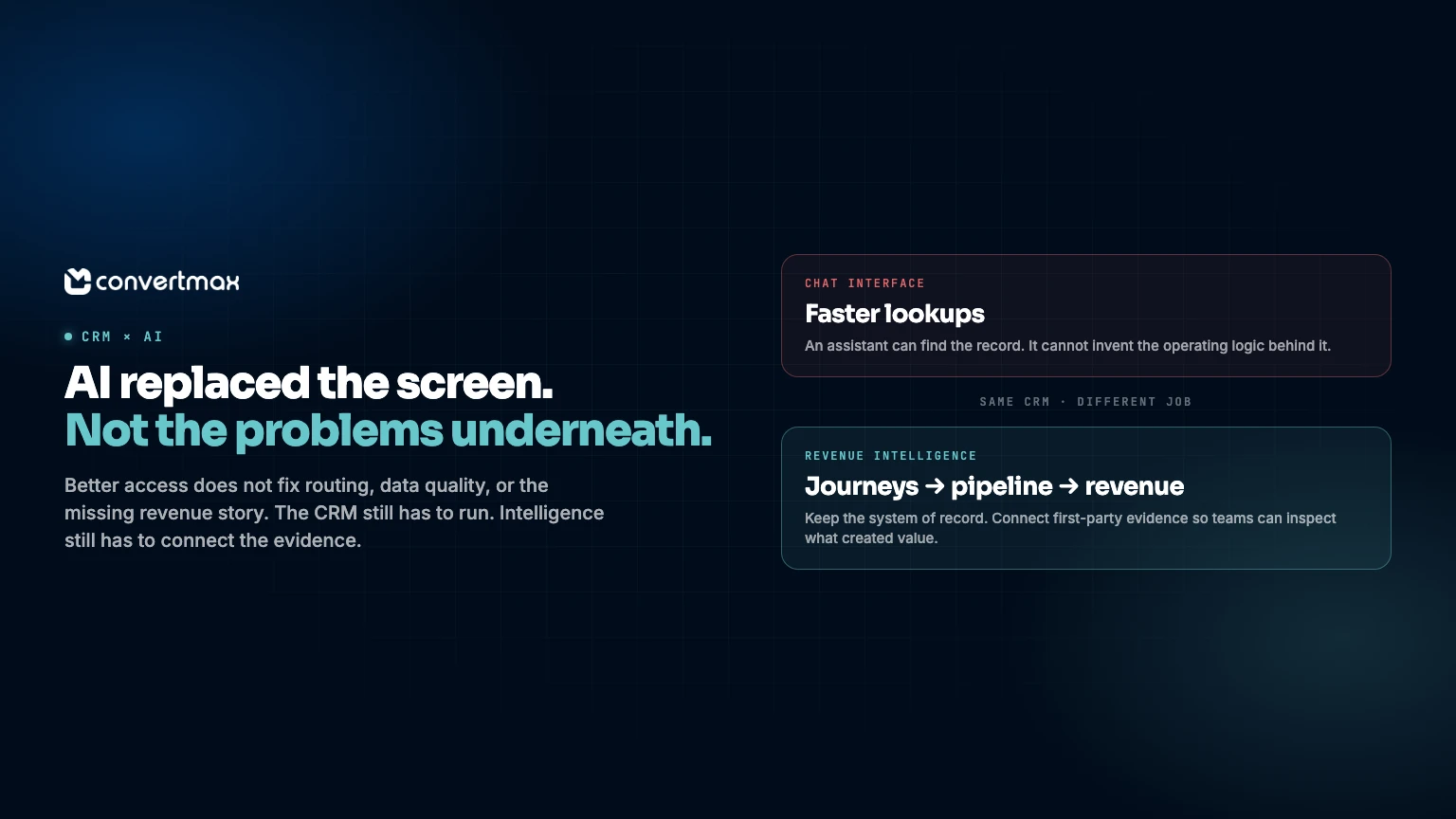
A growing number of revenue teams no longer begin their day inside the CRM. They start with an AI assistant.
They want the last conversation with an account. A phone number while a prospect is waiting. A quick read on stalled deals, growing accounts, or the activity patterns that are easy to miss in a crowded record.
For those jobs, a conversational interface can feel much faster than opening records, switching tabs, and building a report.
That shift is real. It does not make the CRM irrelevant. It changes what people notice about it.
For years, the CRM screen was where users worked and where leaders assumed much of the value lived. Now an AI interface can handle more of the day-to-day work: lookups, notes, updates, and first-pass analysis. So teams are asking a fair question: what are we actually paying for, and what would stop working if this system disappeared tomorrow?
The answer is rarely simple.
The screen is easier to replace than the machinery behind it
Contact records are usually portable. The operating logic built around them is not.
Most established CRM setups contain years of accumulated routing rules, lifecycle definitions, assignment logic, permissions, opt-out controls, integrations, sequence triggers, calling history, reporting conventions, and odd exceptions that only make sense because somebody solved a problem a long time ago. It may be untidy. It is still doing work.
That is why replacing a CRM is different from placing a new interface on top of one. An AI assistant can make a customer record easier to find. It cannot, on its own, recreate the background decisions that occur when a form is submitted, a call is logged, a lead is reassigned, or a customer changes status.
The useful question is not, “Can we export our contacts?” It is, “Can we reproduce the operating logic around those contacts without losing history or creating risk?”
For many companies, the answer is not yet. That is not a lack of ambition. It is a realistic view of the job. Rebuilding workflows, integrations, deliverability safeguards, security controls, audit trails, and reporting definitions takes time. And there is a good chance something important gets missed along the way.
AI is exposing a pricing question that was already there
CRM infrastructure has value. There is no serious debate about that.
The tension is that the familiar pricing model often assumes that value shows up as people spending hours in the product. That assumption is getting weaker.
If a team uses a conversational layer for daily search, quick updates, and account context, a per-seat price can begin to feel detached from how the system is used. The database, automations, integrations, and governance may still be essential. The traditional application interface may become the place people visit only for specialist work.
This does not make the underlying platform interchangeable. It does invite a more honest conversation about what customers are buying. Is it an operating system of record? A user interface? Both, packaged in a way that made sense before AI became part of the daily workflow?
The market will settle the commercial answer over time. Revenue leaders do not need to wait for it. A stack audit can separate the cost that supports important operating capability from the cost that reflects work habits already moving elsewhere.
Better access does not fix bad data
There is a catch. A smoother interface can make poor CRM data more dangerous, not less.
When ownership is stale, lifecycle stages conflict, routing rules are out of date, or activity is missing, an AI assistant can still give a quick answer. It may sound entirely plausible. But it is working from partial evidence.
That produces a familiar loop. People avoid the CRM because updating it is tedious. The data decays. The team turns to AI for a cleaner experience. Then the assistant is asked to explain a record that has become less trustworthy over time.
AI can reduce the effort of writing notes, standardizing fields, and finding anomalies. That helps. It cannot correct years of weak definitions or missing activity without a deliberate data-quality effort. Someone still has to decide what a valid stage means, who owns an account, which event counts as a conversion, and when a record should close.
The problem is no longer only CRM adoption. It is data discipline.
Chat is strong at discovery. It is not always faster for precision.
Conversational search is especially useful when a question crosses systems or needs context. Finding every interaction tied to a phone number, assembling a timeline before a sales call, or spotting a pattern across deals can be far easier in chat than in a maze of filters.
But not every task needs interpretation. A simple record lookup, a filtered list of accounts, or a report with a few specified columns may still be quicker in a familiar grid. Prompts can require clarification. Summaries can omit the detail that changes a decision. When the stakes are high, a raw record is often more useful than a polished account of it.
So the better model is not chat instead of structured views. Use chat for discovery and synthesis. Keep direct access to the underlying evidence when somebody needs to inspect the details.
The bigger opportunity is decision intelligence
The more interesting CRM question is not whether users can ask better questions about what happened. It is whether the business can get a credible answer to what it should do next.
Revenue teams need to know why one campaign produced customers while another produced only activity. They need to see where a promising journey loses momentum. They need to know whether calls, forms, sales activity, and closed revenue tell the same story or contradict one another.
A CRM is designed to manage relationships and the sales process. It is not always built to connect every pre-lead and post-lead signal into one complete revenue story. That gap shows up when marketing, sales, finance, and leadership make decisions from different partial reports.
This is where a revenue-intelligence layer can help without attempting to replace the CRM. The operating record stays in place. An additional layer joins first-party journeys, marketing activity, calls, CRM outcomes, and closed revenue, so the team can assess what actually created business value. Convertmax is built for that role: it connects evidence across systems while the CRM continues to run the relationship and pipeline. See What Is Convertmax?.
That avoids a false choice. The point is not to remove infrastructure that supports the business. The point is to stop expecting one system to answer questions it was not built to answer alone.
Treat the AI shift as a chance to repair the foundation
AI is changing the front door to the CRM. It is not removing the need for a well-run system of record, clear definitions, dependable integrations, and accountable data stewardship.
The teams that get the most from this change will not be the ones that replace every existing tool first. They will be the ones that separate the jobs. Keep the operating foundation dependable. Make daily work easier. Connect journey evidence to revenue. Then use AI to help people act on a version of the truth they can inspect and trust.
That is more valuable than a new interface. It is a better way to run the revenue engine.
If your reporting cannot reliably connect marketing activity, customer journeys, calls, pipeline progress, and closed revenue, see how Convertmax builds the missing revenue view.