By Elena Marsh
Why Convertmax Is CRM Agnostic (And Why That Matters)
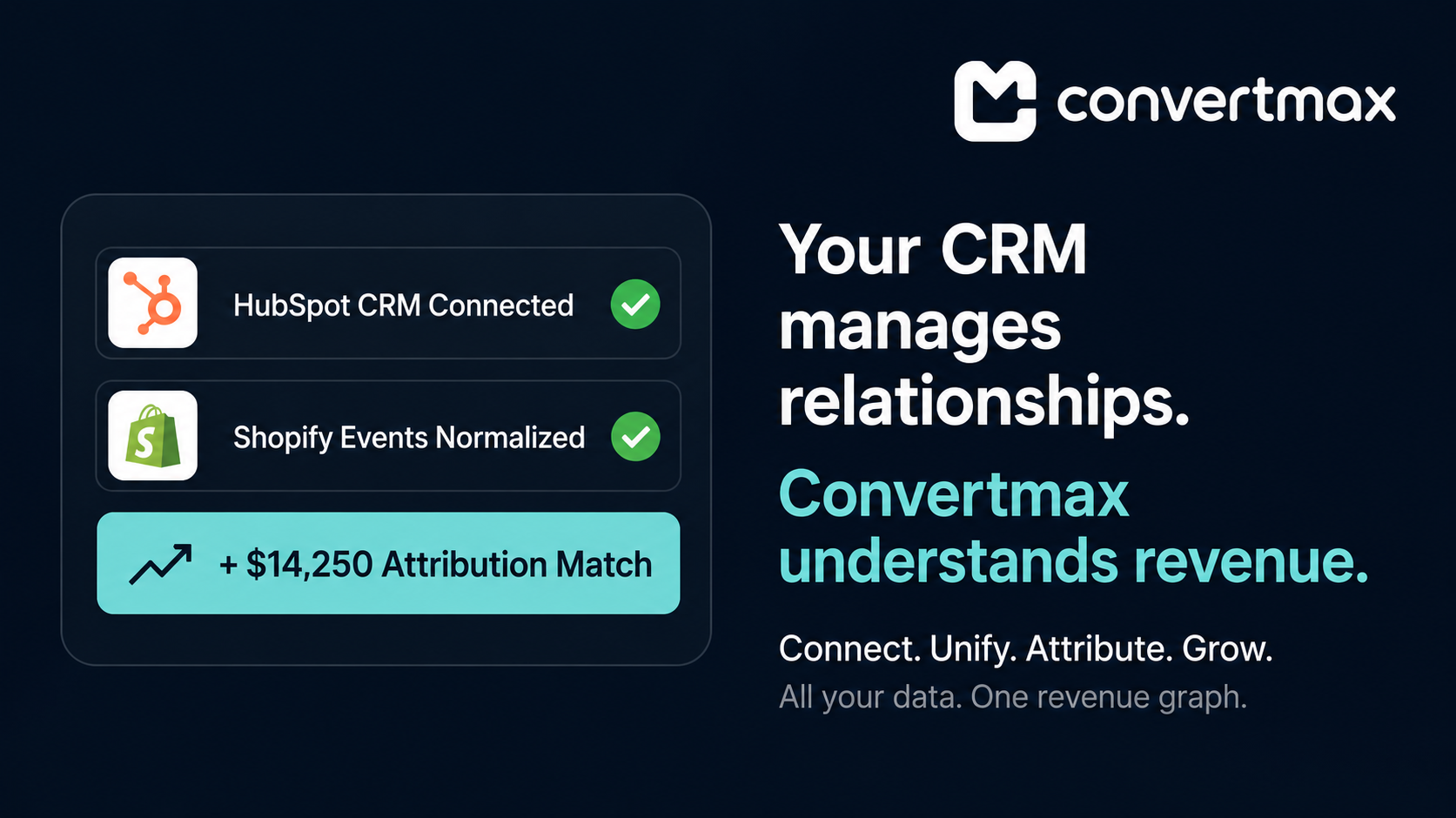
For years, the standard advice in B2B tech has been simple: pick a CRM and build your entire sales and marketing operation around it. It sounds clean in theory, but the reality on the ground looks very different.
Most companies do not run their business on a single platform. They rely on a broader operating system: a CRM, an ecommerce platform, ad networks, payment processors, call tracking, email tools, support software, and more. Revenue does not happen inside one application. It happens across all of them.
That is exactly why Convertmax is built to be CRM agnostic.
The CRM should not own your revenue data
Your CRM matters. It is where your sales team manages pipeline, updates opportunities, and maintains customer relationships. But it is not where the customer journey starts.
Think about a typical path to revenue. A buyer might click a Google Ads campaign, visit your site, read a few blog posts, talk to an AI assistant, call your business, enter an email nurture, make an initial purchase through Shopify, and then finally become an opportunity in the CRM.
By the time that record appears in a CRM, much of the story has already been written. If your reporting starts only when the lead hits the CRM, you miss most of the journey that actually created the opportunity.
That is a major problem for teams trying to improve marketing attribution, understand buyer behavior, or connect spend to revenue outcomes.
The multi-system reality
It is increasingly common for organizations to operate across multiple systems at once. Marketing may live in HubSpot, sales may work in Close, customer success may prefer Salesforce, ecommerce may run through Shopify, accounting through QuickBooks, support through Zendesk, and lifecycle programs through Klaviyo.
So which one is the source of truth?
The honest answer is: none of them by themselves.
Each platform owns one part of the customer lifecycle. The biggest opportunities for insight are not buried inside a single tool. They are found in the connections between those tools.
To really understand growth, teams need answers to questions like:
- Which Google Ads campaigns generated the highest lifetime value?
- Which AI conversations actually turned into revenue?
- Which blog articles influenced the most qualified opportunities?
- Which referral sources produced the highest-value customers?
No single CRM answers those questions well because no single CRM owns all of the underlying data.
Avoid vendor lock-in
Businesses evolve, and the tech stack usually evolves with them. A company may start in HubSpot, move to Close as the sales motion changes, and later adopt Salesforce for enterprise requirements. Different teams may prefer different tools at the same time.
Changing CRMs should not mean losing years of reporting logic, attribution history, or analytics continuity.
Because Convertmax sits above operational systems instead of being trapped inside one of them, switching CRMs becomes far less painful. Your reporting can remain consistent even when the systems underneath it change.
That flexibility matters not just operationally, but strategically. It lets teams choose the best tools for execution without rebuilding their measurement stack every time they make a platform decision.
We integrate with what works best
Instead of forcing a closed ecosystem, Convertmax is built to connect with the platforms teams already use.
That includes CRM systems, storefront and billing platforms, ad channels, call tracking, analytics sources, and other revenue systems. Across those connections, Convertmax normalizes customer, lead, revenue, attribution, and engagement data into a common model.
The result is straightforward:
- one reporting layer
- one attribution engine
- one revenue model
- one API across many source systems
That is the difference between tool-specific reporting and revenue intelligence that can survive changes in your stack.
AI works better with more context
AI is only as good as the context it receives. If your AI layer only has access to CRM records, it can only answer CRM questions.
When AI can also see marketing activity, website sessions, revenue events, support interactions, and product or commerce behavior, it becomes much more useful.
Instead of asking, "Show me open deals," teams can ask better questions:
- Why are enterprise healthcare leads converting higher this month?
- Which channels generated customers with the best lifetime value over the last year?
- Which journeys create the fastest path from first visit to closed revenue?
That is the difference between CRM intelligence and full-funnel intelligence.
CRM agnostic does not mean CRM neutral
Being CRM agnostic does not mean CRMs are unimportant. Quite the opposite.
Convertmax is designed to make CRMs more valuable by enriching them with attribution data, customer history, AI insights, and cross-system revenue context that does not exist inside a single platform on its own.
The goal is not to replace the CRM. The goal is to make the CRM smarter by connecting it to the complete customer journey.
Future-proof your revenue stack
Technology changes quickly. Strong businesses stay flexible.
If you add a new CRM, launch a new ecommerce motion, adopt AI agents, or plug in another marketing system, your analytics and attribution should continue working without a reset. That is one reason first-party analytics and cross-platform integration matter so much.
Convertmax is CRM agnostic because your business is not built around a CRM. It is built around your customers and the revenue journey they take across many systems.
The takeaway
We believe businesses should own their customer and revenue intelligence instead of handing it over to whichever software vendor happens to run one part of the workflow.
Convertmax connects touchpoints, platforms, and revenue events into a single model so your team can understand how revenue is created regardless of which CRM you choose today or tomorrow.
Your CRM manages relationships. Convertmax helps explain how those relationships turn into revenue.