By Elena Marsh
Revenue Attribution Needs More Than CRM Fields and Automations
A question comes up in nearly every serious attribution conversation:
How do you connect touchpoints to people, companies, and opportunities, and why can’t a team just build the same thing with CRM fields and workflows?
It’s a fair question. If your funnel is short and clean, the CRM approach can look perfectly adequate.
Capture a UTM parameter. Save it to a contact property. Associate that contact with an opportunity. When the deal closes, report on the source. Done.
For a small number of straightforward, single-contact deals, that may be enough. But it starts to fall apart when you try to explain how revenue was actually created.
Real buying journeys are not tidy. Someone might first find you through a Google search, come back from a LinkedIn post a few days later, browse several pages without filling in a form, join a webinar, receive a follow-up email, speak with sales, then disappear for two months. When they finally return through direct traffic and become part of an opportunity, several other people at their company may already have engaged with your brand.
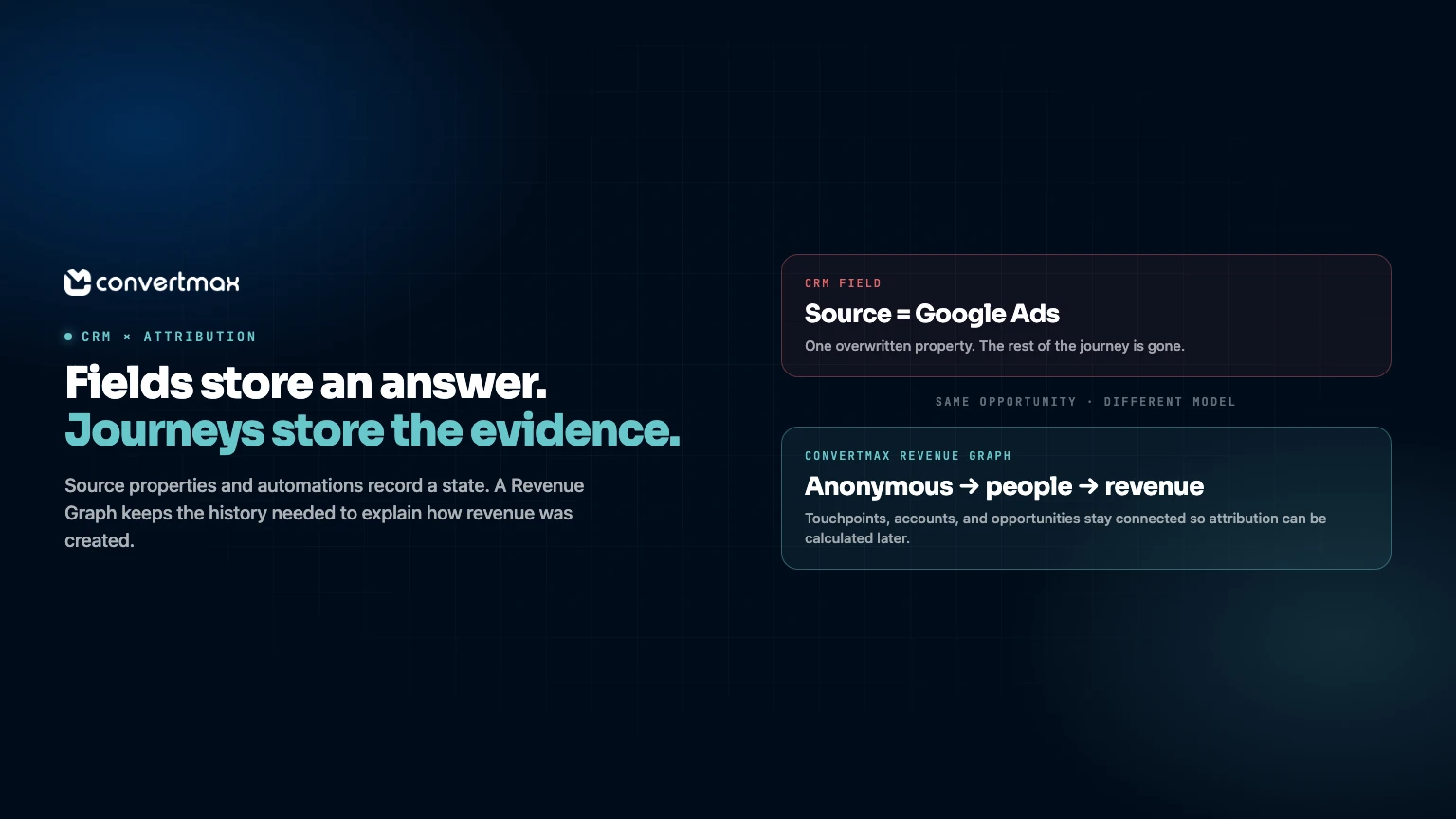
A single Original Source, Latest Source, or Campaign field cannot tell that story. At best, it records one answer to a much larger question.
Convertmax takes a different approach. Rather than treating attribution as a set of CRM properties, it builds a Revenue Graph that connects identities, touchpoints, companies, opportunities, and revenue events. The point is not to collect more fields. It is to preserve the customer journey well enough to analyze it later.
The short version: fields record a state, journeys record a history
CRM properties are useful. They are built to hold the current state of a record: a lead source, a lifecycle stage, a deal owner, a campaign name, or a close date.
Customer journeys are something else. They are sequences of events that happen across time, channels, devices, people, and systems. A source field can be helpful shorthand, but it should not be confused with the underlying history.
| CRM-based attribution | Revenue Graph attribution |
|---|---|
| Stores selected values on contact, company, or deal records | Stores the relationships between people, events, accounts, opportunities, and revenue |
| Often relies on workflows that update or overwrite properties | Preserves the sequence of interactions as evidence |
| Usually centers on one record, such as the primary deal contact | Can consider the broader account and buying group |
| Makes one attribution answer easy to report | Lets teams apply different attribution models to the same journey |
| Tends to be tied closely to a specific CRM setup | Brings CRM, marketing, commerce, call, and analytics data into one intelligence layer |
That distinction sounds technical. In practice, it changes the questions a revenue team can answer.
The journey starts before someone becomes a CRM contact
Most customer journeys begin while the visitor is still anonymous.
Convertmax uses first-party tracking to capture supported interactions such as sessions, page views, landing pages, referrers, UTM parameters, campaigns, ad clicks, form submissions, conversions, calls, commerce activity, and other customer events. At first, those events may belong only to an anonymous browser or session.
Then something changes. The visitor submits a form, makes a purchase, becomes a lead, or is matched through a supported integration. At that point, the earlier activity can be linked to a known identity.
The important thing is what does not happen: the platform does not simply replace an Original Source value with a new one and move on. It retains the trail that led to the identification.
Revenue Graph
- Anonymous visitor
- Sessions
- Touchpoints
- Person
- Company
- Opportunity
- Revenue
That history becomes part of the Revenue Graph. It gives teams a way to look backward without reconstructing the journey from partial CRM properties and old workflow logic.
A CRM contact is a record. An identity is a trail of evidence.
This is where many attribution setups become fragile.
A CRM contact is one record in one system. A customer identity is messier, as it should be. The same person may use multiple browser sessions and devices, submit forms with different email addresses, take sales calls, make purchases, engage with campaigns, and appear in more than one business system.
No one CRM field can cleanly represent all of that. And if the field happens to be blank, updated late, or overwritten by an automation, the attribution trail can become misleading very quickly.
Convertmax resolves the available observations into a persistent identity while retaining the evidence that connects them. The CRM remains important, but it becomes one source of business context within a broader revenue data model rather than the only place the journey exists.
That gives revenue teams more resilience. Attribution does not depend on one contact record being populated correctly at exactly the right moment.
B2B revenue is usually an account story, not a single-contact story
The limitation becomes even clearer in a B2B sale.
Imagine four people from the same company interacting with your business over a few months. One discovers you through Google. Another downloads a guide. A third attends a webinar. A fourth takes the sales call and becomes the primary contact on a $60,000 opportunity.
If attribution looks only at the deal’s primary contact, the first three interactions may vanish from the account’s story. That is a poor reflection of how complex buying decisions actually happen.
Convertmax can model the relationships between people, companies, touchpoints, opportunities, and revenue. Instead of asking, “What source is stored on this deal?” a team can ask a more useful question:
What interactions across this account contributed to the creation, progression, and eventual revenue of this opportunity?
Same company · $60,000 opportunity
Closed won
- AlexInvisible to the field
Discovers you on Google
- JordanInvisible to the field
Downloads a guide
- SamInvisible to the field
Attends the webinar
- RileyOn the deal
Takes the sales call · primary contact
That is the difference between simple contact attribution and revenue intelligence. One looks for a label. The other looks for the chain of events and relationships behind the outcome.
Why workflows and source fields eventually hit a wall
A team can absolutely build parts of attribution inside a CRM. Many teams begin that way, and for good reason. Common properties include:
- First Touch Source
- Last Touch Source
- Original Campaign
- Latest Campaign
- First Landing Page
- Latest Landing Page
- Opportunity Source
- Influenced Campaigns
Automations can populate those fields and make basic reporting easier. The trouble begins when a real journey has more than one meaningful interaction.
The actual journey
- Google Ad
- Blog
- Direct
- Webinar
- Sales call
- Demo
- Closed won
CRM source field
Source = ?
First-touch, last-touch, and multi-touch all need the same history. A single field can keep only one answer.
Which value belongs in the Source field?
Google Ads may deserve credit for introducing the account. LinkedIn may have helped bring it back. The webinar may have shaped the buying conversation. Sales may have turned interest into an active opportunity. Email may have kept momentum alive before the demo.
There is no single objectively correct answer because the underlying question is incomplete. First-touch, last-touch, multi-touch, position-based, campaign influence, and account-level models can all look at the same journey and reach different, valid conclusions. For a fuller view of those models, see how to measure marketing attribution.
The problem with a field-first setup is not that the values are always wrong. It is that intermediate history is often discarded or overwritten. Once that happens, it is hard to revisit the journey with a different model or a better question.
Convertmax keeps the events first and applies attribution logic afterward. That is a different architecture, not just a more elaborate workflow.
Store the evidence, not only the answer
Suppose an opportunity closes for $100,000. A CRM workflow may eventually produce a clean reportable answer:
Opportunity Source = Google Ads
That can be useful. But it does not necessarily preserve the evidence behind the conclusion.
Convertmax maintains the connected relationships that make attribution calculable:
Revenue event → opportunity → company → people → touchpoints → sessions → channels
An attribution model is then applied to that graph. The original journey stays intact, while the interpretation can change depending on what the business wants to understand.
For the same $100,000 opportunity, a team could examine first-touch attribution, last-touch attribution, multi-touch attribution, position-based attribution, campaign influence, channel influence, account-level attribution, or opportunity-level attribution. The customer journey does not need to be rewritten each time.
That matters because attribution is rarely a one-and-done reporting exercise. As a business changes its go-to-market motion, budget mix, sales process, and reporting needs, it will want to ask different questions of the same historical data.
Attribution should be an analysis, not a property-management exercise
Traditional CRM attribution often starts with a familiar question:
What value should we write into this field?
Convertmax starts somewhere else:
What does the Revenue Graph show about how this revenue came together?
That shift opens up analysis that is hard to produce reliably from a handful of updated properties. Teams can look at which channels first introduced accounts that later became customers, which campaigns influenced opportunities without receiving last-touch credit, and what happened before an opportunity was created.
They can also study which touchpoints tend to move an active opportunity forward, which content repeatedly appears in journeys that close, or which marketing channels bring in traffic without producing much downstream revenue. Assistive channels become visible, rather than being dismissed because they were not the final conversion event.
The value is not merely a more complicated dashboard. It is a better way to connect marketing activity to commercial outcomes.
The model should survive changes in your revenue stack
There is also a practical reason to avoid putting the entire attribution model inside CRM fields and workflows: revenue systems change.
Companies move from one CRM to another. They add marketing automation, a data warehouse, a call-tracking tool, new ad platforms, ecommerce, or additional sales systems. And the rules that made sense when the stack was simple often become difficult to maintain after each change.
If attribution lives only in CRM-specific properties and automations, the historical model is tightly tied to that CRM configuration.
Convertmax is designed to be CRM-agnostic. Platforms such as HubSpot, Salesforce, GoHighLevel, Close, Pipedrive, Shopify, call-tracking systems, advertising platforms, and analytics tools can contribute data to the Revenue Graph. The goal is not to replace those systems. It is to give revenue teams a consistent intelligence layer across them.
Why this matters for AI in revenue operations
The quality of an AI system’s answer depends heavily on the context it can access.
An AI agent working only from CRM fields might see a closed-won opportunity labeled Google Ads. An agent working from the Revenue Graph can see the account journey that produced that revenue.
CRM fields
One stored answer
- Opportunity
- $100,000
- Source
- Google Ads
- Stage
- Closed Won
An AI agent working from these fields can repeat the label. It cannot reconstruct the journey.
Revenue Graph
The evidence behind it
- Day 0Paid search introduces the account
- Day 4Organic visits bring people back
- Day 12Three people engage with educational content
- Day 18Someone attends a webinar
- Day 22A sales conversation opens the opportunity
- Day 47Closed won · $100,000
Those are very different starting points for analysis.
That is why Convertmax’s AI capabilities are built around the Revenue Graph rather than an AI interface placed on top of CRM reports. The objective is to let AI reason over the relationships between customers, companies, marketing, sales activity, opportunities, and revenue.
CRM data still matters. A great deal.
None of this reduces the value of CRM data. CRM systems contain vital parts of the revenue story: contacts, companies, opportunities, pipeline stages, owners, activities, sales outcomes, and revenue.
Convertmax complements that information with behavioral, marketing, commerce, call, and attribution data. Instead of asking the CRM to become the entire attribution database, it connects CRM data to the broader journey that came before, during, and after a deal.
The real difference
The simplest way to put it is this:
CRM-based attribution stores conclusions. Convertmax stores the journey and the relationships needed to calculate those conclusions.
CRM fields and automations can answer an important question: what was the lead source when this contact was created?
But modern revenue teams often need to answer a harder one: what happened across marketing, sales, people, systems, and time that caused this company to become revenue?
That is the problem the Convertmax Revenue Graph is built to solve. Once that foundation exists, attribution becomes one useful application of it, alongside customer journey analysis, sales intelligence, account intelligence, revenue analytics, and AI-assisted revenue operations.
If your current attribution reports require a growing collection of fragile fields and workflows, the next step may not be another property. It may be a better record of the journey itself.
Convertmax keeps the evidence connected so teams can analyze revenue instead of managing source fields. Explore the platform or request a demo to see how the Revenue Graph replaces CRM-only attribution.