By Elena Marsh
The Hidden Gap in Modern Order Management Systems: Why OMS Data Alone Isn't Enough
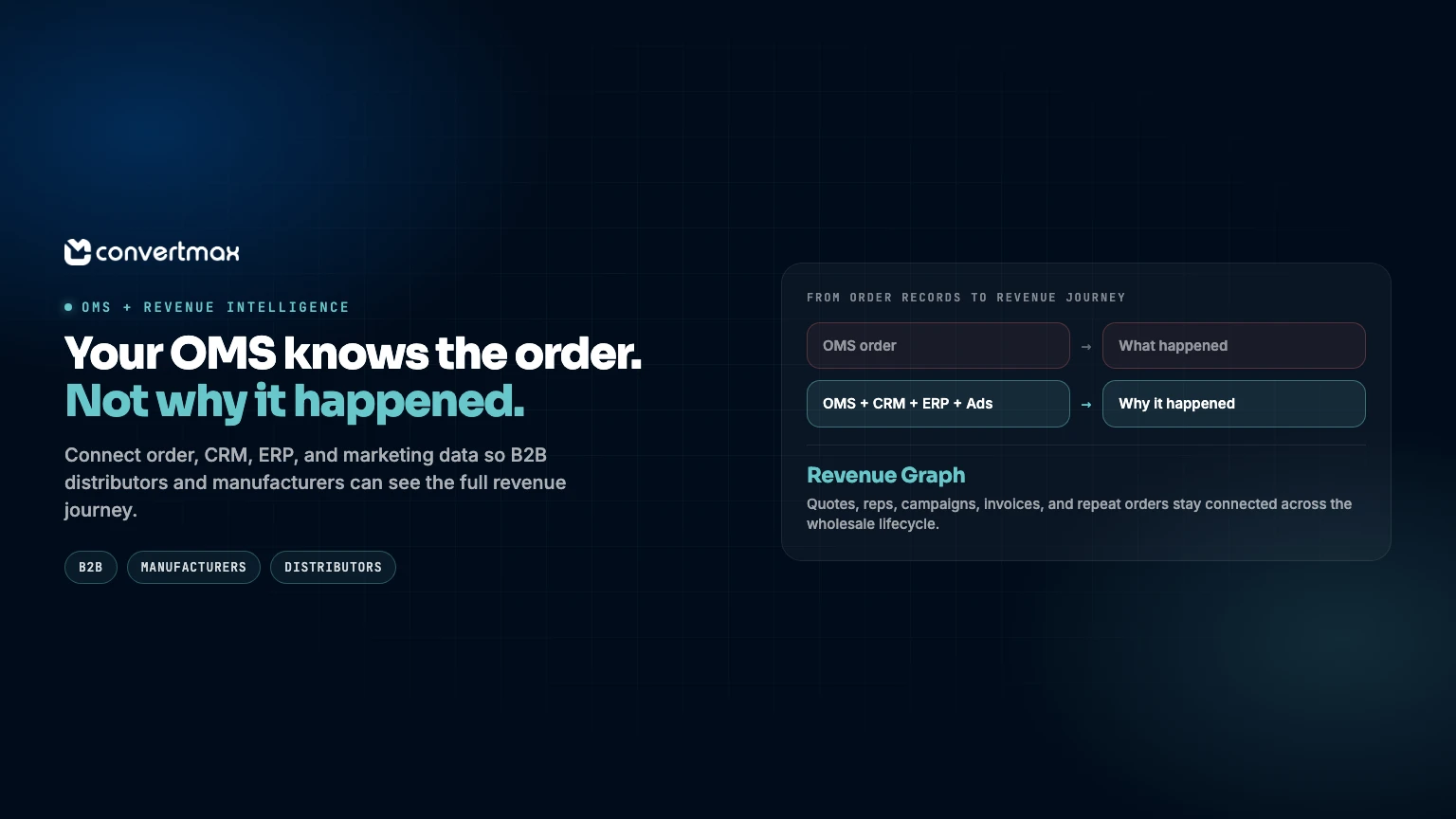
For years, Order Management Systems have been the operational backbone of B2B wholesale distributors, manufacturers, and commerce businesses.
Whether you use OrderEase, Pepperi, RepSpark, Cin7, NetSuite, or another platform, your OMS excels at one thing:
Managing orders.
It knows what was ordered, who placed it, whether inventory is available, the fulfillment status, pricing, shipping details, and invoice information.
But as companies become more data-driven, many executives discover an uncomfortable truth:
Your OMS can tell you what happened. It usually cannot tell you why it happened.
That is where Revenue Intelligence comes in.
What an OMS Does Well
A modern Order Management System is extremely effective at managing operational workflows.
Most platforms provide capabilities such as:
- Customer management
- Product catalog management
- Inventory visibility
- Contract pricing and pricing rules
- Order processing
- Fulfillment
- Shipping
- Returns
- Invoicing
- ERP synchronization
- Sales representative management
Without an OMS, most distributors could not operate efficiently.
But operations are only half the story.
The Questions Your OMS Probably Cannot Answer
Consider asking your leadership team the following questions:
- Which marketing campaigns generated our highest-value wholesale customers?
- Which trade show produced the most lifetime revenue?
- Which sales representatives consistently acquire customers with the highest retention?
- Which product categories attract the most profitable customers?
- Which advertising channels influence repeat purchases?
- Which customers are likely to churn before placing another order?
- Which promotions increase lifetime value instead of simply discounting revenue?
- Which customer acquisition sources generate the best gross margin?
- Which campaigns influenced orders that closed six months later?
These are business questions.
They are not order management questions.
Orders Are Outcomes
An order does not appear out of nowhere.
A typical B2B customer journey may look like this:
Google Search
      ↓
Website Visit
      ↓
Email Signup
      ↓
Sales Representative
      ↓
Quote
      ↓
OMS Order
      ↓
ERP Invoice
      ↓
Repeat Orders
Most businesses have a system for each step.
Very few connect the entire journey.
Why Reporting Becomes Fragmented
Every department has its own software.
Marketing looks at Google Analytics, advertising platforms, and email campaign reports.
Sales works inside HubSpot, Salesforce, Microsoft Dynamics, or another CRM.
Operations manages orders inside the OMS.
Finance uses the ERP or accounting platform.
Customer service relies on a support or ticketing system.
Each system tells part of the story.
None of them tells the complete story.
The Cost of Siloed Data
When data lives in separate systems, companies struggle to answer fundamental questions.
Marketing does not know which campaigns create long-term customers.
Sales managers cannot easily identify which representatives consistently generate profitable accounts.
Executives may not know which products drive customer retention.
Operations cannot connect fulfillment performance to customer lifetime value.
Finance sees revenue after it arrives but may not know which customer interactions created it.
As a result, strategic decisions are often based on incomplete information.
Revenue Intelligence Connects the Missing Pieces
Revenue Intelligence does not replace your OMS.
It sits alongside it and connects it to the rest of your business.
A Revenue Intelligence platform can unify data from:
- Your Order Management System
- CRM
- ERP
- Marketing platforms
- Ecommerce platform
- Call tracking
- Customer support
- Payment systems
- Website analytics
- Sales activity
Once these systems are connected, every order gains context.
Instead of simply seeing an order, you can understand:
- Where the customer came from
- Which campaigns influenced the purchase
- Which salesperson or representative handled the account
- How long the sales cycle took
- How profitable the customer became
- Whether the customer reordered
- Which products increased retention
- The customer's lifetime value
What Revenue Intelligence Looks Like
Instead of managing dozens of disconnected dashboards, executives can answer important questions across the entire business.
Customer Intelligence
- Customer lifetime value
- Customer acquisition cost
- Repeat purchase rate
- Retention rate
- Churn risk
- Days between orders
- Revenue by account type
- Revenue by customer segment
Sales Intelligence
- Revenue by sales representative
- Gross margin by representative
- Close rate
- Territory performance
- Average order value
- Sales cycle length
- New account revenue
- Existing account expansion
Marketing Intelligence
- Revenue by campaign
- Revenue by channel
- Cost per acquired customer
- Return on advertising spend
- Marketing-influenced pipeline
- First-touch attribution
- Multi-touch attribution
- Revenue by trade show or event
Product Intelligence
- Highest-revenue products
- Highest-margin products
- Most reordered products
- Fastest-growing categories
- Products associated with churn
- Product affinity
- Cross-sell opportunities
- Promotion performance
Distribution Intelligence
- Revenue by territory
- Revenue by warehouse
- Revenue by manufacturer
- Revenue by distributor
- Revenue by location
- Revenue by fulfillment method
- Delivery performance by customer segment
- Backorders connected to customer churn
OMS and Revenue Intelligence Work Better Together
Modern OMS platforms are not becoming obsolete.
They are becoming part of a broader connected revenue ecosystem.
The fastest-growing companies are not replacing their operational software. They are adding an intelligence layer on top of it.
Think of the roles this way:
- CRM manages relationships.
- ERP manages financial and operational records.
- OMS manages orders.
- Revenue Intelligence explains how everything connects.
The OMS remains the source of truth for order execution.
Revenue Intelligence connects those orders to the interactions, campaigns, sales activities, products, and customer relationships that created them.
A Practical Example
Imagine a distributor receives a $75,000 wholesale order.
The OMS records the customer, products, price, fulfillment status, and shipping information.
That is useful, but it does not explain the complete journey.
A connected Revenue Intelligence platform could show that:
- The customer first discovered the company through an industry-specific Google Ads campaign.
- A buyer downloaded a product catalog from the website.
- The account entered HubSpot and was assigned to a regional representative.
- The representative completed three calls and sent two quotes.
- The first order was placed through the OMS.
- The customer reordered four months later.
- The account generated $160,000 in revenue over twelve months.
- The original campaign delivered a much higher return than the advertising platform reported.
Now the company understands more than the order.
It understands the revenue journey.
What This Means for Distributors
Most distributors already have much of the data they need.
The challenge is not collecting more information.
The challenge is connecting it.
Once customer interactions, marketing activity, CRM records, sales activity, and order history are unified, entirely new insights become possible.
Leadership can move beyond asking what happened last month and begin understanding what drives future revenue.
Teams can identify:
- Customers that are likely to reorder
- Accounts at risk of becoming inactive
- Sales representatives creating the most profitable relationships
- Campaigns producing long-term customers
- Promotions that increase repeat purchases
- Products that improve retention
- High-value accounts that deserve proactive outreach
This turns reporting into action.
What This Means for Manufacturers
Manufacturers face a similar gap—often with more complexity.
Orders may flow through distributors, dealer networks, direct sales reps, ecommerce portals, and ERP systems before revenue is fully recognized. An OMS may capture the order cleanly while still hiding which channel, partner, campaign, or territory created the demand.
With Revenue Intelligence connected to manufacturing and wholesale systems, teams can see:
- Which distributor or dealer relationships create the most profitable demand
- Which SKUs and product lines drive repeat B2B purchases
- Which campaigns influence manufacturer-direct versus channel-sourced revenue
- Which sales territories convert quotes into durable reorder patterns
- Where fulfillment delays correlate with account churn downstream
That visibility helps manufacturers allocate sales capacity, partner support, and marketing spend toward the journeys that actually grow revenue—not only the orders that already closed.
What This Means for OMS Providers
There is also an opportunity for OMS vendors.
Building advanced attribution, identity resolution, customer journey analytics, call intelligence, CRM reporting, AI insights, and cross-platform data infrastructure can require years of development.
Instead of rebuilding these capabilities internally, an OMS provider can integrate with a dedicated Revenue Intelligence platform.
This creates a better-together story:
- The OMS continues to manage orders and fulfillment.
- Revenue Intelligence connects order data to the rest of the customer journey.
- Shared customers receive more value from both platforms.
- The OMS becomes more valuable without moving outside its core product category.
For OMS vendors serving distributors, manufacturers, wholesalers, and sales-rep organizations, Revenue Intelligence can become a valuable integration, add-on, or referral partnership.
The Revenue Graph for B2B Distribution
The foundation of this approach is a connected Revenue Graph.
A Revenue Graph links the core entities involved in generating revenue:
Customer
   ├── Company
   ├── Contacts
   ├── Website visits
   ├── Campaign interactions
   ├── Calls and emails
   ├── Sales representatives
   ├── Quotes
   ├── Orders
   ├── Products
   ├── Invoices
   ├── Payments
   └── Repeat purchases
Instead of keeping these records isolated inside separate systems, the Revenue Graph preserves their relationships.
This allows businesses to analyze revenue across the complete customer lifecycle.
Final Thoughts
An Order Management System will always be essential for running a distribution business.
But operational excellence and Revenue Intelligence solve different problems.
One keeps orders moving.
The other helps the business understand and grow revenue.
Organizations that combine both gain a much clearer picture of customer behavior, marketing effectiveness, sales performance, product demand, and long-term profitability.
The future is not choosing between an OMS and Revenue Intelligence.
It is connecting them.
See What Your OMS Is Missing
Convertmax connects your Order Management System, CRM, ERP, marketing platforms, ecommerce systems, and customer data into a unified Revenue Graph.
This gives distributors and manufacturers a complete view of the customer journey—from first interaction to quote, order, invoice, and repeat purchase.
Whether you operate an OMS, serve wholesale distributors, or want to get more value from your existing order data, Convertmax can help connect the missing pieces.
Book a Convertmax demo to see how Revenue Intelligence can complement your OMS without replacing it.