By Elena Marsh
Claudeforce vs Convertmax Max AI
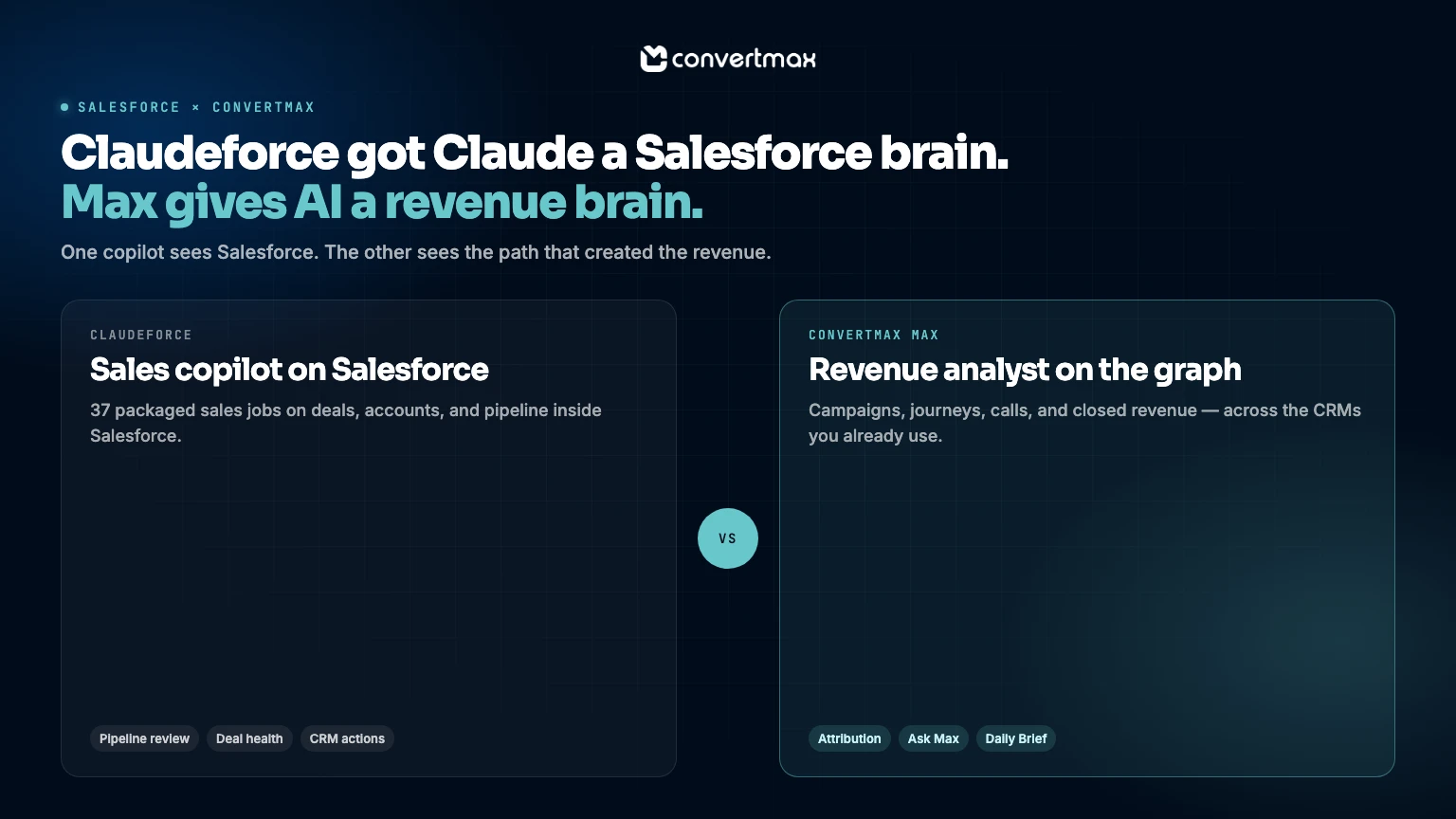
Salesforce and Anthropic announced Claudeforce on August 26, 2026. The first product puts Salesforce inside Claude, with 37 packaged sales jobs such as pipeline reviews, deal health, and daily planning. It is in pilot now, with a wider beta planned for September.
If you already use Max in Convertmax, the idea will feel familiar: Max watches revenue changes, hands you snippets for the questions you would usually ask, and looks up data in the CRM you already have.
The difference is what each assistant can actually see.
Claudeforce is a sales copilot on Salesforce. Max is a revenue analyst on the Revenue Graph.
Salesforce knows Salesforce extremely well. Convertmax is built to know the path that created the revenue—ads, the website, calls, the CRM, orders, and payments—not only the records that ended up in one sales tool.
What each one is for
| Claudeforce | Max | |
|---|---|---|
| Built for | Sales teams living in Salesforce | Marketing, RevOps, and revenue teams |
| Looks at | Salesforce deals, accounts, and activity | The connected journey that produced revenue |
| Works with | Salesforce | Any CRM you already use |
| Marketing attribution | Not the main job | A core job |
| Phone calls | Salesforce activity | Call tracking plus CRM calls |
| Can change records | Yes, using Salesforce permissions | Not yet. Max is read-only today |
| Comes with | 37 packaged sales jobs | Revenue-change monitoring, question snippets for most of what you would ask, and lookups in your existing CRM |
Max watches when revenue moves, gives you starter questions that cover most of what teams actually ask, and can look up records in the CRM you already use. Claudeforce is stronger today on deal coaching and account planning. Max is stronger on attribution, campaigns, and the evidence behind closed revenue.
The part Salesforce got right
Salesforce is not arguing that Claude is magic on its own. It is arguing that the model needs your business context.
Claude does the reasoning. Salesforce supplies the customer data, the workflows, the rules, and the permission to act.
That is the same bet Convertmax made with Max. The model is the interface. The valuable layer is the Revenue Graph: a connected record of people, campaigns, calls, opportunities, orders, and revenue.
A CRM field often stores the conclusion. Someone typed "Google Ads" on the contact. The Revenue Graph can keep the story that led there—the first visit, the later campaign, the sales call, the closed deal. We wrote about that gap in Revenue attribution needs more than CRM fields and automations.
What we are taking from the announcement
We are not changing what Max is. We are moving faster on four things.
Named revenue jobs. Give Max a clear set of jobs people can run, not only a blank question box.
Open the Revenue Graph to other AI tools. Let Claude, ChatGPT, and customer-built agents ask Convertmax about revenue without living only inside our app.
Governed actions. Move from "here is what happened" toward "do this next," with the same care you would expect before changing a CRM record.
Keep saying the quiet part. Max should reason over the evidence behind revenue, not only the last field a salesperson saved.
The short version:
Claudeforce gives Claude a Salesforce brain. Max gives AI a revenue brain.
If you want to try Max on your own data today, open Ask Max or request a demo.