By Elena Marsh
RevOps Is Becoming the AI Orchestrator of the GTM Organization
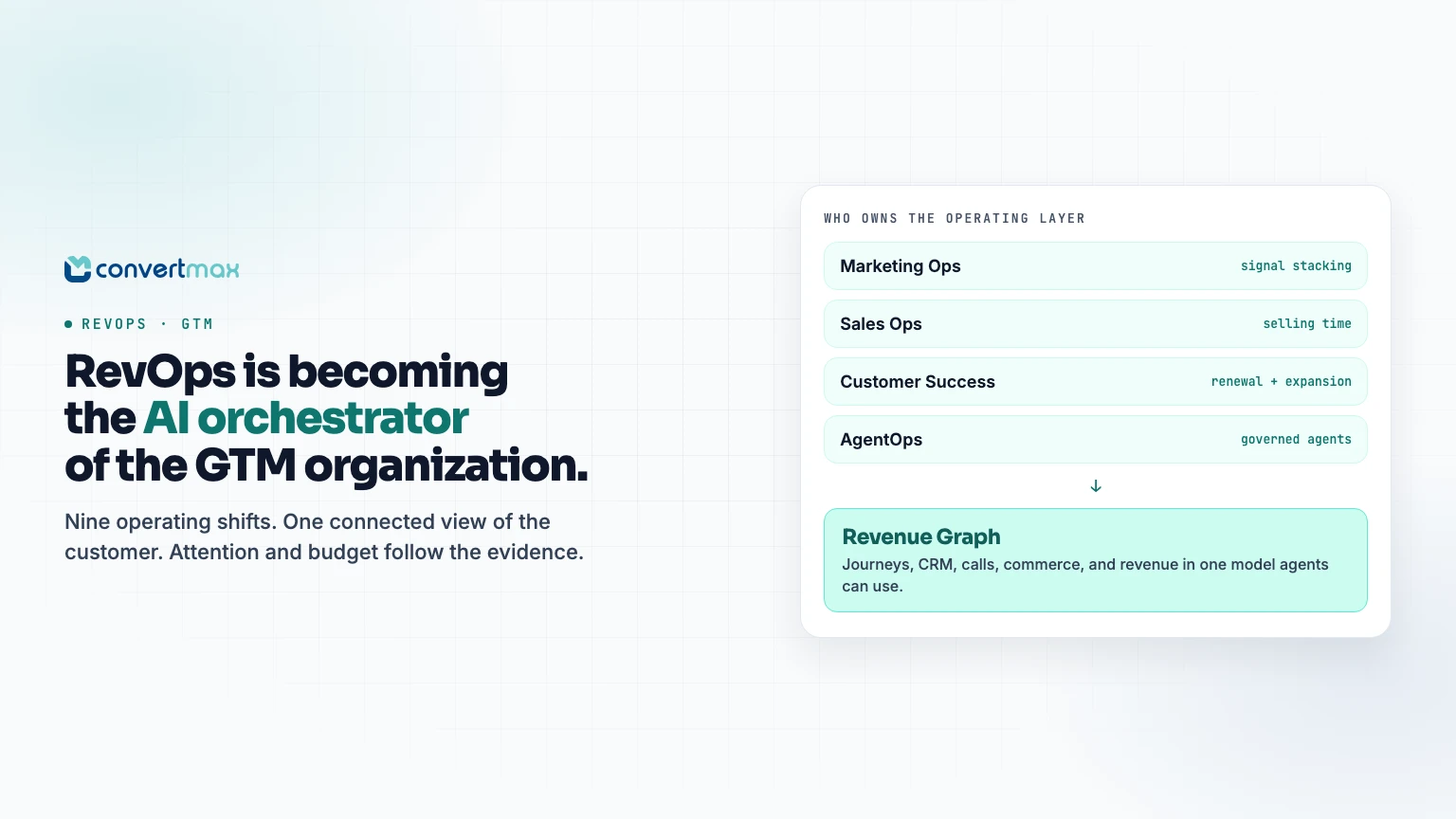
Revenue operations used to be the machinery behind go-to-market: systems, reporting, routing, process design, and the rescue work required when the CRM no longer matched reality. That work is still there. It just carries more weight now.
AI has opened a new lane for RevOps. The job is not to scatter disconnected tools across Marketing, Sales, and Customer Success. It is to decide where intelligence belongs, what data it can rely on, which decisions can be assisted, and how the business will tell whether any of it is helping.
That makes RevOps the natural orchestrator for an AI-enabled revenue organization. The role is shifting from maintaining workflows to building an operating system that can observe customer behavior, understand the context around it, take controlled action, and learn from results.
The pressure is already visible. Salesforce’s 2026 State of Sales research surveyed 4,050 sales professionals. It found that 87% of sales organizations were using AI in some form, while more than half of sales leaders using AI said disconnected systems were holding their work back. 1 Models are not the scarce resource. A connected, governed view of the customer is.
Nine operating shifts are driving the change.
1. Marketing Ops moves from collecting signals to stacking them
A single signal is almost never a buying decision. A pricing-page visit, a job change, a webinar registration, or a spike in account engagement can matter. It can also be nothing.
Marketing Ops has to get better at signal stacking: combining several observations to judge whether an account is in market, how strong its intent appears to be, and whether the timing is right. The aim is not to produce an elaborate score for its own sake. It is to separate the account that produced one weak signal from the account where the right people are returning, engaging with high-intent material, responding to outreach, and behaving like an active buying group.
That changes the budget question. Do not ask, “Which accounts fired a signal?” Ask, “Which accounts have earned more spend right now?”
A useful score considers four things together:
- Fit: Is this an account the business should win?
- Intent strength: How meaningful are the interactions, and how close are they to a commercial decision?
- Signal pattern: Do several independent observations support the same conclusion?
- Timing: Is the activity recent, and does it line up with an opportunity, renewal window, expansion motion, or known business event?
Marketing Ops should own the measurement rules and the feedback loop. A high-scoring account that enters a sales motion should improve the model once the outcome is known. So should the lower-scoring account that converts anyway. Otherwise, the score simply becomes a prettier version of intuition.
This is why connected revenue data matters. Convertmax’s Revenue Graph connects first-party journeys, campaign activity, CRM context, calls, commerce, and revenue. Teams can review the evidence behind an account score instead of accepting an opaque intent label. 2
2. Sales Ops becomes the steward of selling time and methodology quality
Most sales teams do not lack capacity first. They lose capacity to administrative drag.
CRM updates, meeting notes, activity logging, field mapping, and follow-up coordination take time away from customer conversations and deal progress. Salesforce reports that the average seller spends 40% of their time selling, and its respondents expect AI agents to cut time spent on prospect research and email drafting. 1 The exact savings will differ by team. The implication does not: Sales Ops should remove work that does not need seller judgment.
But “automate CRM updates” is too shallow a brief. Activity has to be captured reliably, mapped to the right contacts, accounts, and opportunities, and kept with enough context to be useful later. A clean meeting note with no account association is not clean in any operational sense. Nor is a conversation record that sits in a call tool and never reaches the opportunity history.
Then comes sales methodology. Whether a team uses MEDDPICC, MEDDIC, or its own qualification framework, Sales Ops should know where the process breaks down. Which criteria are missed most often? At what stage does evidence stop being documented? Which gaps show up before a slip, a loss, or a last-minute discount? When does a rep’s confidence exceed what the deal record can support?
AI can inspect conversations and activity at a scale that managers cannot. Sales Ops still has to define what good evidence looks like, how it maps to the sales process, and when a human should review an exception. That is the difference between a helpful inspection layer and generic AI coaching.
3. Customer Success Ops adopts the discipline of a sales team
Customer Success has always used health scores. The old version, a quarterly dashboard with a vague red-yellow-green status, will not be enough.
Customer Success Operations needs to treat onboarding, adoption, expansion, and renewal as linked commercial motions. The inputs are familiar: product use, support interactions, executive engagement, implementation milestones, payment behavior, relationship strength, and customer feedback. The change is operational. Those inputs need to produce a live view of both risk and upside.
A renewal risk signal may show up well before a customer raises a concern. An expansion signal may appear when usage spreads to a new department, an executive returns to reviews, or a new team begins to work in the product. Those patterns should prompt a person to investigate. They should not cause an automatic conclusion that an account is safe or ready to buy more.
The strongest Customer Success organizations are beginning to run with sales-level rigor. They maintain renewal and expansion pipeline, set forecast categories, inspect the evidence behind every outlook, and study stage conversion. Customer Success Ops makes it possible by establishing common definitions and putting the data in front of the team before the quarter has already gone sideways.
4. Enablement becomes continuous, evidence-based, and visible
The annual sales kickoff, or SKO, was never enough. It is plainly insufficient now.
Enablement needs to become a continuous system that shows people what good looks like in the work they did this week, not just in the material they received months ago. AI makes that more practical. It can review discovery calls, deal reviews, onboarding sessions, and customer conversations at volume. But reviewing activity is not the same as improving it.
The work is to define a standard, measure behavior against it, help managers coach the gap, and show whether the behavior changes. A discovery score without a clear rubric will be ignored. A methodology-adherence score that cannot explain why it moved will not be trusted.
Enablement can apply the same discipline across the revenue organization. What does a strong discovery question sound like? What counts as evidence of a real business pain? Does a Customer Success handoff contain the information the onboarding team needs? Those are not separate training problems. They are operating standards that should follow the customer journey.
This gives Enablement a stronger way to show its impact. Attendance, completion, and satisfaction still have a place. They are not enough on their own. Teams can now track observed behavior, methodology adherence, manager coaching, and the business outcomes that follow.
5. Systems becomes the work of building a usable, governed data layer
The central systems job is not picking the next application. It is building a unified data layer that brings structured and unstructured information into a form that people and agents can use safely.
Structured information includes CRM fields, stages, amounts, product records, and usage metrics. Unstructured information includes call transcripts, emails, notes, support conversations, documents, and web behavior. Both describe the customer. Neither tells the full story alone.
What matters is the relationship between the records. A sequence of web activity belongs to a person. That person belongs to an account. The account has an opportunity. The opportunity has conversations and commercial terms. The result eventually appears as revenue. Convertmax calls this connected model a Revenue Graph. It keeps the relationships between marketing, sales, CRM, calls, commerce, and revenue available for analysis. 3
With that context in place, AI can reason over a meaningful customer story rather than a stack of disconnected exports. Without it, each agent produces its own partial version of the truth.
Governance has to grow with the capability. The National Institute of Standards and Technology’s AI Risk Management Framework calls for trustworthiness to be considered through the design, development, use, and evaluation of AI systems. 4 For RevOps, that means data access, consent, lineage, permissions, review thresholds, and auditability are operating requirements. Not a legal footnote at the end of the rollout.
6. Deal Desk moves upstream from redlines to value engineering
AI can handle much of the repetitive Deal Desk workload: finding clause changes, comparing templates, flagging policy deviations, drafting a first pass at redlines, and assembling approved information. That does not make Deal Desk less important. It gives the team room to get involved earlier.
The larger commercial win is helping build a credible business case before the deal becomes a pricing conversation. When buyer and seller share a clear view of the problem, the intended result, the financial case, and the path to value, discounting is less likely to become the default response to uncertainty.
That places Deal Desk closer to value engineering, forecast inspection, capacity planning, and headcount decisions. The team needs visibility into stuck deals, repeated commercial friction, the volume of nonstandard work coming into the funnel, and whether the business is staffed to support it.
The aim is not to automate judgment away. It is to hold human attention for the commercial situations where it matters most.
7. Leadership needs fewer AI projects and better follow-through
The risk is not that revenue teams will do too little with AI. It is that they will launch dozens of disconnected experiments and mistake activity for strategy.
Leadership has to separate high-impact operating changes from AI slop. A strong initiative has a specific business problem, a named process owner, clear source data, a decision or action it will improve, and a way to measure both adoption and outcome. “Build an AI assistant” is not an operating objective. “Reduce unassigned high-intent accounts by 50% while maintaining seller acceptance rates” is getting closer.
Most of the hard work is stakeholder alignment. Marketing, Sales, Customer Success, Finance, IT, Legal, and Enablement may all touch the same change. Leaders have to agree on the operating definition, the intended behavior, who can override an agent, and what happens when an output is wrong.
Change management belongs in the business case. If a tool changes how reps qualify deals, managers inspect pipeline, or Customer Success teams forecast renewals, the rollout needs coaching, feedback channels, and an explicit policy for exceptions. Great technology without adoption is just another dashboard.
8. GTM Engineering becomes part of RevOps, not a side experiment
Go-to-market, or GTM, Engineering is often treated as an outbound function: enrich a list, identify a trigger, write a tailored sequence, and automate the first touch. That is useful. It is only the first chapter.
Over time, GTM Engineering should reach across the customer journey. It can build the data products, automations, and agent-assisted workflows behind acquisition, routing, sales execution, onboarding, expansion, and renewal. That is why it belongs in the RevOps operating model, even when the reporting line sits elsewhere.
The analyst role is changing alongside it. Analysts are still essential for measurement design, causal thinking, judgment, and decision support. More of their work, however, will live inside the systems and products operators use each day. The valuable analyst is not only the person who creates a report. It is the person who can turn a recurring question into a trusted, observable workflow.
There is a trap here. Clever automations that are disconnected from the revenue model do not stay clever for long. GTM Engineering needs the same definitions, permissions, acceptance criteria, and feedback loops as every other RevOps capability.
9. AgentOps becomes a core RevOps responsibility
When agents start researching accounts, updating CRM records, drafting follow-ups, watching health signals, and supporting commercial work, somebody has to run the operating layer around them.
Call that responsibility AgentOps. It means keeping an inventory of agents, documenting their purpose and data access, monitoring consumption and cost, evaluating output quality, managing permissions, and setting escalation paths for human review.
This is not just an IT control function. A sales development agent that draws from the wrong customer data creates a commercial problem. A renewal-risk agent that misses product-adoption evidence creates a forecast problem. A Deal Desk agent that drafts outside policy creates a margin and governance problem.
RevOps is well placed to coordinate these trade-offs because it already sits where process, data, systems, and commercial outcomes meet. But AgentOps has to be treated as an operating discipline, not a spreadsheet assigned to the team that happens to have the most tools.
The Revenue Graph is the starting point, not the finish line
The future RevOps organization will not be measured by the number of AI tools it has launched. It will be measured by whether it can direct attention and budget toward the accounts and customers most likely to create value, give people more time for the work only they can do, and stay in control as more decisions become software-assisted.
That starts with connected revenue context. Convertmax builds a first-party view from the first interaction to closed revenue, connecting journeys, CRM intelligence, calls, commerce, and revenue in one model. 2 3 With the history intact, RevOps can move past isolated reports and start designing the feedback loops that make the whole GTM organization smarter.
The best teams will not use AI as a fresh coat of paint on old processes. They will rebuild the operating model around evidence, accountability, and action.