By Elena Marsh
AI May Speed Up Shopping. It Doesn't Always Shorten the Journey
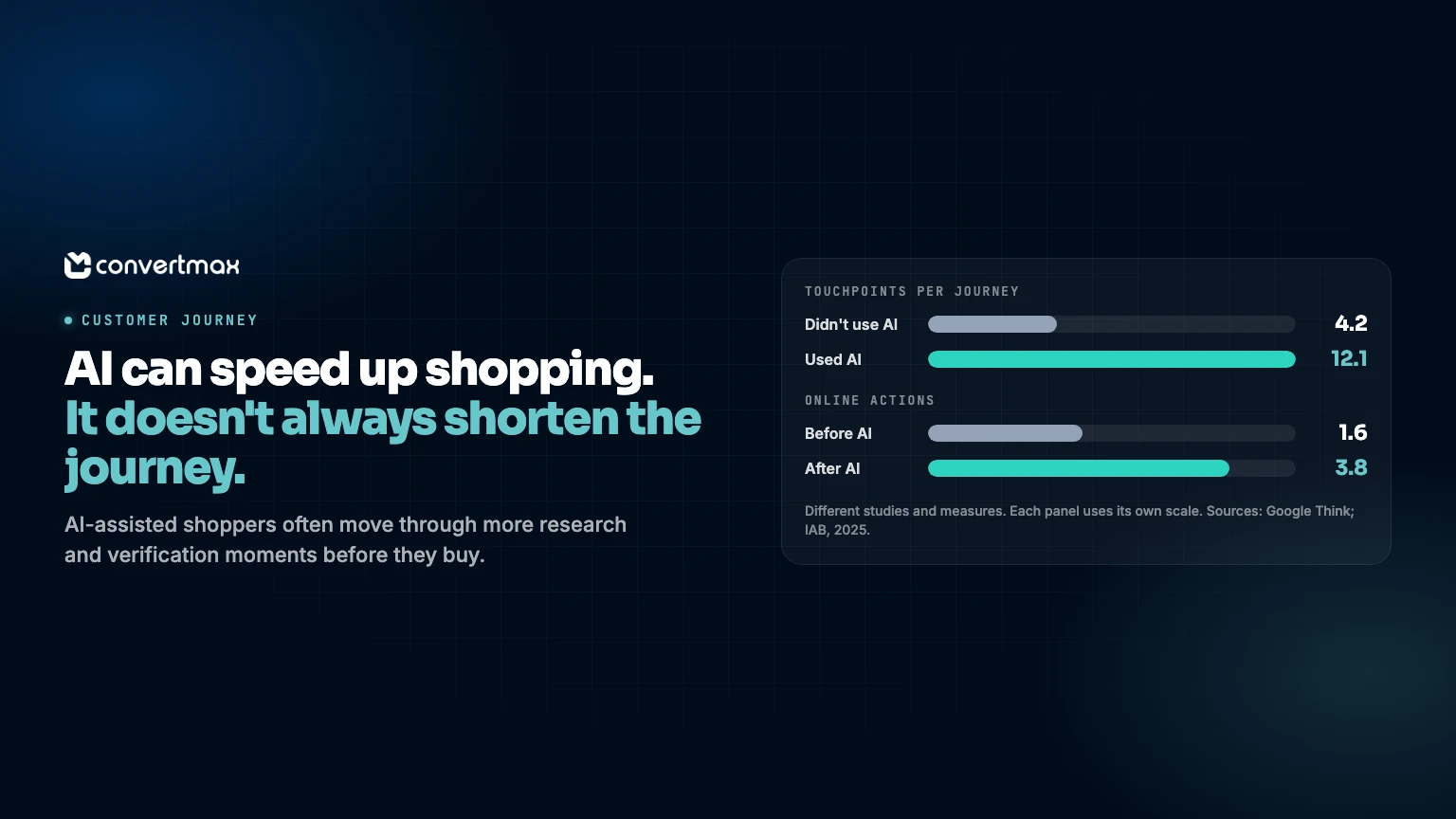
AI can get a shopper to a shortlist in minutes. That sounds like a shorter buying journey. Sometimes it is. But a quick answer can also send people into a new round of checking before they're ready to buy.
Google reports that online shoppers who used AI during a purchase journey noticed or interacted with an average of 12.1 touchpoints, compared with 4.2 for shoppers who didn't use AI. In a separate study, IAB and Talk Shoppe found that shoppers completed an average of 1.6 online actions before engaging with AI and 3.8 afterward. Ninety-five percent said they took at least one more action after using AI to shop.
These studies measure different things, so the numbers aren't a direct comparison. Still, they point to a useful shift: AI may make individual research tasks easier while adding more moments where shoppers look for reassurance.
A faster answer can lead to more checking
Imagine a shopper asking an AI assistant to narrow twenty products down to three. The hard part of comparing options is done. Then the shopper checks the price, reads reviews, confirms the item is in stock, and makes sure the retailer's page matches what the AI said.
That checking is common. IAB and Talk Shoppe found that 46% of shoppers fully trusted AI shopping recommendations. Eighty-nine percent said they double-check AI information before buying. The assistant may help someone decide what to consider, while a retailer page, review, creator, or store visit helps them feel comfortable acting on it.
So the journey can move forward even when the marketing report sees little. By the time the person returns through branded search or types a web address directly, the final visit can look like the whole story.
The last click arrives late
A last-click model gives the conversion to the touchpoint immediately before the sale. If that touchpoint is branded search, search gets the credit. That's accurate as far as it goes. It doesn't tell you what first put the brand on the shortlist or what made the shopper trust it.
Some of the path is hard to observe. People can compare AI recommendations, talk to colleagues, or read reviews without clicking through to your website. The trail may only become visible once they return, fill out a form, call, or buy.
That gap isn't limited to retail. A B2B buyer might first hear about a company on a podcast or from a colleague, then spend weeks researching. When they finally fill out a form, the CRM records a new lead. The early influence may be missing.
Keep more of the visible journey connected
A useful measurement setup links the signals a business can actually collect: first-party website activity, known leads, calls, opportunities, and closed revenue. It won't reveal every private conversation or offsite interaction. It can keep more of the observable path together, so marketers can see which channels introduced, assisted, or closed a sale.
Different attribution models answer different questions. First touch points to where a journey began. Last touch shows what closed it. Linear and U-shaped models distribute credit across more than one moment. None is the one true version of the customer journey. Looking at more than one can show how much your channel story depends on the model you chose.
Convertmax connects first-party journey data with anonymous and known sessions, CRM activity, calls, and revenue, then lets teams compare attribution models side by side. The point isn't to add another dashboard. It's to make budget decisions with a fuller view of the evidence.
Attribution has a limit, though. It describes observed paths and allocates credit. It doesn't prove a channel caused a sale. To estimate causal lift, marketers need an experiment, such as a holdout or geo test, that compares outcomes with and without the channel. Attribution helps show the paths people took. Incrementality testing helps answer what might have happened without the marketing.
Consistency helps earn the next step
When an AI assistant recommends a product, shoppers may check the details elsewhere. If the price, availability, specifications, or reviews don't line up, doubt creeps in. Service businesses face the same issue. The offer and claims on a landing page should match what a prospect sees in ads, listings, sales conversations, and other channels.
There's a brand question here, too. WPP Media and Oxford's Saïd Business School analyzed 1.2 million purchase journeys and reported that, on average, 84% of purchases involved people choosing brands they were already biased toward. That's a finding from their dataset, not a rule for every category. But it's a reminder that many later touchpoints may be checks on a preference that already exists, rather than a contest starting from scratch.
A campaign can help build that preference long before the purchase. Search or a direct visit may still get the final conversion credit. That's one reason clicks alone can understate the work of brand activity.
Measure the journey that's actually happening
AI tools may take on more research and comparison over time. The path could get shorter. For now, the evidence suggests AI-assisted shoppers often keep checking before they buy.
Marketers don't have to settle the debate over whether the funnel is expanding or collapsing. They need to see where their own customers discover, verify, return, and convert. Keep information consistent. Connect the first-party activity you can observe to CRM and revenue outcomes. Compare attribution views, and use experiments when you need to know whether marketing created incremental lift.
The final click is easy to count. What made someone ready to click is the more useful question.