By Priya Lang
Marketing ROI Tracking: Stop Measuring Activity and Start Measuring Money
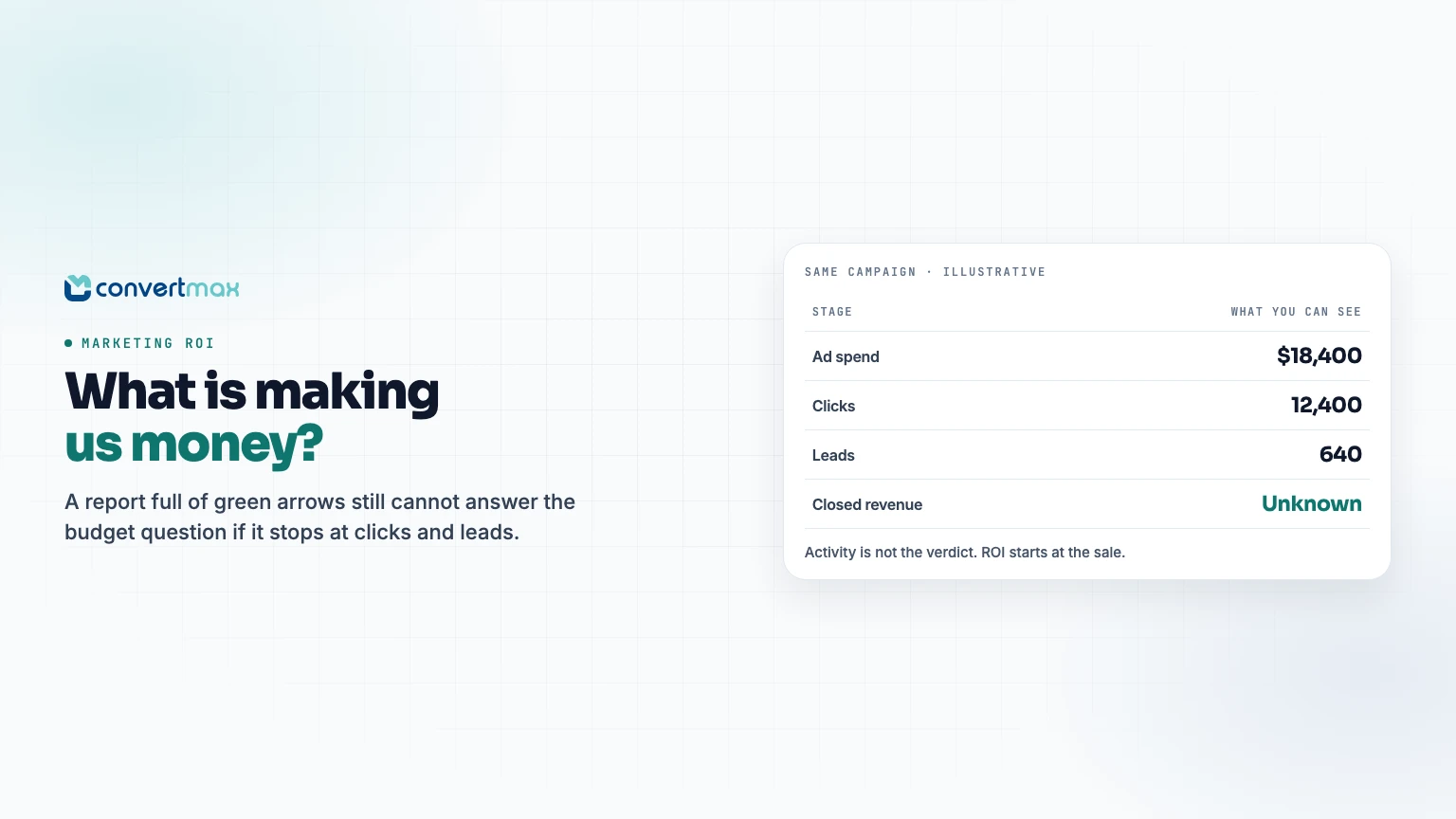
A report can be full of green arrows and still be useless when it is time to approve next month’s spend. The owner wants a straight answer: what is making us money?
That answer is usually spread around the business. The ad account has cost and clicks. Analytics records website activity. The CRM holds leads and deal stages. Sales knows which conversations went somewhere. Revenue may land in a billing, commerce, or finance record later. None of those views is necessarily wrong. They just do not tell one connected story.
Marketing ROI tracking is the work of connecting the investment to the business result: spend, first contact, qualified demand, sale, and revenue. Without that line of sight, teams tend to defend channels based on visible activity rather than commercial value.
Why platform results and lead counts fall short
ROAS, lead volume, form fills, calls, and website conversions all have a job. They can tell you whether an ad earned attention, whether a landing page prompted a response, or whether demand is arriving. But they cannot answer the full ROI question by themselves.
A platform may receive credit for a conversion even though another channel started the relationship. A form fill may never lead to a sales conversation. A lower-volume campaign may create customers who close sooner, spend more, or remain customers longer. And a buyer who calls instead of completing a form can disappear from a web-only report.
Early-funnel metrics are signals, not a verdict. The operating question comes later: after sales follows up, which sources and campaigns are producing customers and revenue that justify their cost?
When the view ends at leads, a team can protect a busy channel and cut one that is bringing in profitable customers. That is not a reporting problem. It is a budget problem.
Start with the decision, then define the stages
Do not start with a dashboard. Start with the decision you need to make.
Maybe you need to know whether paid search is producing closed revenue. Maybe you want to review campaigns before renewing spend. Or perhaps you need to see whether a certain service, location, or offer is attracting the right kind of demand. The decision determines what the report must show.
Then define the few stages that matter in your own sales process. Keep the language familiar. A consultation-led business might follow ad click, call or form submission, qualified consultation, proposal, and closed sale. An online seller might follow first visit, product view, checkout, completed order, and repeat purchase.
Consistency matters more than complexity. A qualified lead should mean the same thing in a marketing review and a sales meeting. A customer should be linked to a closed deal, paid order, or another agreed revenue event, not assumed at the moment an inquiry appears.
| Check | What to decide |
|---|---|
| Revenue event | Which closed deal, order, invoice, or sale counts as revenue? |
| Qualification point | What shows that an inquiry deserves sales follow-up? |
| Source detail | Do you need channel, campaign, ad group, landing page, or a mix? |
| Revenue window | How long after a first touch will you watch for a sale? |
| Cost basis | Will the view include ad spend only, or agency and production costs too? |
These choices do not need a committee. They do need agreement. Otherwise, the report simply gives old arguments cleaner labels.
Connect spend, demand, and the closed sale
Once the decision and stages are clear, map the records that need to remain connected. Begin with spend. You need channel and campaign context from the marketing source, plus a way to retain that context when someone fills out a form, calls, books, or buys.
Then comes identity. A person might click an ad on a laptop, call from a phone, and later appear in the CRM through a salesperson. If those moments cannot be related to the same person or account, marketing gets the credit in one place while revenue sits in another. First-party tracking and identity resolution help carry the thread as the journey moves between systems.
The final connection is sales and customer data: closed deals, orders, billing records, and relevant customer history. With those records connected, you can compare cost with revenue instead of stopping the analysis at leads. Customer lifetime value can be part of the picture when the first transaction does not represent the full value of the relationship.
Customer journeys will not be tidy. People return directly, switch devices, call instead of filling out a form, and take time to decide. The aim is not to pretend that one click explains a sale. It is to create a credible, repeatable view of the marketing activity connected to revenue.
Make the report part of the operating rhythm
Marketing ROI tracking earns its place when it shows up before a budget decision, not after one. Keep the routine manageable. In a weekly check, look at spend, lead flow, and whether follow-up is happening. In a monthly review, look at qualified demand, closed revenue, and campaign ROI with the people who manage budget and sales process.
Check the connections before naming a winner. Are calls tracked but not connected to their source? Are campaign names inconsistent? Are CRM records duplicated? Did a sales or billing stage change without the report changing with it? A small break can make a clean-looking number hard to trust.
Ownership helps. Marketing owns campaign naming and spend context. Sales keeps lead and deal stages current. Operations or finance confirms the revenue definition. Someone should be responsible for the health of the connections between those records. If nobody is, the report goes stale quietly.
Where Convertmax fits
Most SMB teams do not want to assemble, reconcile, and maintain this view themselves. Convertmax is a done-for-you revenue attribution platform for that work.
Convertmax is Revenue Intelligence for businesses that want to know what is making them money. It connects marketing, website leads, calls, CRM, customers, and sales so businesses can see exactly what produces revenue. It follows first-party journeys from first click to closed revenue.
Depending on the stack, Convertmax can connect Google Ads, HubSpot, GoHighLevel, call platforms, commerce, billing, analytics, and CRM systems. It combines attribution, CRM intelligence, call tracking, customer journey reporting, first-party tracking, identity resolution, multi-touch attribution, campaign ROI, and customer lifetime value reporting. Your existing systems stay in place. Convertmax connects information that is otherwise split between them.
For the next step in the measurement chain, see lead source tracking.
If you can name your marketing channels but cannot confidently name the revenue each one brings in, book a Convertmax demo or get a free revenue and attribution audit. Start with the gaps between spend, leads, sales, and revenue.