By Jonah Hale
Closed-Loop Marketing Attribution: What the Complete Picture Actually Requires
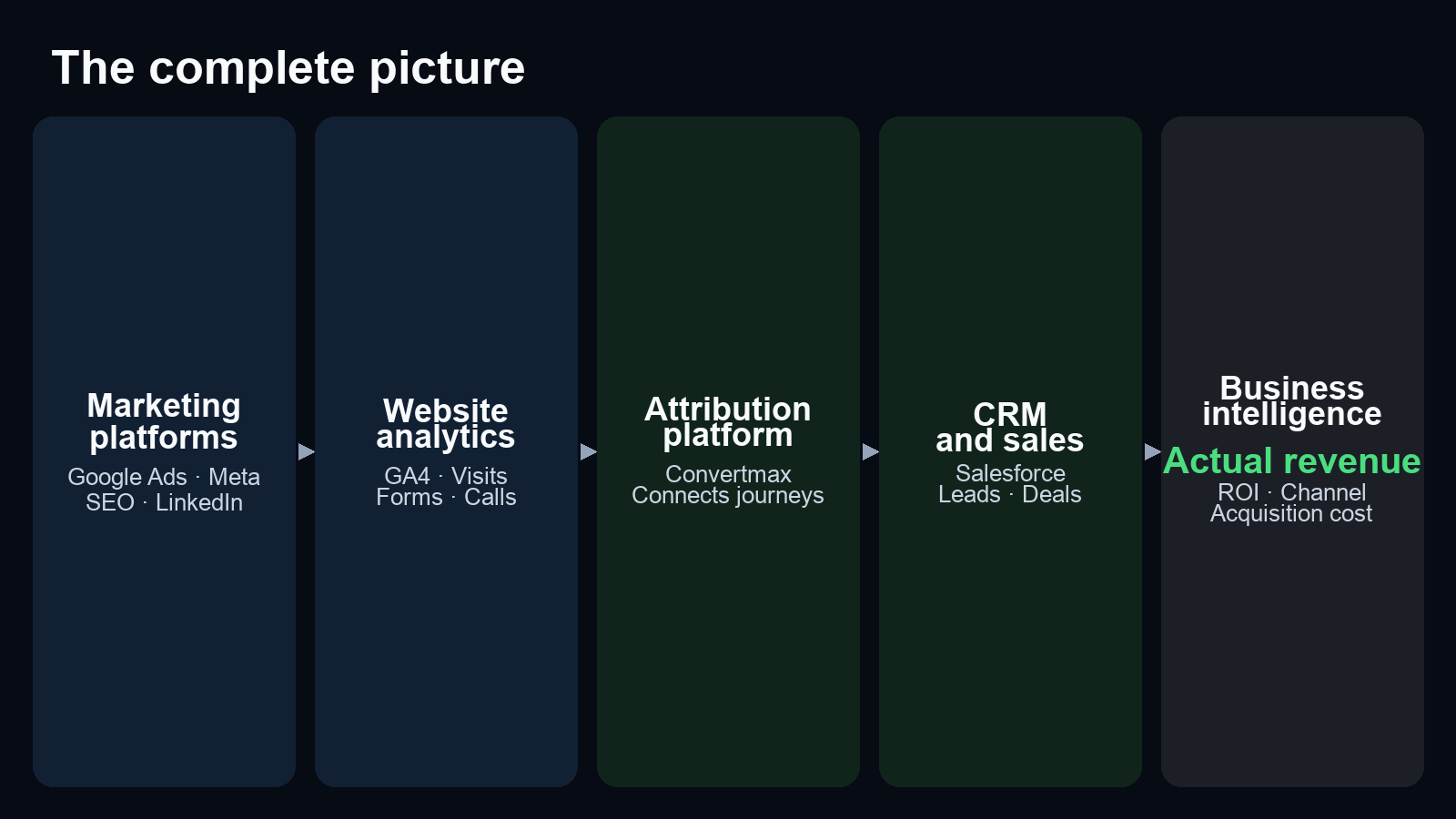
Most marketing reports end at the same place. A conversion: a form fill, a call, a demo request, a checkout. The number moves up or down, someone asks why, and the answer depends a little on which dashboard happens to be open.
The question that actually matters sits on the far side of that conversion. Of the people who converted, which ones became customers? What did they pay? Did they stay? And which parts of the marketing that brought them in produced that outcome?
Connecting those two sides is the bigger concept: closed-loop marketing attribution. It is not a model, and it is not a dashboard. It is a return path. Revenue and customer outcomes travel back from the CRM and the billing system to the campaign that started the journey, and decisions travel back out to the channels.
What "closed loop" means, precisely
A loop is closed when three things are true at once.
- You can trace a specific payment back to a specific journey, and name the marketing sources inside that journey.
- The thing being attributed is commercial — closed-won revenue, a paid invoice, a renewal — not a conversion event that stands in for one.
- The finding changes what happens next in the channel: the budget, the bid strategy, the audience, the speed of follow-up.
Miss any one of the three and you have reporting, not a loop. Plenty of setups get the first two and stop. The report is correct, the meeting happens, and the ad account keeps optimizing toward the same cheap conversion it optimized toward last quarter.
Where loops break
Five failure points account for most open loops. They are worth checking in order, because the earlier ones are cheaper to fix.
1. The join key is missing, or made of string
A form submission with no campaign parameters. A phone call through a tracked number. An invoice sitting in a billing system under a customer name that matches nothing in the CRM. When the layers have no shared identity, they never meet, and the attribution platform has to guess.
Agree on the key before you shop for the tool. Usually that means a first-party identifier plus disciplined campaign tagging on every inbound path, including the ones that do not go through a landing page.
2. The conversion is standing in for the outcome
A GA4 conversion is an event. A $5,000 job is revenue. The two are related, but they are not interchangeable, and a report that treats them as though they were will keep recommending more of whatever produces events.
The fix is dull and effective: define the commercial outcome in the CRM and billing layer, then attach it to the journey. If your business runs on calls and quotes, that means connecting call activity to revenue rather than stopping at "call received."
3. Campaign names drift
The same campaign appears as four different names across GA4, Google Ads, and the CRM source field. Attribution dutifully reports four campaigns that are really one, none of them reaching statistical relevance on its own.
This is unglamorous, and it is one of the most common reasons a closed-loop report will not reconcile with the ad platform it came from. Fix the naming convention once, in writing, and treat it as infrastructure.
4. The model is treated as a verdict
An attribution model distributes credit among recorded touchpoints. It does not prove that any one touch caused the sale. A loop built on a single model, with no test behind it, produces a confident answer that nobody can defend in a budget meeting, and the team quietly goes back to last-click.
Use models as lenses. Comparing models tells you where to look next. It does not make the decision for you.
5. Nothing travels back
The report gets read, the budget does not move, and the ad platform keeps bidding on the same conversion. The loop is open at the last connection, which is the one that costs the most.
What has to be true for the loop to close
Six conditions, and most of them are agreements rather than features.
| Condition | What it looks like in practice |
|---|---|
| One definition of revenue | Written down and agreed with finance: cash collected, closed-won booked, or recurring revenue. Pick a primary and name it everywhere. |
| One identity key | A first-party identifier that survives from first visit to invoice, with campaign parameters captured at entry. |
| Source data carried forward | Campaign and channel written into the CRM record when it is created, not reconstructed months later. |
| A commercial outcome | Closed-won deals and paid invoices connected, with the difference between them kept visible. |
| A return path to the platforms | Outcome values sent back to ad platforms so bidding optimizes for customers rather than events. |
| A review that changes something | A recurring meeting where a loop finding moves budget, targeting, or follow-up speed. |
The fourth condition earns its own note. Booked revenue and collected cash are not the same number, and a loop that blurs them will eventually produce a report that finance rejects. Keep both. Attribute to the one your business is actually managed on, and show the other beside it.
A worked example
A services company runs paid search, local services ads, organic search, and email. Most leads arrive as phone calls through tracked numbers, and the office quotes each one before anything gets booked.
An illustrative example. Before the loop closes, the picture is flattering. Google Ads reports 240 conversions for the quarter at a $58 cost per conversion, and the team is preparing to increase spend.
Once calls are matched to CRM records and then to invoices, the picture changes in three places.
- About a third of those "conversions" were calls about a job type the company does not take. The ads were matching on a keyword that reads as relevant and is not.
- Of the calls that did produce a quote, one campaign's quotes died at price far more often than the others. The leads were real, the offer was not competitive.
- Organic search and repeat email produced fewer conversions, but a notably higher average invoice and more repeat work.
The decision that follows is not "cut paid search." It is a negative keyword list, a bid adjustment toward the job types that actually invoice, and a follow-up sequence for quotes that go quiet after seven days. Those three moves are only visible from inside a closed loop, and each of them traces back to a specific invoice.
Three tests for whether your loop is actually closed
Trace one invoice backwards. Take the largest payment received last month and follow it back to a campaign, keyword, or source. If that takes ten minutes, the loop is closed. If it takes a meeting, it is not.
Reconcile with finance. Total attributed revenue for a period should match the revenue number finance reports for the same period, under the same definition, within a tolerance you have stated out loud. If it does not, you are running two versions of the truth and the loop will not survive the first budget challenge.
Check the return path. Did any outcome value reach an ad platform in the last 30 days? If not, the loop runs one way, and the platforms are still optimizing for their own idea of a good conversion.
Build order matters
Teams usually build this stack top to bottom, because that is how the layers are drawn. It works better in reverse.
- Start at the money end. Connect the CRM, then billing. Define the commercial outcome before anything else.
- Then the join. Get one reliable key from inbound source to customer record.
- Then the journey. Capture the touches that precede the conversion, first-party and consented.
- Then the model. Add attribution views once there is something worth attributing.
- Then the write-back. Push outcome values back to the channels and into the weekly review.
Built in that order, every layer has a reason to exist and a number to reconcile against. Built in the other order, you get a beautiful journey report that nobody can tie to a bank deposit.
The loop is closed when a number explains itself
The test is not whether the diagram is complete on a slide. It is whether someone can point at a revenue figure from finance, name the campaign and the keyword behind it, and describe the decision that figure changed.
Everything else — the layers, the models, the dashboards — is scaffolding for that one move. Once a team can make it, attribution stops being a monthly argument and starts being how the business is run.
Explore Convertmax attribution to see how first-party journeys connect to CRM outcomes and actual revenue, or read why revenue attribution needs more than CRM fields and automations.
Related reading