By Elena Marsh
How Health-Tech Companies Use Convertmax to Connect Patient Acquisition to Revenue
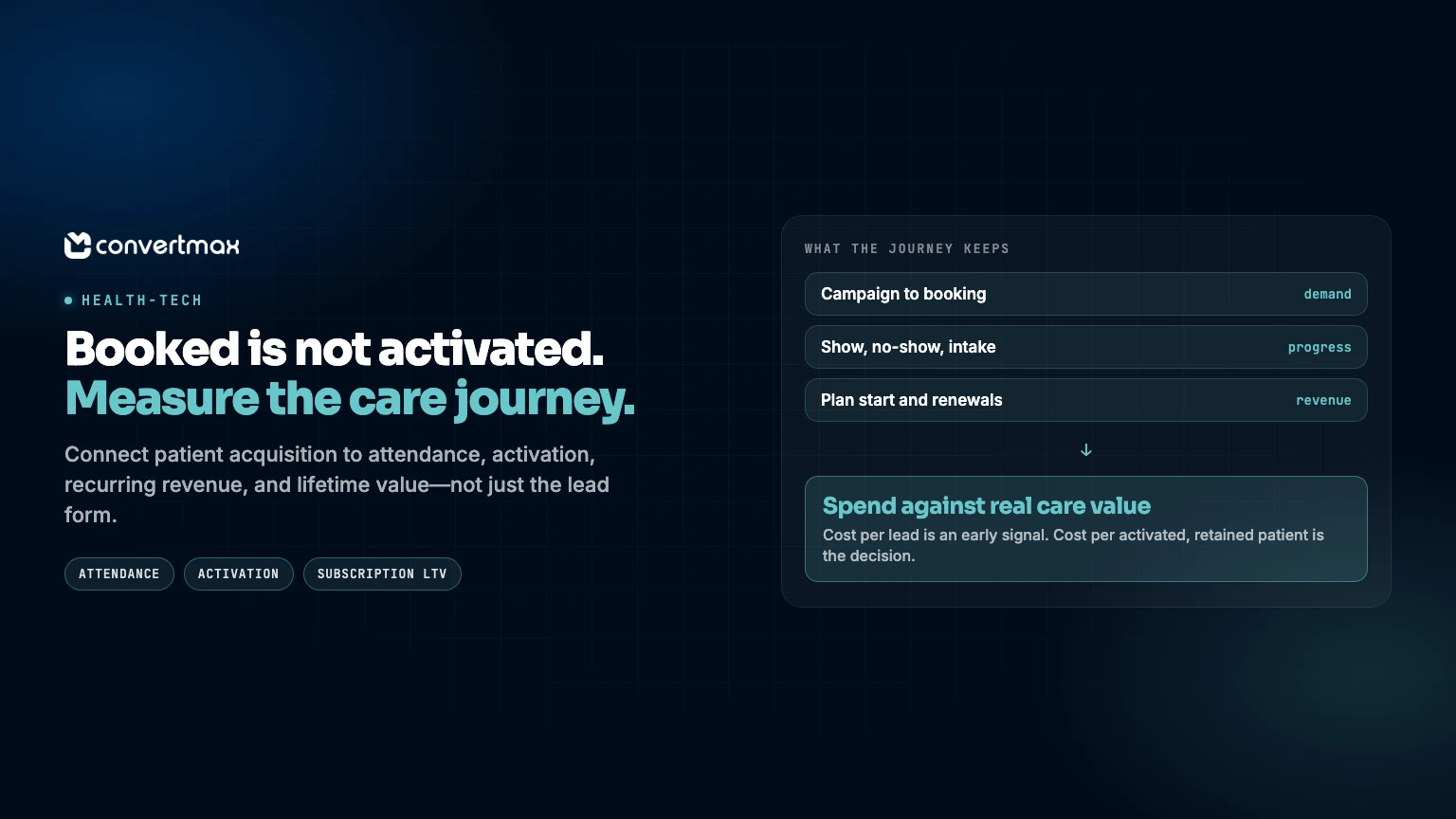
Health-tech growth does not behave like a neat ecommerce funnel.
A prospective patient may discover a company through paid search, book a consultation, miss that appointment, return through an email sequence, complete intake, become eligible for care, begin a membership, and remain on a recurring plan for months. Marketing owns the first interaction. Scheduling owns the calendar. Clinical systems confirm care milestones. Billing records revenue. Every team can report its part of the journey, yet the full picture is often missing.
That is the problem Convertmax is built to solve.
Convertmax is a revenue-intelligence and multi-touch attribution platform for connecting marketing spend to the business milestones that follow. Rather than stopping at clicks, leads, or booked appointments, health-tech teams can see the path to attendance, activation, recurring revenue, retention, and lifetime value.
Cost per lead is only an early signal
Cost per lead is easy to report. It is also easy to overvalue.
A low-cost campaign can produce plenty of prospective patients who never complete intake, do not attend their appointment, or never begin care. Another channel may have a higher cost per lead but bring in fewer, more committed patients who activate, subscribe, and continue with the program.
If the lead form is the only conversion being measured, both campaigns may look similar. Their economics are not.
Health-tech companies need to know more than which source generated demand. They need to know which sources brought in people who progressed through the workflow and created durable revenue. Convertmax preserves the context of the marketing touchpoints all the way through those downstream events.
Map the journey with events that mean something
The best health-tech funnel reflects the company’s actual care and revenue model. A booked appointment is a meaningful signal of demand. It is not proof of attendance, clinical eligibility, treatment start, subscription activation, or realized revenue.
Keeping those milestones distinct is one of the simplest ways to improve growth decisions.
| Journey stage | Example event | What the team can learn |
|---|---|---|
| Discovery and demand | Ad click, content visit, lead form, call request | Which messages and channels create initial interest |
| Scheduling | Consultation booked, appointment rescheduled | How effectively demand moves into the calendar |
| Attendance | Appointment attended, no-show, cancellation | Where scheduling and follow-up affect conversion |
| Intake and eligibility | Intake completed, clinical review complete, patient eligible | Whether prospects reach the point where care can begin |
| Activation | Treatment started, plan activated, first fulfillment completed | Which acquisition sources lead to actual use |
| Revenue | First payment, membership payment, recurring subscription revenue | Which channels create revenue, not just pipeline |
| Retention and value | Renewal, continued adherence, repeat purchase, subscription LTV | Which cohorts produce long-term value |
This is not about reducing a care journey to a single number. It gives each function a more accurate handoff. Marketing can judge the quality of demand. Operations can spot booking and attendance problems. Leadership can see which cohorts activate and remain valuable over time.
Use case: see the difference between bookings and real attendance
Many health-tech companies optimize advertising toward booked appointments. It is a sensible intermediate target. It can also be misleading when no-show rates are high.
Imagine that one campaign produces 100 booked consultations at a low cost, while another produces 70 at a higher cost. In an ad-platform report, the first campaign wins. But what if just 40 of its bookings attend, while 55 bookings from the second campaign attend and move forward into care? The picture changes quickly.
Convertmax keeps the stages visible:
- Marketing source and campaign
- Booked appointment
- Reschedule, cancellation, or no-show
- Attended appointment
- Completed intake or care-plan milestone
- Treatment or subscription activation
- Ongoing revenue and retention
That lets a team look at cost per booked appointment alongside cost per attended appointment and cost per activated patient. No-shows become part of the growth model, not an operational detail buried in another system.
This matters when marketing and scheduling teams are managing different goals. One campaign may need stronger pre-appointment education, a better reminder sequence, or faster follow-up. Another may deserve more spend because the people it brings in are more likely to attend and continue care.
Use case: measure activation speed in subscription-based care
For a subscription-led care model, enrollment is just the start. A patient may need to complete intake, attend a visit, receive a determination, begin a plan, and pass the first recurring billing milestone before the relationship is genuinely active.
That path is common in hormone health, weight management, longevity, telehealth, and other ongoing-care models. It also introduces a timing issue. Two channels may eventually create the same number of members, but one gets patients to activation in days while the other takes weeks of reminders and staff follow-up.
Convertmax can track time to activation alongside activation rate, acquisition cost, and downstream subscription value. That matters outside the reporting team. Activation speed affects cash flow, staffing needs, patient-success workload, and the time needed to recover acquisition cost.
For a hormone and peptide subscription model, a growth team can link a first marketing interaction to the booked consultation, attendance, eligibility, plan activation, first payment, and long-term subscription LTV. That makes it possible to separate a source that creates a lot of interest from one that consistently brings in patients who start and stay on care.
Use case: attribute spend to recurring revenue and lifetime value
Many health-tech teams can see the first transaction or the initial lead, but not what happens afterward. That creates a blind spot for membership and subscription businesses, where a patient’s long-term value can be far more important than the first month of revenue.
Convertmax brings recurring revenue into the attribution model. Teams can compare sources based on what happens after activation, including recurring payments, renewals, retention patterns, and cohort lifetime value.
The budget discussion becomes more useful. Instead of simply saying that a social campaign cost more than search to acquire a lead, the team can ask whether its activated members retain better and produce higher lifetime value. The answer may support a higher upfront cost. Or it may reveal that a seemingly efficient source is attracting patients who cancel early.
The aim is not to hold every channel to one identical cost target. It is to understand the economic profile of each source well enough to invest with confidence.
Use case: connect systems without replacing them
A health-tech company rarely runs the full patient journey in one platform. Marketing data may sit in advertising networks and analytics tools. Sales and scheduling activity may live in a CRM such as GoHighLevel. Clinical workflow, care management, fulfillment, and subscription billing may each sit elsewhere.
Convertmax acts as the revenue-intelligence layer that connects those records for measurement. It does not need to replace the applications where teams do their daily work. Its role is to preserve the link between marketing activity, pipeline movement, activation, revenue, and retention.
For organizations using GoHighLevel, Convertmax can connect paid and organic touchpoints to contacts and paid invoice revenue rather than treating lead creation as the final event. Operators can see which campaigns are associated with recurring value, instead of stopping at the form fill.
The same framework can support care-program and subscription workflows using tools such as Optimontra. It can also support health-tech teams evaluating clinical-data infrastructure such as Medplum, an open-source developer platform for clinical software built around FHIR-standard data storage and integrations with CRM, scheduling, and specialty tools.
With appropriate privacy, consent, and security controls, these connected data flows can retain the business events needed for attribution while clinical and operational teams continue working in systems designed for their needs. Convertmax keeps the measurement focus on growth and revenue outcomes.
Use case: make multi-touch attribution practical
The last click is rarely the whole story in healthcare.
A patient may first hear about a company through a creator partnership, compare options through search, read educational content, receive a retargeting message, and book after an email reminder. Giving all credit to the final interaction can make the rest of the marketing mix look ineffective, even though it created the awareness and trust that made the booking possible.
Convertmax gives teams a multi-touch view of that journey. Paid search, paid social, content, affiliates, partnerships, email, and outbound can be assessed for the role each one actually plays, whether it introduces a patient, supports consideration, prompts a booking, or helps move a prospective patient toward activation.
That does not mean every channel gets equal credit. It means budget decisions do not have to be based only on the easiest interaction to see.
Start with the decision the team cannot make today
The strongest attribution work starts with a difficult business question, not a dashboard request.
Perhaps booked appointments are growing while paid memberships remain flat. Perhaps a higher-cost channel may be justified by better retention. Perhaps patients from one source activate faster and need less follow-up.
Once the decision is clear, define the few events needed to answer it. Agree on what “activated” means. Identify the source of truth for revenue. Make no-shows, cancellations, refunds, and churn visible. Keep initiated, scheduled, and completed events separate.
Convertmax brings marketing, pipeline, activation, and revenue into the same operating view. For health-tech companies, that means seeing which activity is creating genuine patient and business momentum, then putting the next dollar where it is most likely to count.
Explore Convertmax attribution or review the current integrations to map patient acquisition through attendance, activation, and recurring revenue.