By Elena Marsh
The Telehealth Attribution Gap: What Hybrid Wellness Brands Need to Measure
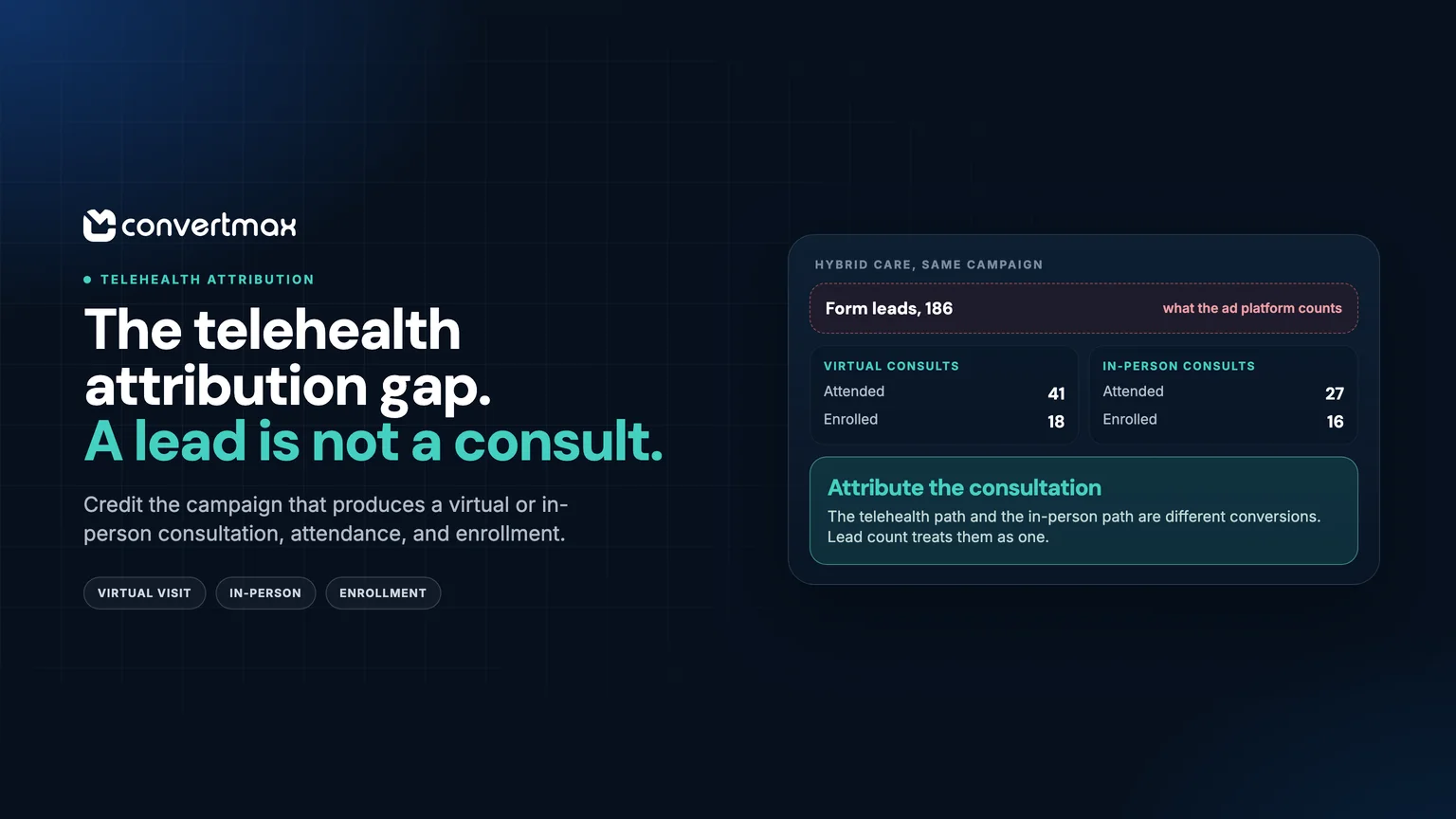
For a hybrid wellness or telehealth brand, the conversion rarely happens at the first form fill. A prospective patient may see an ad, browse treatment information, call a location, request a consultation, complete an assessment, meet with a licensed provider when appropriate, and only then decide whether to begin a plan. If the business measures only the first inquiry, it will have an incomplete picture of what its marketing is actually producing.
4Ever Young Anti-Aging Solutions is a useful public example of the complexity. The company presents itself as a network of medspa and wellness centers offering aesthetic services alongside wellness-oriented services such as bloodwork-led health planning, IV vitamins, supplements, and bioidentical hormone therapy. Its public care path includes a complimentary consultation, a Health or Look Profile, and—where relevant—medical review and a personalized plan.
4Ever Young is used here as an illustrative example based on public information. It is not a Convertmax customer or affiliate.
That is not a simple “click to cart” journey. It is a mix of local discovery, service education, consultation logistics, clinical suitability, and longer-term engagement. Telehealth can add convenient access to some services, but 4Ever Young’s telemedicine page makes clear that availability depends on the service, patient eligibility, provider availability, state law, and the patient’s physical location at the time of care.
The real conversion is a sequence of decisions
When marketing and operations do not share the same view of the journey, each team tends to optimize for the metric closest to its work. Marketing sees clicks, calls, and leads. The front desk sees scheduled consultations. Providers and care teams see whether a person is appropriate for care. Finance sees payments. None of those views is wrong. They simply do not answer the same question.
The commercial question is more complete: which sources introduce people who progress through an appropriate, authorized journey and become valuable customers or patients over time?
That distinction matters in a category where not every inquiry should turn into the same next step. A hormone-health prospect may need a different intake path from someone researching aesthetic services. Someone who prefers virtual care may still need an in-person visit. A person’s location can affect whether telehealth is even an option. Measurement needs to preserve those distinctions rather than treating every call, form, or booking as identical.
Convenience shapes the top of the funnel
The patient experience begins before a consultation. Prospects want to know what is available, how quickly they can be seen, whether virtual care may be suitable, and what happens next. That makes scheduling and routing part of the acquisition experience, not only an operations task.
McKinsey reported that 45% of appointments booked through online scheduling platforms were scheduled 24 to 72 hours in advance. In the same research, care groups offering both in-person and telehealth options received more bookings than groups offering only one modality. These are market observations, not a guarantee for any specific provider, but they underline a practical point: near-term availability and meaningful choice can affect demand.
Press Ganey’s 2025 consumer-experience report likewise found that 80% of surveyed consumers said online scheduling influences their choice of provider. Yet only 27% rated their online scheduling experience as excellent. For a wellness business that depends on consultations, that gap is an opportunity. A person who is ready to explore treatment should not have to navigate an unclear path simply to learn whether a virtual or in-person consultation is possible.
The answer is not to promise telehealth everywhere or to reduce clinical decisions to a form. HHS recommends clear scheduling processes, real-time updates, and reminders in hybrid-care programs, while emphasizing that virtual versus in-person care should be chosen based on the patient’s condition, preferences, and information needed for the visit. A sound digital journey can collect useful routing information early, set appropriate expectations, and leave eligibility and care decisions to licensed professionals.
Why lead volume is a poor proxy for growth
A campaign that drives hundreds of inquiries can look successful in an ad platform even if those leads do not schedule, do not attend, are not eligible for the advertised service, or never begin a paid plan. Conversely, a channel with a modest number of leads may produce stronger consultation attendance, enrollment, and repeat revenue.
This is the attribution gap. The marketer may know the source of a click, while the business knows a consultation was completed or a plan was purchased. Without a reliable connection between those events, the organization cannot confidently answer basic questions:
- Which campaigns are generating completed consultations, not just generic leads?
- Which landing pages or calls introduce people who become eligible, engaged customers?
- Are virtual and in-person pathways performing differently for comparable services and locations?
- Which sources lead to durable value, where repeat care or memberships are part of the model?
- Are franchise-development inquiries being kept separate from consumer-care inquiries?
The last question is especially important for a brand such as 4Ever Young, which publicly markets both services and franchise opportunities. Its franchise site describes a separate business-development journey with different economics, decision-makers, consent expectations, and sales cycle. Combining franchise leads with patient or consumer inquiries can make reports look healthier while making them far less useful.
Where Convertmax could fit
Convertmax is not a CRM, scheduling platform, clinical-record system, or visitor-facing appointment chatbot. It describes its role as a revenue-intelligence layer that connects first-party journey data with CRM intelligence, call tracking, and multi-touch attribution to show the path from marketing touchpoints to pipeline and closed revenue. Scheduling stays with the scheduling system; Convertmax can ingest approved booking, cancellation, billing, and related events for measurement.
For a hybrid wellness organization with compatible systems and appropriate governance, that creates a practical measurement model. Rather than replacing the tools used by the front desk, care team, or sales team, Convertmax could be evaluated as the layer that connects approved signals across them.
A useful implementation would begin with a shared definition of the nonclinical funnel. For example, marketing touches could be connected to consultation request, booking, attendance, plan enrollment, payment, and—where appropriate and permitted—repeat or membership revenue. The goal is not to make every event a revenue conversion. It is to understand how the journey moves from source to meaningful business outcome.
Convertmax’s published integrations and materials describe the ability to connect form, call, CRM, payment, and selected scheduling events to source and journey reporting. Its Optimontra integration, for example, describes bringing appointment and billing milestones into the attribution layer, while its call-tracking integrations can associate authorized calls with campaigns, keywords, and landing pages.
For an organization like 4Ever Young, four applications stand out.
1. Measure consultation quality, not only inquiry quantity
A campaign should not be judged only by its cost per form or cost per call. With the right event definitions, teams can compare channels by consultation bookings, confirmed attendance, and downstream nonclinical revenue events. This gives paid-media and location teams a more useful common language.
2. Preserve the difference between service lines and care paths
Attribution works best when it respects the journey it is measuring. Aesthetic consultations, wellness evaluations, and telehealth-eligible services may have different questions, handoffs, and timelines. A good measurement design uses those distinctions to improve reporting; it does not flatten them into a single, misleading “lead” category.
3. Separate consumer and franchise funnels from the first touch
Consumer-care marketing and franchise development should be reported independently. They involve different audiences and outcomes, so they should not share the same conversion definitions, retargeting logic, or revenue reports. Separate reporting makes budget decisions more defensible and reduces the risk of mixing unrelated data.
4. Learn which channels create lasting value
Some wellness businesses have recurring plans, repeat visits, or membership-like relationships. When approved downstream payment and retention events can be connected back to marketing sources, teams can move beyond the short-term question of “Which campaign got the lead?” to the more useful question of “Which campaign introduced people who stayed engaged?” Convertmax’s platform positions this as multi-touch reporting from first click to closed revenue rather than single-touch lead reporting.
Start with a measurement blueprint, not a dashboard
Attribution cannot repair an undefined process. Before connecting systems, a hybrid-care business should agree on the events that matter and the boundaries around them.
First, identify the approved business outcomes. These might include a consultation scheduled, a consultation attended, a nonclinical enrollment milestone, a payment, or a renewal. Avoid treating sensitive clinical details as marketing metrics simply because they are available in a system.
Next, identify the systems that own each event. A scheduling platform owns appointment status. A CRM may own lead and sales status. A payment platform owns revenue transactions. A call-tracking platform owns call-source information. Convertmax can be evaluated as the analysis and attribution layer that connects authorized data across those sources; it should not be expected to replace them.
Then, decide which journey splits matter. Location, service interest, virtual versus in-person preference, and consumer versus franchise intent may all be relevant. For telehealth, eligibility should remain a care and compliance matter—not a marketing shortcut—and should be determined under the organization’s policies and applicable law.
Finally, decide what the team will do with the findings. If a campaign generates calls but few attended consultations, the next action might be to review the landing-page expectations, routing rules, response times, or booking options. If a source produces fewer leads but more completed journeys, the team may choose to protect or expand that investment. Attribution becomes valuable only when it changes the quality of the decision.
Trust is part of the conversion strategy
Healthcare-adjacent marketing cannot treat data as a free raw material. Any use of patient or prospective-patient information for measurement requires appropriate privacy, consent, security, data-minimization, and regulatory review. That is particularly important when telehealth, state-based eligibility, health information, or clinical records are involved.
Convertmax’s healthcare materials explicitly condition connected data flows on appropriate privacy, consent, and security controls. Its public privacy policy describes customer analytics processing, encrypted data in transit and at rest, and restricted-use agreements for third-party AI providers. Those statements are not a substitute for an organization’s own legal, security, and compliance assessment.
The practical principle is straightforward: measure what is necessary for approved business decisions, minimize what you move, and keep clinical judgment and sensitive health information out of marketing logic unless there is a clear, authorized reason and suitable safeguards.
The opportunity is clarity, not more dashboards
Hybrid wellness and telehealth businesses already create a wealth of signals: visits, calls, forms, consultations, bookings, attendance, payments, and repeat engagement. The problem is usually not a lack of data. It is the lack of a trustworthy line between the first marketing touch and the outcomes the business actually values.
For organizations with a journey similar to 4Ever Young’s, the next step is not necessarily a new booking tool or a new CRM. It is a shared, privacy-conscious view of the funnel—one that distinguishes consumer care from franchise development, respects telehealth eligibility, and measures progress beyond the first inquiry.
That is where a revenue-intelligence layer such as Convertmax can be useful: not by making clinical decisions or replacing the systems that run care, but by helping teams see which approved marketing journeys produce completed, valuable outcomes.