By Elena Marsh
Stop Counting Leads. Build a Signal-Driven Multi-Touch Attribution Lead Engine
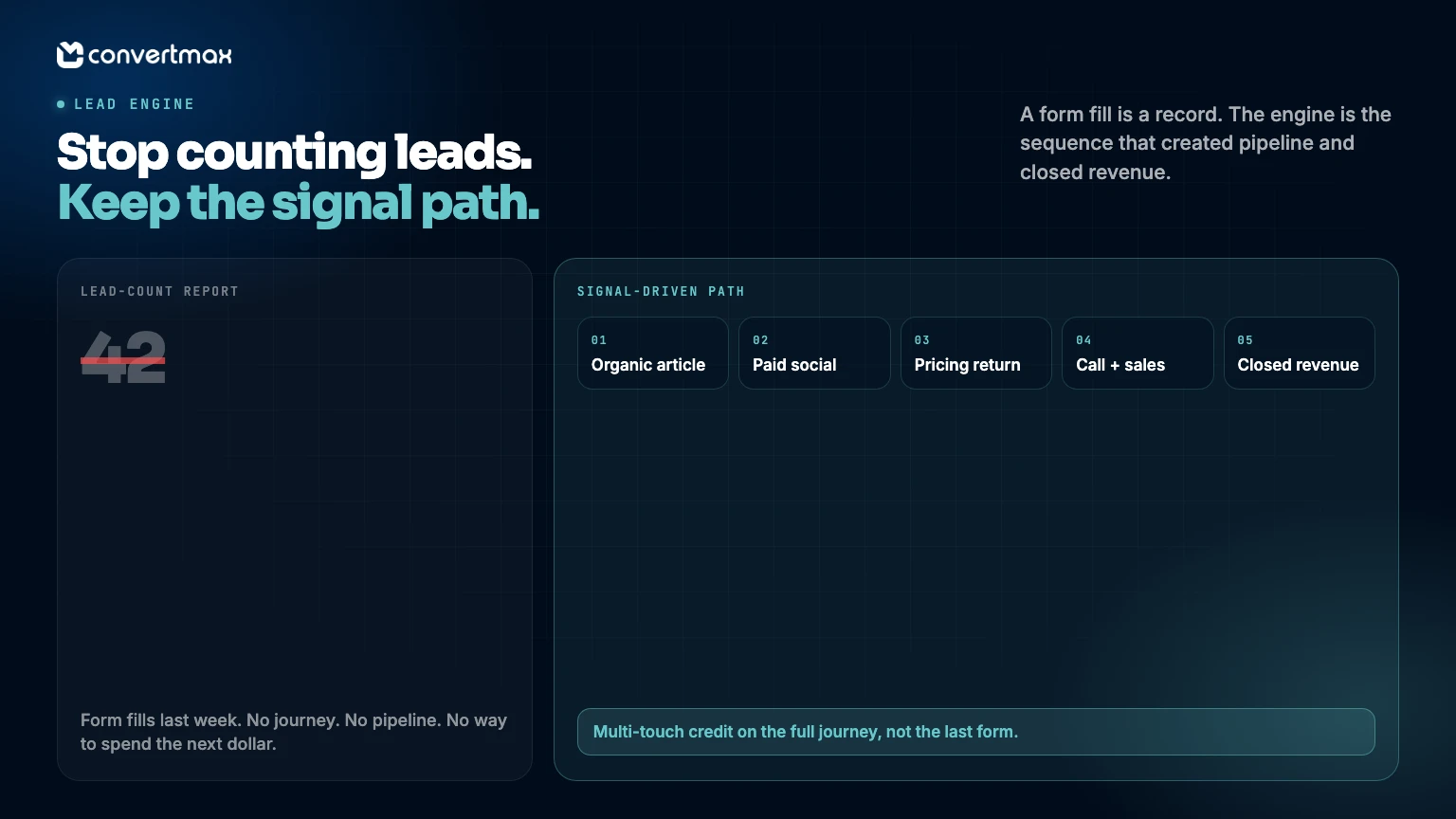
Most lead reports answer one narrow question: how many people filled out a form?
That count is easy to collect. It is a weak stand-in for demand.
A form submission does not show whether the person had already compared pricing, returned after a sales call, clicked an ad three weeks earlier, or went on to become a customer. It definitely does not tell you where the next dollar of budget should go.
A more useful question is this: which signals, across which journeys, are creating qualified pipeline and closed revenue?
That is the work of a signal-driven, multi-touch attribution lead engine. Not a lead-scoring widget. Not another ad-platform report. It is the operating system that connects what a buyer does to the commercial outcome that follows.
Convertmax is built around the same idea. Its platform brings together first-party journey data, CRM intelligence, call tracking, and multi-touch models, then follows the thread from first click to closed revenue.
A lead is a record. A signal is evidence.
A CRM record matters, but it usually shows up late in the story. Before someone becomes a lead, they may have read a case study, watched a demo, visited pricing twice, clicked a retargeting ad, and called the business.
Each action is a signal. Some point to interest. Some point to fit. Others suggest urgency. A single action rarely tells you much. The pattern does.
For a high-consideration business, a journey might look like this:
- A prospect finds a problem-focused article through organic search.
- They return via a paid social ad and download a guide.
- A week later, an email brings them back to the pricing page.
- They call the business, speak with sales, and convert after a branded search.
A last-click report gives the branded search all the glory. A lead-count report gives the guide download the credit. Neither one explains the path very well, and neither gives a growth team much to work with. See moving beyond last-click and lead source tracking.
A signal-driven engine keeps the sequence. It connects that sequence to a person or account when there is enough evidence. Then it makes the journey available for both attribution and action.
Five layers of a lead engine that can learn
1. Capture the signals buyers actually produce
Begin with first-party event collection on the site. Track the actions that separate casual traffic from real movement: campaign entry, important page views, form interactions, return visits, content depth, demo requests, phone calls, checkout behavior, and logged-in activity where appropriate and consented.
Do not track every click just because you can. Ask whether an event helps explain intent, fit, progression, or revenue. If it will never change a decision, it is probably just noise.
Then bring in what happens away from the browser. Calls, sales meetings, CRM stage changes, opportunities, invoices, orders, and renewals all belong in the same view. Attribution gets flimsy when the journey ends at the form. Good measurement carries it into pipeline and revenue.
That is not simply a Convertmax point of view. Attribution guidance also recommends including online and offline touchpoints, then revisiting the model as data-quality gaps and buyer behavior change.
2. Resolve identity without pretending it is perfect
People do not introduce themselves the first time they arrive. They browse anonymously. They switch devices. They use a personal email to research, then contact sales weeks later. That is normal.
The aim is not a fictional, perfectly complete identity graph. The aim is a responsible connection when a reliable key appears, such as a form submission, authenticated session, call conversion, CRM contact, or order.
Keep anonymous activity intact. Stitch it to the known record only when the evidence holds up. Keep the matching logic and source data inspectable, too. When a number carries uncertainty, say so. Teams will trust a defensible answer far more than a polished but opaque one. For the identity layer, see visitor identification.
3. Make CRM outcomes part of attribution
This is where plenty of lead reporting breaks down. Marketing data lives in one system, sales data in another, and finance has the final revenue number somewhere else. Before long, every team has a different answer to the same question: what worked?
Connect the revenue source instead.
A lead engine needs CRM stages and commercial outcomes as the backbone of its reporting. Attach the journey to meaningful milestones: qualified lead, sales-accepted lead, opportunity created, pipeline value, closed-won revenue, and lifetime value where it makes sense. This separates a campaign that produces lots of inquiries from one that produces fewer, stronger opportunities.
Convertmax connects first-party journey data with CRM and commerce revenue sources, call activity, and campaign credit. That gives teams a way to follow the full chain instead of settling for disconnected conversion totals. CRM fields and automations are not enough.
4. Use multi-touch attribution as a lens, not a verdict
No attribution model proves causality on its own. It is a way of assigning credit, not a replacement for judgment, testing, or honest sales feedback.
So do not spend weeks asking, "Which model is the true one?" Ask, "What does each model help us notice?"
| Attribution lens | What it helps reveal | What it can miss |
|---|---|---|
| First touch | Channels that introduce qualified demand | The work that moves people toward a decision |
| Last touch | The final conversion context | Earlier discovery and consideration activity |
| Linear multi-touch | A broad view of shared journey credit | Differences in depth or timing between touches |
| Position-based | Discovery and conversion moments | Middle-funnel education that changes intent |
| Time-decay | Activity closest to the outcome | Research that began long before conversion |
Use the views together. If paid search looks strong only in a last-touch view while content appears across opportunity journeys, neither channel has automatically earned a bigger or smaller budget. You have a sharper hypothesis. Now test it.
The same holds for lead scoring. A score is a routing and prioritization tool, not a trophy. Check it against what happens downstream. If it creates more sales activity but no lift in qualified pipeline, it is not pulling its weight.
5. Put the findings into a weekly rhythm
Attribution earns its place when it changes behavior. Otherwise, it is a prettier retrospective.
A practical weekly review can be short:
- Review the campaigns and pages that influenced new pipeline, not merely raw lead volume.
- Look for repeat signal patterns among good opportunities: return visits, pricing engagement, calls, content combinations, source paths, or account behavior.
- Check lead velocity and stage progression by channel. Are leads moving, or simply entering the CRM?
- Compare model views before changing budget. A single-credit report should not make that call alone.
- Give sales a concise view of the active signals that make a lead worth fast follow-up.
That routine turns attribution into a feedback loop. Marketing sees where attention turns into commercial traction. Sales gets context before outreach. Leadership gets an explanation that goes further than platform-reported conversions.
What this looks like in the real world
Picture a B2B company running paid search, LinkedIn ads, webinars, email nurture, and outbound follow-up. LinkedIn generates a healthy number of form fills. Paid search appears to create most of the last-touch conversions.
Once the team connects first-party journeys to CRM opportunity data, a different pattern appears. Webinar attendees who later return through email and visit pricing have the best opportunity rate. LinkedIn is introducing many of those people. Paid search is often present near conversion. Outbound calls create the next meaningful step for a particular segment.
The right decision is no longer "cut LinkedIn" or "scale paid search" because one column happens to be larger. The team can take a better next step: tighten LinkedIn audience and webinar messaging, create fast follow-up for attendees showing repeat intent, and maintain paid-search coverage for high-intent demand.
That is a lead engine at work. It joins evidence instead of forcing every channel to fight for one winner-take-all conversion. For channel-level measurement, see LinkedIn attribution and marketing attribution for SaaS.
Build for decisions, not data volume
More events do not make attribution better. Better definitions do.
Before implementation, agree on what a qualified lead means, which CRM stage represents true sales acceptance, when an opportunity is sourced versus influenced, how calls are handled, and which revenue source is authoritative. Put those decisions in writing. Update them when the business changes.
Then keep reporting close to the decisions it should support: where to add or cut budget, which campaigns need a different audience or offer, which leads deserve faster follow-up, and where the sales process is losing momentum.
Convertmax provides the first-party tracking, journey reporting, CRM intelligence, call attribution, and multi-touch revenue views needed to put that system in place without asking a growth team to maintain a separate analytics pipeline.
The finish line is not a dashboard. It is a team that can look at a lead, understand the signals behind it, see the journey that shaped it, and make the next move with less guesswork.
Explore Convertmax lead attribution or review the platform to connect first-party signals to pipeline and closed revenue.