By Elena Marsh
Marketing Attribution for SaaS: The Complete Guide to Measuring Revenue in 2026
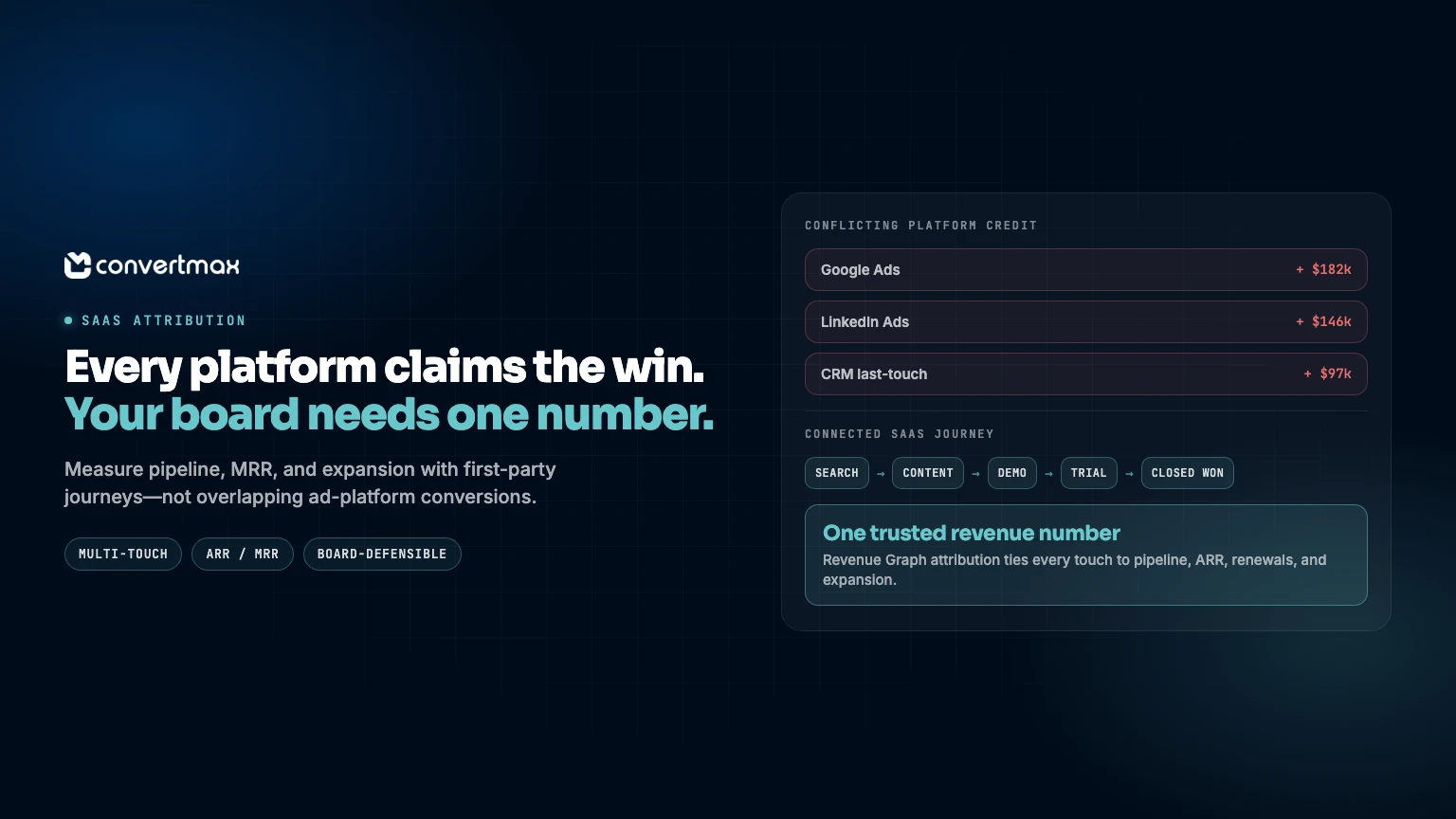
Marketing Attribution for SaaS Is Broken
Marketing attribution for SaaS companies has never been more important—or more difficult.
Modern buyers rarely discover a product through a single ad or campaign. They might first find your company through Google Search, return after reading a blog post, click a LinkedIn ad weeks later, attend a webinar, speak with a sales representative, start a free trial, invite teammates, and only purchase months later.
Yet most attribution software still tries to answer a complex question with a simple rule:
- Give all credit to the first click.
- Give all credit to the last click.
- Split it evenly across every interaction.
- Let each advertising platform claim success independently.
The result is predictable:
- Google Ads reports one number.
- LinkedIn reports another.
- Meta claims additional conversions.
- Your CRM tells a different story.
- Finance has its own version of revenue.
When the board asks, "How much revenue did marketing actually generate?", nobody has an answer everyone trusts.
This is why marketing attribution for SaaS is evolving beyond campaign reporting and into Revenue Intelligence—a connected approach that measures the complete customer journey using first-party data.
What Is Marketing Attribution for SaaS?
Marketing attribution for SaaS is the process of understanding which marketing efforts influence recurring revenue, not simply which campaign generated a lead.
Unlike ecommerce, where a purchase often happens in a single session, SaaS customer journeys are typically much longer and involve multiple teams, channels, and decision-makers.
A typical SaaS buying journey might include:
- Organic search
- Paid search
- Social advertising
- Content marketing
- Email nurturing
- Product comparisons
- Sales calls
- Product demos
- Free trials
- Product usage
- Procurement
- Closed-won opportunity
- Customer onboarding
- Renewals
- Expansion revenue
Every one of these interactions can influence revenue.
Good SaaS marketing attribution measures the entire lifecycle—not just the first conversion.
Why SaaS Attribution Is Different
SaaS businesses face challenges that traditional attribution models were never designed to solve.
Recurring Revenue
Revenue doesn't stop after the initial sale.
Marketing may influence:
- Monthly recurring revenue (MRR)
- Annual recurring revenue (ARR)
- Renewals
- Upsells
- Cross-sells
- Expansion revenue
If attribution ends at the first purchase, it ignores much of the value created.
Long Buying Cycles
Enterprise SaaS sales often take weeks or months.
A prospect might interact with dozens of touchpoints before purchasing.
Single-touch attribution oversimplifies this reality.
Multiple Decision Makers
Most B2B SaaS purchases involve:
- End users
- Managers
- Finance
- IT
- Procurement
- Executive sponsors
Each stakeholder may discover your product through a different channel.
Sales-Assisted Conversions
Unlike many ecommerce businesses, SaaS frequently relies on:
- SDR outreach
- Discovery calls
- Product demos
- Solution engineers
- Proof of concepts
- Executive meetings
These offline interactions rarely appear in advertising reports but are critical to revenue generation.
Traditional Attribution Models Explained
Understanding the strengths and weaknesses of common attribution models helps explain why many SaaS companies struggle to trust their reporting.
First-Touch Attribution
All credit goes to the first interaction.
Advantages
- Easy to understand
- Highlights awareness channels
Limitations
- Ignores every interaction after discovery
- Doesn't reflect modern buying behavior
Last-Touch Attribution
The final interaction receives all credit.
Advantages
- Simple to implement
- Often supported by analytics platforms
Limitations
- Overvalues bottom-of-funnel activities
- Undervalues content and demand generation
Linear Attribution
Revenue is divided equally across all interactions.
Advantages
- Recognizes every touchpoint
Limitations
- Treats all interactions as equally important
Time-Decay Attribution
Recent interactions receive more weight.
Advantages
- Better reflects purchase momentum
Limitations
- Can undervalue early-stage education
U-Shaped Attribution
Most credit goes to the first touch and lead conversion.
Useful for lead generation.
Less useful for complex SaaS buying journeys.
W-Shaped Attribution
Credit is shared between:
- First touch
- Lead creation
- Opportunity creation
A stronger model for B2B SaaS.
Data-Driven Attribution
Machine learning estimates contribution using historical patterns.
Potentially more accurate—but only when the underlying customer data is complete and connected.
Even the most advanced attribution model cannot compensate for fragmented data.
The Biggest Problems with SaaS Marketing Attribution
Every Platform Claims Credit
Advertising platforms optimize for their own success.
Each platform only sees part of the customer journey.
This naturally leads to overlapping conversion claims.
Customer Data Lives Everywhere
Modern SaaS companies commonly use:
- CRM
- Marketing automation
- Product analytics
- Customer support
- Call tracking
- Billing
- Data warehouse
- Website analytics
Each system stores a different piece of the customer story.
Without connecting them, attribution remains incomplete.
Offline Revenue Is Often Invisible
Phone calls
Trade shows
Executive introductions
Partner referrals
Customer success conversations
These interactions influence revenue but rarely appear in advertising reports.
Identity Resolution Is Difficult
The same customer might appear as:
- Anonymous website visitor
- Marketing contact
- CRM lead
- Opportunity
- Customer
- Billing account
Connecting those identities accurately is one of the biggest challenges in SaaS attribution.
Marketing Attribution vs Revenue Attribution
Many companies stop measuring after lead generation.
Revenue attribution continues much further.
Instead of asking:
Which campaign generated this lead?
Revenue attribution asks:
- Which campaigns generated pipeline?
- Which channels produced closed revenue?
- Which campaigns shortened sales cycles?
- Which sources create the highest lifetime value?
- Which marketing investments drive expansion revenue?
This shift changes marketing attribution from a reporting exercise into a business decision-making tool.
What Is Board-Defensible Attribution?
Board-defensible attribution is attribution that can withstand scrutiny from:
- Marketing
- Sales
- Revenue Operations
- Finance
- Executive leadership
- Investors
- Board members
It isn't based on whichever platform reports the highest ROAS.
Instead, it is built on connected first-party customer data that multiple departments can validate.
A board-defensible attribution model should:
- Use first-party tracking
- Connect customer identities
- Measure revenue instead of conversions
- Include offline interactions
- Validate numbers across systems
- Produce consistent executive reporting
If finance cannot reproduce your marketing numbers, they are unlikely to be trusted.
The Revenue Graph Approach
Traditional attribution connects events.
A Revenue Graph connects relationships.
Imagine a customer journey like this:
Google Search
        ↓
Blog Article
        ↓
Pricing Page
        ↓
Demo Request
        ↓
Sales Call
        ↓
CRM Opportunity
        ↓
Proposal
        ↓
Closed Won
        ↓
Onboarding
        ↓
Renewal
        ↓
Expansion Revenue
Instead of treating these as isolated events, a Revenue Graph links them into a connected timeline.
This allows teams to understand:
- Which channels generate revenue
- Which content influences enterprise deals
- Which campaigns shorten sales cycles
- Which customer journeys create the highest lifetime value
Rather than assigning arbitrary credit, the Revenue Graph provides context for every revenue event.
Building a Modern SaaS Attribution Stack
Effective SaaS marketing attribution requires more than an analytics platform.
A modern stack typically includes:
- CRM
- Marketing automation
- Website analytics
- Product analytics
- Call tracking
- Billing platform
- Customer support
- Data warehouse
- Identity resolution
- Revenue Intelligence platform
Each component contributes part of the customer story.
The goal is not replacing these tools—it is connecting them.
Marketing Attribution Metrics Every SaaS Company Should Track
Beyond clicks and conversions, modern SaaS businesses should measure:
Revenue per Visitor
How much revenue is generated for every website visitor?
Pipeline per Campaign
Which campaigns create qualified pipeline rather than simply leads?
Revenue per Marketing Channel
Compare:
- Organic search
- Paid search
- Paid social
- Referrals
- Partnerships
using actual revenue rather than platform-reported conversions.
Customer Acquisition Cost (CAC)
Track acquisition costs by channel, campaign, and customer segment.
Lifetime Value (LTV)
Understand which marketing investments create long-term customers—not just immediate wins.
CAC Payback Period
How long does it take for marketing spend to be recovered through recurring revenue?
Sales Cycle Length
Identify which campaigns accelerate purchasing decisions.
Expansion Revenue
Marketing can influence renewals, cross-sells, and upsells.
This should be included in attribution whenever possible.
Common SaaS Attribution Mistakes
Many organizations struggle because they:
- Trust advertising platforms as their source of truth.
- Ignore offline interactions.
- Measure leads instead of revenue.
- Fail to connect CRM and marketing systems.
- Stop attribution after form submissions.
- Ignore renewals and expansion revenue.
- Depend entirely on UTM parameters.
- Build executive reports from spreadsheets.
Avoiding these mistakes dramatically improves reporting confidence.
Choosing SaaS Marketing Attribution Software
When evaluating attribution platforms, consider whether they support:
- First-party tracking
- Multi-touch attribution
- CRM integrations
- Marketing automation integrations
- Call tracking
- Product analytics
- Warehouse connectivity
- Identity resolution
- Revenue reporting
- Executive dashboards
- API access
- Privacy-first architecture
The best platform is the one that provides a consistent, trusted view of revenue across the organization.
Why Revenue Intelligence Is Replacing Attribution Software
Attribution alone answers one question:
Who deserves credit?
Revenue Intelligence answers much bigger questions:
- Where does revenue come from?
- Which customers are most profitable?
- Which campaigns create the best lifetime value?
- Which sales activities improve win rates?
- Which marketing investments should increase next quarter?
Modern revenue teams need answers that extend beyond campaign reporting.
This is why Revenue Intelligence platforms are becoming the next generation of marketing measurement.
How Convertmax Helps SaaS Companies
Convertmax was built specifically to solve the challenges of marketing attribution for SaaS.
Instead of relying on disconnected reports, Convertmax creates a unified Revenue Graph that connects customer interactions across marketing, sales, product, and revenue systems.
By integrating with CRMs, marketing automation platforms, ecommerce systems, call tracking providers, analytics tools, and data warehouses, Convertmax provides a connected view of the customer lifecycle.
This enables organizations to:
- Measure marketing's impact on pipeline and revenue.
- Understand multi-touch customer journeys.
- Connect online and offline interactions.
- Track renewals and expansion revenue.
- Deliver consistent reporting to marketing, sales, finance, and executive leadership.
Rather than asking which platform deserves credit, Convertmax helps teams understand how every interaction contributes to business growth.
Frequently Asked Questions
What is marketing attribution for SaaS?
Marketing attribution for SaaS measures how marketing activities contribute to recurring revenue, customer acquisition, and long-term growth across the entire customer lifecycle.
Which attribution model is best for SaaS?
There is no universal answer. Multi-touch and data-driven models generally outperform first-touch or last-touch approaches, especially when combined with connected first-party data.
Is Google Analytics enough for SaaS attribution?
Google Analytics is valuable for website measurement, but it cannot independently connect CRM data, sales activities, product usage, billing, renewals, and customer success. Most SaaS companies need additional systems to achieve complete revenue attribution.
What is board-defensible attribution?
Board-defensible attribution is a methodology built on connected, verifiable first-party data that produces consistent revenue reporting trusted by marketing, sales, finance, executives, and investors.
What is a Revenue Graph?
A Revenue Graph is a connected data model that links customers, touchpoints, opportunities, revenue events, renewals, and expansion into a unified view of the customer journey.
Final Thoughts
Marketing attribution for SaaS is no longer just about assigning credit to the last click or proving which advertising platform generated the most conversions. Modern SaaS organizations need a deeper understanding of how every interaction contributes to pipeline, recurring revenue, customer retention, and long-term growth.
As buying journeys become more complex and executive teams demand greater accountability, disconnected reports are no longer enough. The future belongs to organizations that can connect first-party customer data across marketing, sales, product, finance, and customer success into a single source of truth.
That's the philosophy behind the Revenue Graph.
By moving beyond traditional attribution models and embracing Revenue Intelligence, SaaS companies gain more than better dashboards—they gain the confidence to make strategic investment decisions backed by data everyone can trust.
If you're looking to build board-defensible marketing attribution for SaaS, the first step isn't choosing another reporting tool. It's creating a connected view of the customer journey that turns fragmented data into actionable revenue intelligence.