By Elena Marsh
AI Search Is Changing B2B Buying. Can You Measure Its Revenue Impact?
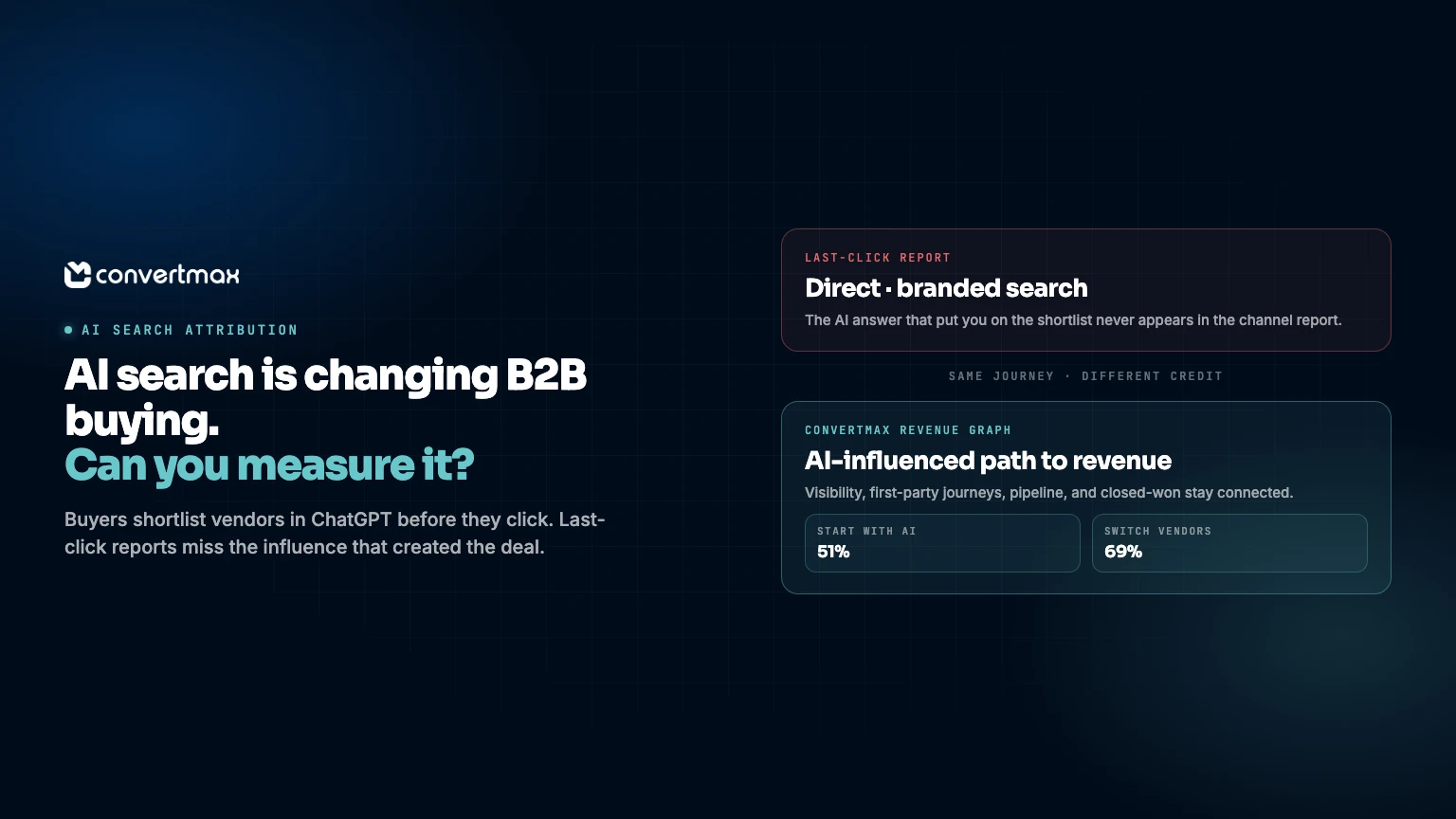
For years, B2B search strategy has followed a familiar pattern. Rank for the right terms. Win the click. Capture the lead. Report the conversion.
That pattern still matters. It just no longer shows the whole journey.
Buyers are now doing more of their early research inside ChatGPT, Perplexity, Gemini, and other answer engines. They ask for vendor comparisons, implementation advice, category explanations, and reasons to trust one provider over another. By the time they arrive on a company site, the shortlist may already be taking shape.
Forrester reports that 94% of business buyers use AI in their buying process. Its 2025 Buyers' Journey Survey also found that generative AI or conversational search was named a more meaningful information source than any other source by twice as many buyers.
So the question is not whether B2B buyers will use AI search. They already are. The harder question is whether your business can see, influence, and measure what happens there.
The B2B AI-search statistics worth paying attention to
G2 surveyed 1,076 B2B software buyers and decision-makers in March 2026. The findings are specific to software buying, but they point to a wider shift in complex, research-heavy sales.
| What the research found | What it means in practice |
|---|---|
| 51% of B2B software buyers now start research with an AI chatbot more often than with Google. Eleven months earlier, that figure was 29%. | The first vendor impression may come from an AI answer, rather than a results page or a visit to your site. |
| 71% use AI chatbots at some point in their software research. | AI turns up throughout the journey, not only at the discovery stage. |
| 69% chose a different vendor from the one they had originally planned to buy after receiving AI-chatbot guidance. | AI visibility can change who makes the shortlist. It is not just an awareness play. |
| 33% bought from a vendor they did not know beforehand. | Strong third-party evidence can put a brand into deals it may never have been considered for. |
| 45% say citations from software review sites are the most confidence-inspiring signal in an AI-generated answer. | Reviews and independent proof help turn a recommendation into a credible option. |
There is a catch. G2 also found that 64% of buyers encounter inaccurate AI recommendations often or very often. A brand mention is not automatically a good result if the description is stale, incomplete, attached to the wrong use case, or simply wrong.
You need to know both where your brand appears and what the answer says about it.
This is not just a new traffic source
The click still matters. It often comes later.
Exposure Ninja cites research indicating that AI-search referral traffic converted at 14.2%, compared with 2.8% for Google organic traffic. That is a 5.1x difference. A multi-source analysis published by Loganix repeats the figures and attributes them to an Exposure Ninja analysis.
Those numbers should be treated as directional, not as a promise. Definitions of conversion, audience mix, and tracking quality differ from one business to the next. But the underlying behaviour makes sense. An AI user can compare options, read a synthesis, and narrow a field before they ever click through. When they do reach your site, they may be further along than an organic visitor who has only just started exploring the category.
"Buyers have moved from reference to inference." Tim Sanders, Chief Innovation Officer at G2, on the move from collecting sources to receiving an AI-produced shortlist.
That creates a quiet attribution problem.
A prospect may see your company in an AI answer, search for your brand a few days later, visit directly, book a meeting after a sales conversation, and become a customer months after that. Last-click reporting will usually credit branded search, direct traffic, or a final retargeting touchpoint. The influence that made you a credible option in the first place can disappear from the report.
What B2B teams should measure now
AI-search work should not end with a folder of screenshots or a list of prompts that never make it into the revenue report. The job is to connect AI visibility to buyer-journey evidence, and then to pipeline and revenue.
| Measurement layer | Questions to ask | Evidence to collect |
|---|---|---|
| Visibility | Do we appear for category, comparison, problem, and use-case questions? Where are competitors mentioned but we are not? | Repeated prompt testing, share of voice, citations, cited pages, and competitor comparisons. |
| Message quality | Are AI tools describing our positioning, ideal customer, capabilities, and proof correctly? | Saved answers, citation context, review coverage, product documentation, and expert content. |
| Demand capture | Do AI-assisted buyers later arrive through brand search, direct sessions, demo requests, calls, or sales outreach? | First-party web journeys, CRM records, call tracking, meeting notes, and self-reported attribution. |
| Revenue impact | Which AI-influenced paths lead to qualified opportunities, pipeline, and customers? | Connected touchpoint histories, opportunity stages, revenue, and cohort-level conversion trends. |
No dashboard can show every part of an AI-assisted path. Referral traffic from ChatGPT or Perplexity is observable, but plenty of influence happens without an outbound click. A useful programme combines first-party journey data with a simple sales habit: ask prospects how they first heard about you and what they were trying to find out.
The answer will not always fit neatly into a channel dropdown. That does not make it less valuable.
Plan around buyer questions, not just keywords
Keyword research still earns its keep. It cannot be the only planning unit.
AI-search prompts are often long, situational, and shaped by the person asking them. A CFO has different concerns from a demand-generation leader. An operator looks for something different from a technical evaluator. Start with the decision each person is trying to make, then create clear, evidence-backed content that answers it.
For a revenue intelligence platform, buyers may be asking how to prove marketing's contribution to revenue, why platform-reported ROAS differs from finance, how to connect anonymous visits to pipeline, or which channels create high-value customers. These are not just topics. They are decisions waiting to be made.
Third-party validation belongs in the plan as well. G2 found that review-site citations are the signal buyers find most confidence-inspiring in AI answers. Product pages, integration documentation, customer evidence, expert commentary, reputable reviews, and accurate company information all contribute to the public record that AI tools and buyers can check.
Build an attribution model that reflects the real journey
You do not need perfect attribution before you act. With research increasingly happening in a chat window, perfect attribution is unlikely.
You do need a better operating model. Treat AI-influenced demand as a trackable path, not an unexplained rise in branded and direct traffic. Tag measurable AI referrals. Preserve anonymous pre-conversion activity where consent allows. Connect web sessions, campaigns, sales conversations, and customer milestones to the same account and opportunity record in a Revenue Graph. Ask sales teams to capture the original buyer question, not only the last visible source. Then compare the quality and revenue progression of AI-influenced opportunities with other cohorts.
That is the move from channel reporting to revenue intelligence. It lets teams test useful questions: Which decision topics surface our brand? Which mentions create qualified demand? Where do prospects disappear between anonymous research and pipeline? Which touchpoints help an account move forward?
AI search may make B2B buying less visible before it makes it less measurable. Companies that keep first-party journey data connected will be better placed to see the influence, find the blind spots, and invest with more confidence.
If your current reports cannot connect early research, sales activity, and revenue, Convertmax can help. Get a free Attribution Accuracy Audit to identify gaps in buyer-journey measurement and build a clearer view of what drives growth.