By Elena Marsh
GTM Intelligence and GTM Engineering: How They Work Together to Create Revenue
Buying signals now arrive from every direction. A prospect visits a pricing page. An account adds headcount. A public agency receives a grant. A product user crosses an adoption threshold. A contact replies to a campaign, or a sales call uncovers a new initiative.
The hard part is not finding another signal. It is deciding which signals deserve action, turning those decisions into dependable work, and proving that the work created revenue.
That is why GTM Intelligence and GTM Engineering are becoming separate, complementary functions. They sit close to one another, use much of the same data, and often work on the same commercial problems. But they do different jobs. We already covered what a GTM Engineer does. This article is about how that role works with GTM Intelligence, and where measurement sits between them.
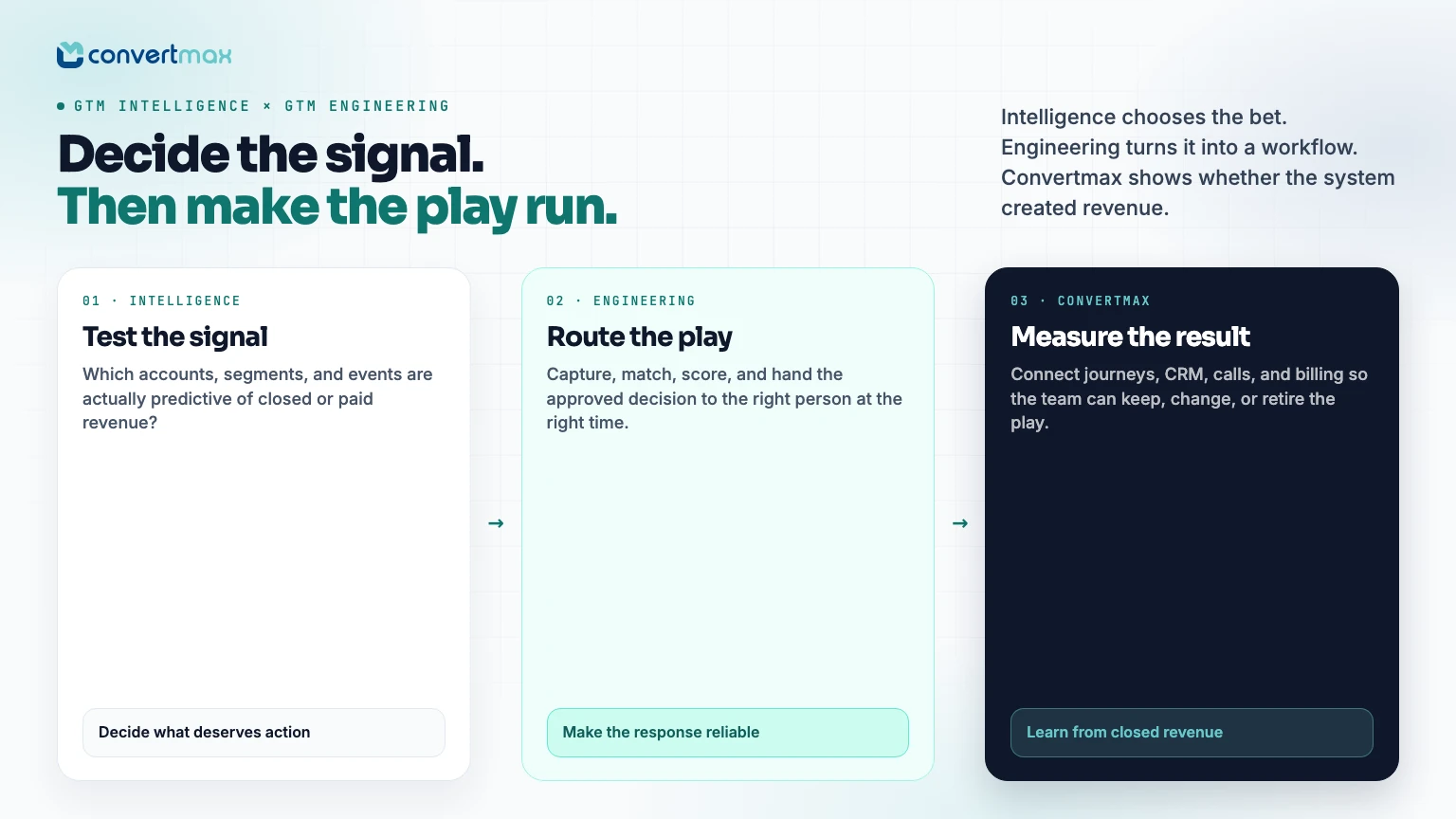
GTM Intelligence decides what the company should believe and prioritize. GTM Engineering turns that decision into repeatable execution. Convertmax connects the customer journey and revenue evidence that help both teams learn whether the system is working.
This distinction matters. When it is unclear, companies often make one of two mistakes: they automate a hunch before it has been tested, or they produce good analysis that never reaches a seller, marketer, or customer-success manager at the moment it could change an outcome.
The difference in one question
A simple way to separate the roles is to look at the question each one is responsible for answering.
GTM Intelligence asks: Which accounts, segments, signals, and commercial conditions are most likely to create a worthwhile outcome?
GTM Engineering asks: How do we capture that signal, apply the decision, route the work, and make the response reliable at scale?
The Intelligence team might find that mid-market accounts in a particular vertical are more likely to close when they show a recent compliance event and return to a high-intent page. The Engineering team might then build the system that identifies those accounts, enriches and deduplicates records, applies the approved score, creates the right CRM context, and routes a timely task to the correct person.
Neither role can carry the whole job alone. A model that cannot be used does not create value. An elegant workflow that acts on a poor model simply spreads bad judgment faster.
Why the two roles are easy to confuse
Both functions work at the intersection of data, systems, and revenue. Both may use SQL, CRM data, enrichment vendors, automation tools, and artificial intelligence. Both care about account scoring, segmentation, pipeline conversion, and data quality.
The overlap is real, but it is not the same work.
A GTM Intelligence lead is accountable for the quality of the commercial decision. They build and test ideal customer profile definitions, account and contact standards, intent and propensity models, segments, and market hypotheses. They should be able to explain why a signal entered the model, how the model performed on holdout data, where it fails, and whether it improves the chances of creating pipeline or revenue.
A GTM Engineer is accountable for the quality of the execution system. They connect tools, design data flows, automate enrichment and routing, build triggers, protect source-of-truth rules, and remove manual friction from repeatable revenue work. Their measure of success is not a well-documented workflow. It is faster response, cleaner handoffs, consistent action, and measurable commercial improvement.
Convertmax serves a different purpose from either function. It is a revenue intelligence platform that connects first-party journey data with CRM activity, calls, commerce, billing, and revenue events. That gives both teams a shared account of what happened before and after the team acted.
A practical division of responsibility
| Commercial problem | GTM Intelligence | GTM Engineering | Convertmax |
|---|---|---|---|
| Choosing target accounts | Defines ICP, segments accounts, tests fit and intent signals, and sets score logic. | Makes the approved score available in operating systems and keeps the data flow dependable. | Connects the buyer journey and downstream pipeline or revenue evidence used to evaluate the choice. |
| Testing a new buying signal | Designs the test, controls for segment effects, and measures lift, precision, recall, or calibration. | Captures the signal, joins it to the account record, and ensures it can be used in a workflow. | Shows the connected marketing, CRM, call, commerce, and revenue outcomes for accounts exposed to the signal. |
| Routing a high-priority account | Defines what qualifies as high priority and what information a seller needs to understand the recommendation. | Builds enrichment, deduplication, routing, alerts, task creation, and feedback capture. | Preserves the context behind the account journey and helps measure whether the route led to a better result. |
| Improving data quality | Sets standards, coverage requirements, and a remediation order based on commercial impact. | Implements validation, field mapping, identity rules, and monitoring in the operating stack. | Makes missing identities, lifecycle definitions, and revenue links visible in the end-to-end customer story. |
| Learning from the result | Decides whether to retain, change, or retire the model or hypothesis. | Adjusts the workflow after the decision and deploys the next version safely. | Connects activity to pipeline, paid revenue, and other agreed outcomes. |
The distinction is simple on paper. In a smaller company, one capable operator may cover both roles. In a larger organization, the work may sit across Revenue Operations, data, marketing operations, sales systems, or growth teams. The important point is that the decision-making loop and the execution loop need clear owners.
From a market signal to a revenue action
Consider a public-sector software company. Its GTM team notices that some agencies become more active after a budget approval, grant award, compliance review, or procurement notice. The company wants to know whether those events should change account priority.
Step 1: GTM Intelligence decides whether the signal is real
The Intelligence team does not begin by declaring every budget event a buying signal. It treats the event as a hypothesis.
The team defines the account population, documents the event source, checks data coverage, and compares accounts with the event against a suitable baseline. It looks at more than opens, clicks, and meetings. Did those agencies create qualified opportunities? Did they move through the sales process differently? Did they produce closed or paid revenue? Does the pattern remain after accounting for agency type, territory, solution, and sales coverage?
This is where a strong GTM Intelligence function earns its keep. It recognizes the difference between a signal that is interesting and one that is predictive. It uses holdout testing, backtesting, score-band analysis, and calibration rather than relying on a single anecdote from the field.
Convertmax can provide part of the evidence layer for that analysis. It connects the pre-conversion journey with later CRM and revenue events, so the team can see how accounts interacted with marketing, website content, calls, and sales activity before the commercial outcome. The warehouse or modeling environment remains the right place to run advanced statistical work, but a connected Revenue Graph makes that work more credible.
Step 2: GTM Engineering makes the approved signal usable
Suppose the signal survives the test. The next challenge is operational.
The GTM Engineer determines how the event enters the system, how it is matched to an account, what happens when records conflict, and which team should act. They may automate enrichment, set data-quality checks, trigger a score refresh, add a concise explanation to the CRM record, create an outreach task, or send the account to a particular territory queue.
The work needs restraint. A seller does not need a feed of raw procurement records. They need a useful prompt: this account meets the agreed fit threshold, a verified market event occurred, it has returned to a high-intent page, and similar accounts have historically produced qualified pipeline. Here is the owner. Here is the next step.
That is GTM Engineering. It turns approved commercial logic into a system people can rely on, rather than a slide deck, a spreadsheet, or a quarterly target list.
Step 3: Convertmax measures whether the play improved the outcome
Then the team needs to find out whether the system worked. Did the routed accounts receive faster follow-up? Did they create more qualified pipeline than similar accounts? Did the pattern hold through closed revenue? Which touchpoints influenced the result, and did a channel appear to create demand or merely claim credit after the fact?
Convertmax connects first-party customer journeys to CRM, calls, commerce, and revenue data so teams can examine those questions across the full path to a deal, purchase, or repeat customer. It is not the automation engine and it is not the scoring model. Its role is to make the commercial evidence less fragmented and the attribution more defensible.
That sequence matters: test the signal, operationalize the decision, then measure the result.
What breaks when one side is missing
The difference between these roles becomes most obvious when a company has only one of them.
When GTM Engineering runs ahead of GTM Intelligence
An engineering-oriented team can build impressive systems quickly. It can enrich accounts, write workflows, identify visitors, trigger outreach, and route leads in real time. But speed does not fix a weak strategy.
If the ICP is vague, account data is unreliable, or the score has never been evaluated against closed outcomes, automation can turn guesswork into a larger volume of activity. The workflow may appear successful because it produces tasks, sequences, or meetings. It may still be steering the company toward poor-fit accounts.
The remedy is not to slow down every build. It is to give each workflow an explicit commercial hypothesis and a measurement plan before it goes live.
When GTM Intelligence never reaches the operating system
The other failure mode is quieter. An intelligence team runs thoughtful analyses, produces useful segments, and identifies real patterns, but the findings are delivered in a report after the moment to act has passed.
A model that exists only in a notebook cannot improve speed-to-lead. A new segment definition will not alter outbound behavior until it changes routing, messaging, territory views, audience selection, or account prioritization. Insight without an execution path becomes research, not GTM intelligence.
The remedy is to treat GTM Engineering as a partner from the start. When the Intelligence team proposes a new signal or rule, it should also define what action changes if the evidence holds, who receives that action, and what feedback must return to the model.
When neither team has a trusted revenue view
There is a third problem: both teams may be doing good work against disconnected data.
Marketing sees clicks and form fills. Sales sees opportunities. Finance sees payments. Product sees usage. The GTM Engineer can make each local workflow more reliable. The GTM Intelligence team can improve its analysis within the records it has. Yet the company still cannot reliably say which acquisition sources, target signals, or commercial plays created customers and revenue.
Convertmax is meant to solve that measurement gap. Its Revenue Graph connects marketing, website, CRM, calls, commerce, billing, and revenue signals so a team can work from a connected account of how customers became revenue.
The operating model: intelligence, execution, measurement, learning
The most useful way to combine the functions is not to organize them around tools. It is to organize them around a recurring loop.
- Intelligence forms the hypothesis. Define the account pattern, market signal, or segment question worth testing. State the expected outcome and the conditions under which the signal should not be trusted.
- Engineering builds the play. Capture the required data, resolve identities, apply the decision rule, route the next action, and create a safe feedback mechanism.
- Convertmax connects the outcome. Tie the actions and touchpoints to pipeline, revenue, and other agreed business outcomes across the customer journey.
- The team learns and revises. GTM Intelligence interprets the result. GTM Engineering adjusts the workflow. Revenue Operations maintains the definitions, governance, and operating cadence around both.
Revenue Operations has an important role in this model. RevOps defines the shared operating rules: lifecycle stages, source-of-truth logic, data ownership, service-level expectations, KPI definitions, and the process for managing exceptions. GTM Engineering builds the machinery that makes those rules executable. GTM Intelligence brings the analysis that tells the company which rules and priorities deserve to change. That is the same split described in What is a GTM Engineer?.
This avoids a false choice between people and systems. A workflow needs human judgment behind it. A judgment needs a route into the workflow. And both require a reliable way to observe what happened once the work reached the market.
Where Convertmax fits, and where it does not
Convertmax sits between the operating systems a company already uses and the decisions the company needs to make. It connects first-party behavior, campaign and web activity, CRM records, calls, commerce, billing, and revenue so the customer journey can be evaluated against commercial results.
That makes it useful to both GTM Intelligence and GTM Engineering, but for different reasons.
For the Intelligence team, Convertmax provides a connected revenue outcome that can support validation of account signals, acquisition sources, segments, and targeting hypotheses. It can help the team look beyond a score, lead, or campaign result in isolation.
For the Engineering team, Convertmax provides the measurement context needed to assess whether a workflow or play changed the business outcome. It can show what happened before conversion, which touchpoints influenced the path, and where the journey appears to lose momentum.
But some responsibilities should stay outside the platform:
| Convertmax supports | The business still owns |
|---|---|
| Connected journey and revenue data | ICP design, scoring logic, statistical model selection, and validation standards |
| Revenue attribution and customer-path analysis | CRM architecture, permissions, automation rules, and source-of-truth governance |
| Evidence on channel, campaign, and play performance | The decision to launch, stop, or change a commercial motion |
| A shared view for Sales, Marketing, Finance, and leadership | Field enablement, accountability, coaching, and cross-functional change management |
This is not a narrow caveat. It is the right division of labor. Convertmax supplies a clearer view of how revenue is created. The GTM team decides what to do with that view and builds the operating system to carry it out.
Start with one decision that matters
A company does not need to redraw its whole GTM org chart to use this model. Start with one expensive question where the current answer is weak.
For example:
- Which account signals identify opportunities that become closed revenue, not merely meetings?
- Which inbound accounts deserve an immediate sales response, and which belong in a different motion?
- Which product-usage threshold should trigger a sales-assist play?
- Which campaign sources create customers with the strongest downstream value?
Choose one question. Define the hypothesis, the required signal, the owner, the execution path, and the revenue outcome that will determine whether the play was worth keeping.
GTM Intelligence and GTM Engineering are not competing titles for the same job. One improves the quality of the bet. The other makes the bet executable at scale. Convertmax helps both teams see the revenue trail that follows.
Explore Convertmax for RevOps and GTM teams or read what a GTM Engineer does.