By Elena Marsh
Convertmax Adds Subscription Revenue Intelligence
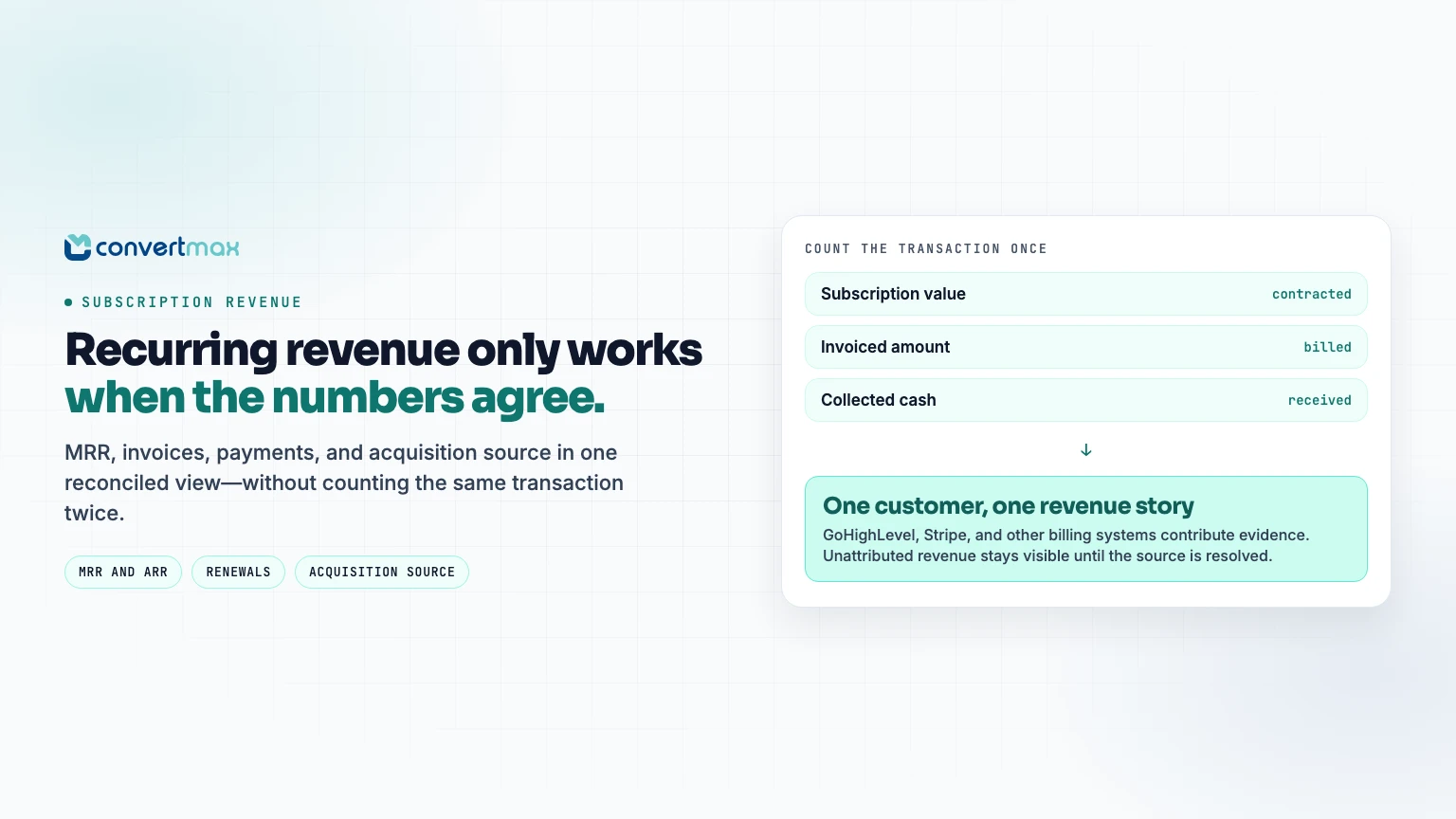
Recurring revenue is only useful when the numbers agree. That is harder than it sounds when subscriptions, invoices, payments, and customer records live across GoHighLevel, Stripe, and other billing systems.
Convertmax is adding subscription reporting for businesses that sell recurring services. The first release brings recurring revenue, customer relationships, payment activity, renewal timing, and acquisition data into one reporting experience.
It is built to answer the day-to-day questions that subscription businesses actually have: What recurring revenue exists right now? Which customers need attention? When are renewals and cancellations due? And where did the revenue come from?
A current view of subscription health
The new reporting gives teams a practical picture of their subscription position today. They can see:
- Monthly recurring revenue (MRR) and annualized recurring revenue (ARR)
- Revenue-generating customers and active subscriptions
- Payment issues that need attention
- Upcoming billing activity
- Explicit renewal dates and scheduled cancellations
- Current recurring revenue by acquisition source
- Unattributed revenue that still needs a source relationship
That last point matters. When a revenue record has no clear source, it should not quietly disappear into an “other” bucket. Convertmax keeps it visible so the relationship can be resolved.
Reporting that starts with the customer and subscription
The reporting is organized around the Customer and Subscription relationships already present in Convertmax. Connected systems contribute evidence to those relationships rather than creating a new customer, subscription, or revenue record for every event they send.
This gives the report a stable center. A customer can appear in GoHighLevel, Stripe, and another billing system, but the business should still be able to understand that person as one customer with one set of related subscription activity.
Reconcile the transaction before counting the revenue
Revenue reconciliation is a major part of the release.
A GoHighLevel subscription, Stripe subscription, invoice, and payment can all describe the same underlying transaction. Convertmax is designed to recognize that relationship and count the activity once.
The measures remain deliberately separate:
| Measure | What it represents |
|---|---|
| Subscription value | The recurring value associated with the subscription |
| Invoiced amount | The amount billed to the customer |
| Collected cash | The payment actually received |
Keeping these measures apart prevents two common reporting errors. A recurring payment does not inflate MRR, and a payment retry does not become a second sale. The result is a cleaner reading of what is contracted, what has been billed, and what has been collected.
Honest coverage from the first connection
A newly connected source can show its current subscription position immediately. Historical retention metrics are different: they remain unavailable until enough reliable history has accumulated.
That distinction is intentional. A partial data set can make a report look more complete than it is, particularly when retention and churn are involved. Convertmax keeps historical coverage visible, so teams can use the current data without mistaking it for a mature retention history.
What comes next as history builds
As historical snapshots accumulate, Convertmax will add reporting for:
- 30-, 60-, and 90-day retained MRR
- MRR movement waterfalls for new business, expansion, contraction, churn, and reactivation
- Retention cohorts
- Deeper customer-level subscription timelines
Explore the Convertmax platform or review the current integrations to see how subscription reporting fits the rest of the revenue stack.