By Elena Marsh
What Convertmax Does for RevOps Teams
Revenue Operations has a hard assignment. The team is expected to help Sales, Marketing, Finance, Product, and Operations work from the same view of the business, even though each function lives in different systems. Web analytics shows visits. Ad platforms show clicks. The CRM shows contacts and deal stages. Billing shows payments. None of those tools, on its own, tells the whole revenue story.
That is where Convertmax fits.
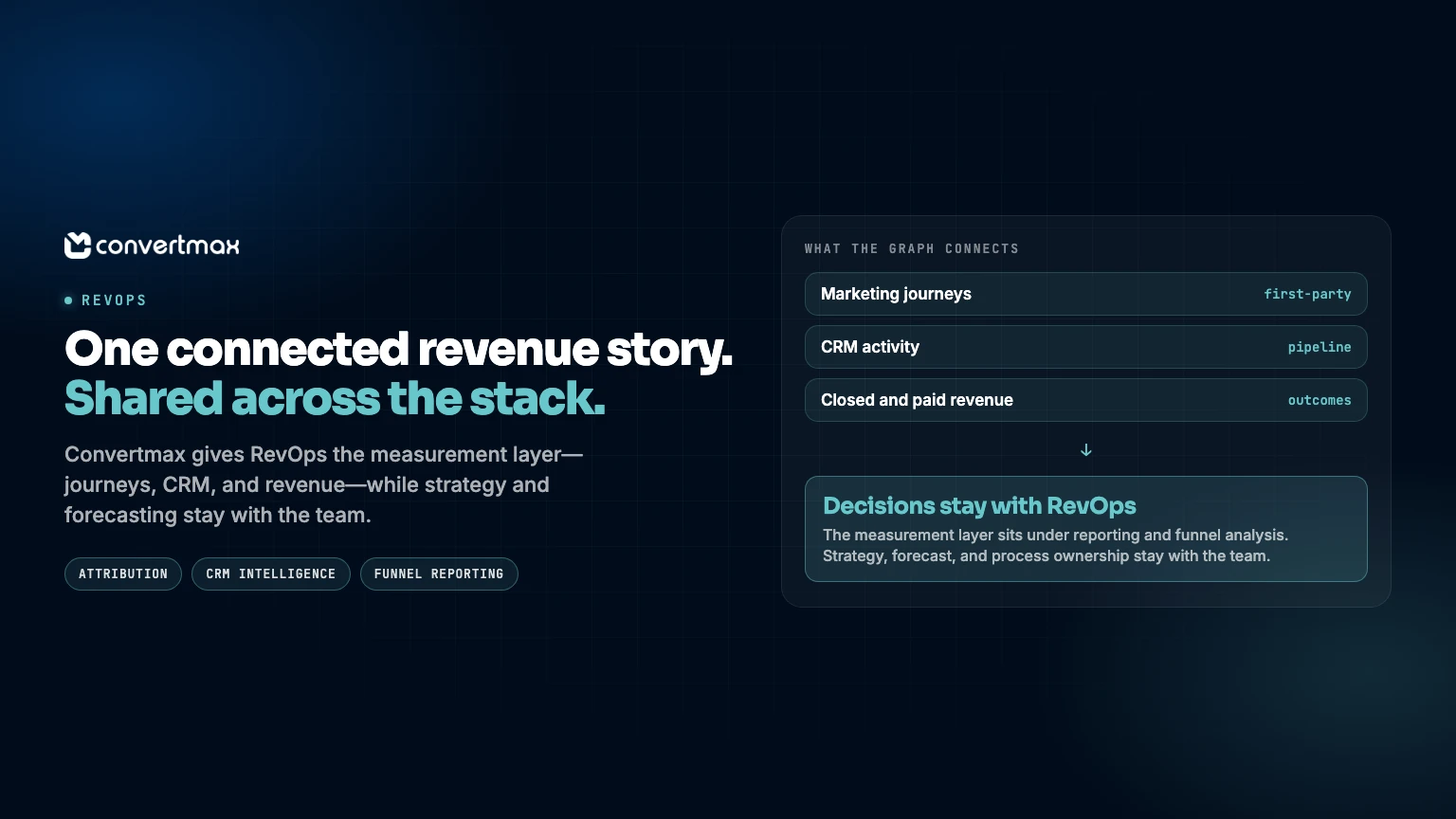
Convertmax is a done-for-you revenue attribution and intelligence platform. It connects first-party customer journeys with CRM activity, calls, commerce, and revenue events, so teams can see how a buyer moved from first touch to closed or paid revenue. For a RevOps team, it supplies the measurement layer behind reporting, funnel analysis, and channel decisions. It is not a replacement for the people who set strategy, own the forecast, or keep the revenue engine running.
The short version: Convertmax directly supports attribution, journey reporting, CRM intelligence, and revenue analysis. It enables better RevOps decisions, but it does not take over RevOps strategy, forecasting, process ownership, or cross-functional leadership.
The real RevOps issue: the data does not travel together
Most go-to-market systems are perfectly capable within their own boundaries. The problem appears when someone asks a question that crosses those boundaries.
Take a closed-won deal. A prospect may have first arrived through paid search, returned later through an organic page, completed a form, booked a call, and then closed after a sales conversation. The ad platform may claim the conversion. Analytics may report a different source. The CRM only sees the deal after the lead is known. Finance sees the payment later still.
RevOps gets stuck reconciling the story after the fact.
Convertmax is designed to connect those events in a Revenue Graph. It keeps the relationship between marketing activity, web behavior, CRM records, conversations, commerce, and revenue intact. First-party tracking and identity stitching help tie an early anonymous visit to a later known contact and the eventual revenue outcome.
That does not eliminate the need for RevOps. It gives RevOps a cleaner foundation for the work that matters.
How Convertmax maps to core RevOps responsibilities
The useful distinction is between what software can measure and what a RevOps team must decide, design, and lead.
| RevOps responsibility | How Convertmax helps | What remains with RevOps |
|---|---|---|
| Develop and implement full-funnel revenue strategy | Connects campaigns, pages, calls, CRM activity, and revenue so teams can see the path to purchase. | Set market priorities, choose the revenue motion, allocate resources, and make the trade-offs. |
| Own reporting, forecasting, and KPI dashboarding | Supports reporting and KPI analysis with connected journey, pipeline, and revenue data. | Define KPIs, targets, forecast categories, review cadence, and the formal forecast model. |
| Optimize the CRM and tech stack, including HubSpot and BI tools | Syncs HubSpot revenue data, supports optional attribution writeback, and exports to BigQuery or Microsoft Fabric. | Own CRM architecture, permissions, automation rules, data governance, and workflow design. |
| Run growth experiments and funnel initiatives | Makes it easier to see campaign ROI, conversion paths, drop-off points, and the sources behind valuable customers. | Design the test, choose the treatment, set the decision rule, and carry out the rollout. |
| Work across Sales, Product, Finance, Operations, and Marketing | Creates a shared, evidence-based view of how activity becomes pipeline and revenue. | Set agreements, manage handoffs, resolve conflicts, and lead change across the business. |
The point is not to automate a RevOps role out of existence. The point is to stop making skilled operators build their revenue view from exports, screenshots, and competing platform reports.
1. Make full-funnel strategy measurable
A revenue strategy needs a feedback loop. Without one, it is easy to optimize for numbers that look good early in the funnel but do not turn into meaningful revenue. Lead volume can go up while pipeline quality goes down. A campaign can drive low-cost traffic that never gets past a sales conversation.
Convertmax collects first-party session and campaign data, connects the relevant CRM, commerce, and call systems, then applies multi-touch attribution to revenue outcomes. RevOps can use that view to ask the questions a channel report alone cannot answer: Which channels influence customers who close? Which pages help create qualified demand? Where do prospective customers disappear? Which acquisition sources produce higher-value customers?
That can be especially useful when a company is expanding into a new region or launching a new motion. Convertmax will not pick the market or create the go-to-market plan. It can, however, give the team the same revenue lens across channels and campaigns. The difference between attention and actual commercial traction becomes much easier to see.
2. Improve reporting without pretending attribution is forecasting
RevOps reporting should explain what happened and help the next decision happen faster. A collection of disconnected dashboards usually falls short on both counts.
Convertmax brings campaign, channel, page, CRM, call, commerce, and revenue signals into the same attribution model. Its reporting is built to show the touchpoints influencing sales and to connect marketing activity to pipeline, orders, invoices, and payments, based on the sources a team has connected.
But there is a boundary worth keeping clear: attribution reporting is not forecasting.
Convertmax can make the inputs to a forecast more reliable. It can show historical conversion patterns, channel quality, revenue events, and points of funnel leakage. RevOps still needs to define forecast categories, account for opportunity risk and seller judgment, set targets, and own the operating rhythm. A planning model or BI environment may remain the home of the official forecast.
That is not a limitation to hide. It is the correct division of labor.
3. Add a revenue-intelligence layer to HubSpot and the broader stack
For many revenue teams, HubSpot is the operational home of the customer record. It should stay that way. Convertmax is designed to complement HubSpot, not replace it.
The HubSpot integration syncs contacts, closed-won deals, and Revenue Hub objects such as quotes, invoices, payments, subscriptions, and line items. It can stitch the hubspot_contact_id to first-party sessions and campaign data. When attribution writeback is enabled, it can send first-touch and last-touch data, UTM history, attributed revenue, and touchpoints back to HubSpot contact and deal properties.
That gives Sales useful journey context in the CRM, while RevOps and Marketing get a fuller view of how quote-to-cash activity relates to the marketing that preceded it. A deal record does not have to be the first point at which the buyer story becomes visible.
Convertmax also supports exports to BigQuery and Microsoft Fabric for warehouse and BI workflows. It offers Make.com as a bidirectional automation option, alongside webhooks for particular sources and integrations.
The RevOps team still has the important work. It decides which fields are authoritative, what should be written back, how lifecycle stages are defined, and which automations should be allowed to change a record. Software can move data. Someone still has to make the system sensible.
4. Give growth experiments a revenue-grade readout
A landing page can improve its conversion rate and still hurt the business if the additional conversions turn into poor-fit leads. The same thing can happen when a campaign is evaluated on form fills rather than pipeline or paid revenue.
Convertmax helps teams look past the first visible metric. The platform is built to show which campaigns generate pipeline, which channels close customers, which pages convert, which touchpoints influence sales, and where customers drop out. Because the events are tied to the same journey and revenue outcome, a team can evaluate an experiment against business results rather than click-through rate alone.
It does not run the test. It does not choose the headline, build the audience, or decide when to roll out a change. What it does provide is a much less foggy readout once the experiment is underway.
5. Give cross-functional teams one revenue story
Good RevOps does not require every team to use the same software. It requires people to make decisions from facts that fit together.
Finance needs paid-revenue visibility. Sales needs deal and conversation context. Marketing needs a defensible view of channel performance. Product and Operations need to understand where customers find friction. When those functions are looking at unconnected systems, alignment can turn into a debate about whose number is correct.
Convertmax connects the customer journey to those revenue signals in a single reporting layer. Teams using HubSpot can make attribution context available on contact and deal records. Teams with a warehouse can export event, contact, and revenue data to BigQuery or Microsoft Fabric for wider analysis.
The platform will not schedule the meeting, write the service-level agreement, or fix a broken handoff. That remains RevOps work. But it can give those conversations a common starting point: a connected account of what happened before revenue was created.
A sensible division of responsibility
Convertmax delivers the analytical foundation. RevOps owns the operating model built on top of it.
| Convertmax provides | RevOps owns |
|---|---|
| First-party journey tracking and identity resolution | Lifecycle definitions, revenue processes, and data governance |
| Multi-touch attribution across campaigns, calls, CRM, commerce, and revenue | Attribution policy, decision rules, and the handling of exceptions |
| Reporting on channel performance, customer journeys, pipeline, revenue, and conversion paths | KPI selection, executive reporting, targets, and forecast methodology |
| CRM intelligence, optional attribution writeback, warehouse exports, and selected automation paths | CRM design, automation logic, permissions, data quality, and change management |
| Evidence for finding funnel leakage and assessing channel quality | Experiment prioritization, execution, and rollout decisions |
The best first step is not to create a larger dashboard. Start with a meaningful question, such as: Which acquisition sources create paid revenue, not merely leads? Connect the systems needed to answer it. Validate identity keys, lifecycle definitions, and revenue events before the results make their way into executive reviews.
Once that first revenue story is trusted, the reporting can grow with it.
Convertmax is not the RevOps function. It makes the function more effective.
RevOps is a people-and-process discipline. Convertmax is analytical software that makes the data part of the discipline more useful.
For teams responsible for revenue operations, it can be the first-party attribution and revenue-intelligence layer across customer journeys, CRM records, calls, commerce, and revenue. That helps the team report with more confidence, investigate funnel performance, connect HubSpot to revenue outcomes, and give stakeholders a more defensible view of what is working.
The team still sets the strategy. It still owns the forecast. It still decides how Sales, Marketing, Finance, Operations, and Product will work together. Convertmax helps those decisions begin with a clearer picture of how the company creates revenue.
Explore the Convertmax platform or review the current integrations to see how it can fit your revenue stack.