By Cole Brennan
Your AI Can Connect to Your Tools. Does It Understand Your Revenue?
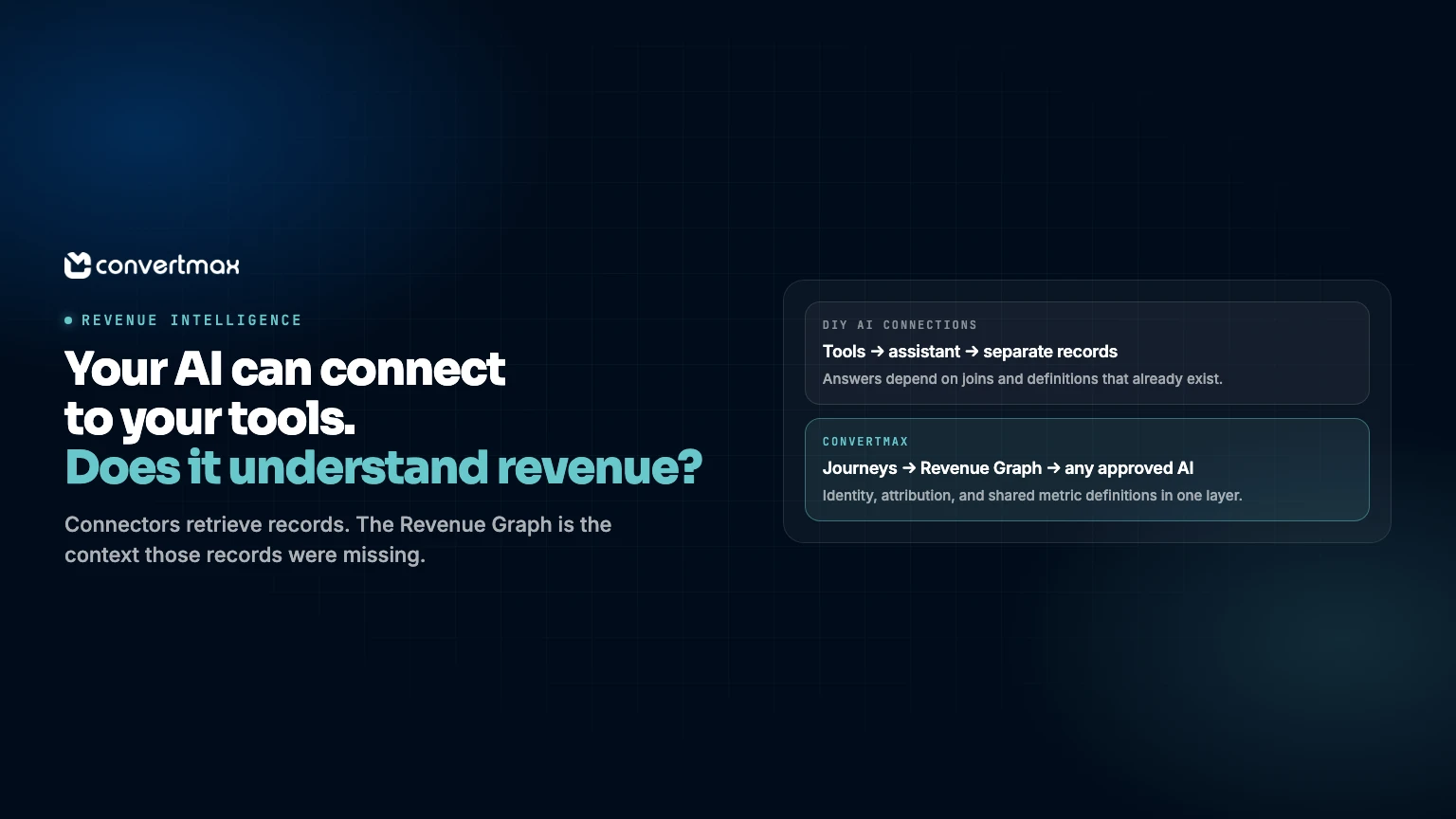
Connecting ChatGPT or Claude to your CRM is a reasonable plan. The connectors are getting easier. A model can already look up a contact, read a deal, and summarize a Stripe customer.
That answers a different question from the one revenue teams actually have.
Access to records is one job. An understanding of revenue is another.
An assistant wired to separate tools can retrieve what each system already stored. It can join those records when the identity, the journey, and the metric definitions already exist. Convertmax is that layer: a Revenue Graph that connects marketing, sales, commerce, and billing, then makes the same context available to Max, ChatGPT, Claude, or another approved agent.
MCP connects tools. It does not define revenue.
The Model Context Protocol is a way for an assistant to reach a system. It is a connection protocol. A revenue intelligence system is a different product.
A connector does not, on its own, resolve customer identity, attribute a sale across a weeks-long journey, recover tracking that was never captured, or reconcile a CRM amount with an invoice. More connectors add more records. The relationships among those records are a separate piece of work.
| Capability | Connecting AI tools yourself | Convertmax |
|---|---|---|
| First-party tracking | The assistant reads whatever was already captured | Journeys and events are captured before they disappear |
| Customer identity | The assistant infers who belongs with whom | The Revenue Graph connects known identities to observed journeys |
| Attribution | You supply the model and the rules | Multi-touch attribution is built in |
| Revenue reconciliation | Each system can report a different number | Marketing and sales activity ties to revenue outcomes |
| Metric definitions | The same metric can be interpreted differently each time | Shared definitions govern how records are joined |
| Sales questions | Custom prompts against the CRM | Sales and revenue analysis across the connected journey |
| AI interoperability | A connector to maintain for every assistant | The same revenue context for approved AI clients through MCP |
What you get still depends on the systems you connect, the quality of that data, and the plan you are on.
AI cannot analyze a journey that was never recorded
Picture a company using HubSpot, Google Ads, call tracking, and Stripe.
A customer:
- Finds the business through a Google ad.
- Comes back three weeks later through organic search.
- Calls.
- Talks with two sales representatives.
- Signs a $12,000 contract.
- Starts a $500 monthly subscription.
Ask Claude which marketing campaign generated the most valuable customers.
With separate connections, Claude may retrieve the campaign, the call, the CRM deal, and the Stripe subscription. Treating those records as one customer, judging whether the original campaign influenced the sale, and keeping the $12,000 contract distinct from later subscription revenue all depend on work that has to exist before the question is asked.
That work is first-party tracking, journey relationships, attribution, and a revenue model. The assistant then reasons over a foundation that is already there. A chat window on disconnected data has nothing to reconstruct if the path was never stored.
The Revenue Graph is the part worth paying for
A general-purpose model reasons well over information it can see. A durable record of how customers become revenue is a system of its own.
The Revenue Graph connects touchpoints, people, conversations, opportunities, orders, and revenue. The semantic layer defines how those entities are joined and how metrics are named.
Questions like these then share one set of definitions:
- Which acquisition sources produce customers with the highest lifetime value?
- Are the strongest salespeople receiving better leads, or converting similar leads more effectively?
- Which campaigns produce customers who renew?
- Did revenue fall because of lead quality, sales execution, or churn?
- Which marketing investments influenced paid revenue, past the conversions they produced?
Max can discuss those questions. Other models can too, once they can see the same graph. The advantage is the connected, defined data under the answer.
Keep the AI you already use
Keep Claude or ChatGPT. Convertmax is the revenue context they can share with Max and with the agents you already run.
MCP, APIs, and warehouse export are ways to take that context with you. Max stays useful because it is built on the graph. The other tools get more useful because the joins and definitions are already decided.
Connecting AI to your business data is easy. Making that data tell the true story of your revenue is the hard part. That is what Convertmax does.
When connecting tools yourself is the better choice
A company that already runs a mature warehouse, reliable identity resolution, event tracking, modeled metrics, and AI connectors may have this layer already. An internal stack can be more specific to that business.
Convertmax fits when revenue depends on several systems and the team still cannot explain, with confidence, how a customer became revenue.
| Customer | Fit |
|---|---|
| Small business with one CRM and clean data | Low to moderate |
| Agency managing several client systems | High |
| B2B company with a long sales cycle and many touchpoints | High |
| Ecommerce business connecting acquisition to repeat purchases | High |
| SaaS company with a CRM, billing, and subscriptions | High |
| Enterprise with a mature analytics team and its own semantic layer | Depends on what Convertmax adds |
The strongest fit is a business that runs across tools and still cannot trace a sale back to the activity that created it.
The cost comparison usually leaves out the expensive part
A ChatGPT or Claude subscription can look like $20 to $100 a month. That price covers the assistant. Pipelines, identity matching, attribution, metric definitions, and access control sit outside it. Those are the expensive parts, whether a team builds them or buys them.
Convertmax plans are $249, $599, and $1,199 a month. Every plan includes first-party analytics, multi-touch attribution, conversion tracking, and Ask Max. Growth and Pro add a Daily or Weekly Brief.
A business spending $30,000 a month on advertising covers a $599 plan if better measurement helps it stop about 2% of spend that was not producing revenue. That is a scenario, not a forecast. The savings show up when the measurement is accurate and someone changes the spend.