By Elena Marsh
Max Is the AI Harness Built on the Revenue Graph
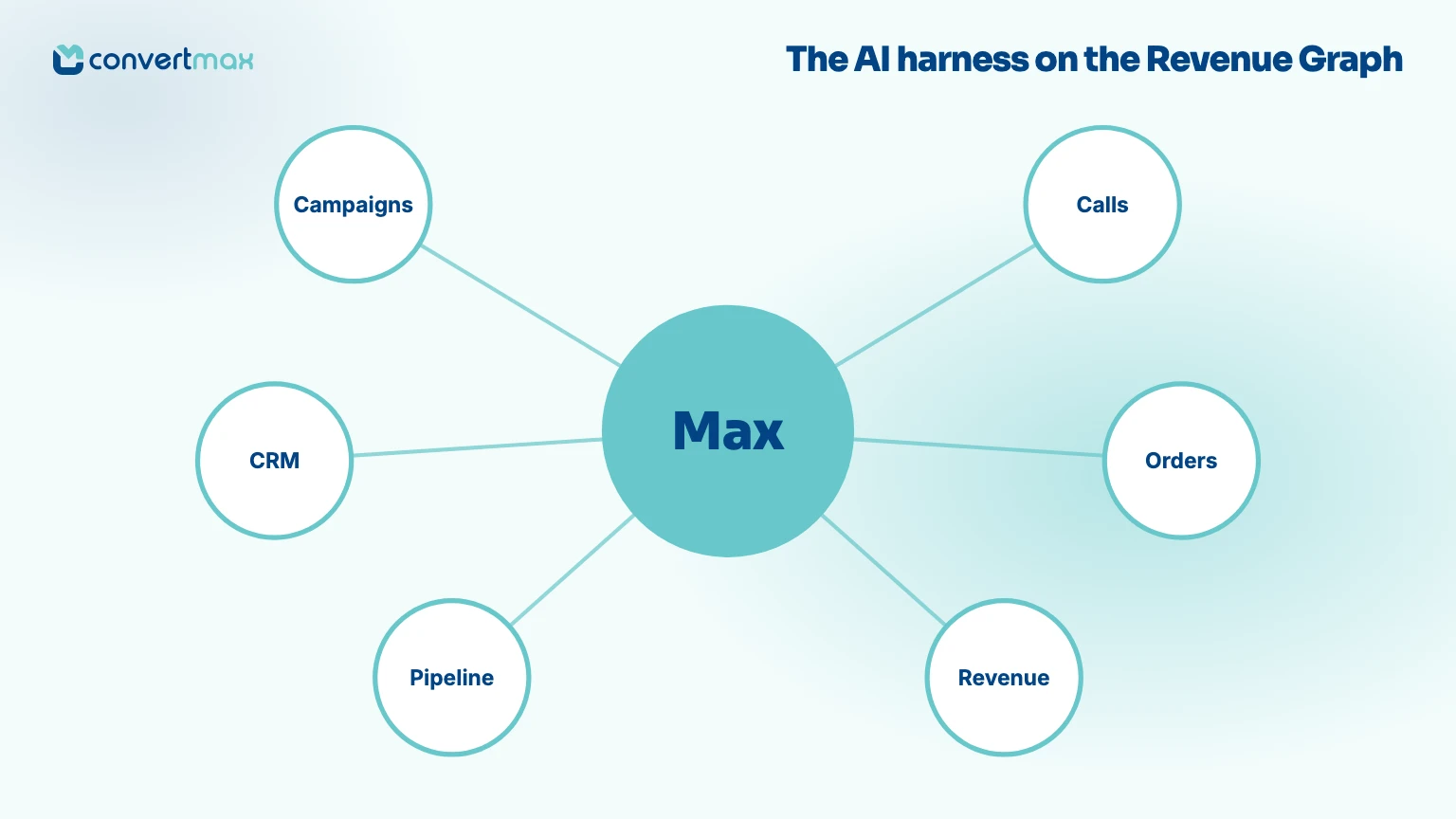
There is no shortage of AI assistants. Most can summarize a spreadsheet, answer a question about a dashboard, or offer a recommendation from a CSV.
That is not what Max is.
Max is the AI harness built on the Convertmax Revenue Graph. It turns connected customer, touchpoint, and revenue data into investigation, signal detection, and decision-ready answers.
The distinction is worth making. An assistant is usually defined by its interface: a chat box, a prompt, an answer. A harness is defined by the system it connects and the work it enables. Max does not sit beside revenue data as a generic AI layer. It works from the graph that connects how a customer became revenue.
So when a growth team sees a number move, Max can help take them from “revenue changed” to “what changed, where did it happen, and what needs attention?”
An assistant is an interface. A harness is a working system.
Calling Max an AI assistant is not inaccurate. Teams can ask it questions in plain language, keep a conversation going, and investigate a result without moving among reports.
But that label stops too early.
Generic assistants start with whatever data they are given. The routine is familiar: export a report, upload a file, explain the columns, hope the relevant context made it through, then interpret the reply yourself. The answer may be polished. It might even help. The connections behind the numbers are usually gone.
Revenue decisions rely on those connections. A click is not revenue. A lead is not revenue. A call, a demo, an opportunity, an order, and a payment are not separate facts either. They are parts of one journey. If a team wants to understand what created an outcome, that journey has to stay connected.
The Revenue Graph is that foundation. Convertmax brings together first-party journeys, CRM activity, calls, commerce, billing, and revenue events, preserving the relationships among touchpoints, people, conversations, opportunities, orders, and revenue.
Max is the harness built on top of it.
The Revenue Graph gives Max what a generic AI tool is missing
AI is only as useful as the context it can use. Access to a table is not the same as understanding a business.
The Revenue Graph gives Max the connections that matter when a revenue question gets specific:
- A campaign can be examined alongside the visits, leads, calls, pipeline, customers, and revenue connected to it.
- A conversion change can be viewed with the channel mix, time period, and journey steps around it.
- Revenue can be investigated as the outcome of related activity, not as a total pulled from a dashboard.
- Attribution can follow the full customer journey instead of giving every question a last-click answer.
This does not turn every pattern into a cause. Nor should it. Max surfaces the relevant evidence, comparisons, and relationships so a team can start an investigation on firmer ground.
That is a better job than giving fluent answers about disconnected exports.
What the harness does
Max makes the Revenue Graph useful in the normal rhythm of revenue work: notice a change, ask a question, follow the evidence, decide what to do.
It makes connected data conversational
With Ask Max, teams can ask about attribution, campaigns, conversions, and revenue in plain language. Responses come from the selected Convertmax property, not from a generic knowledge base. And follow-up questions keep their context, allowing an investigation to become more precise rather than forcing the team back to the first prompt.
“Why did paid revenue decline this week?” is rarely just one question. It becomes a string of them. Which channels moved? Which campaigns account for the difference? Did conversion rates change? Was the shift in traffic, pipeline, or close rate? The harness keeps the thread tied to the Revenue Graph while the team works through it.
It makes revenue changes visible before somebody goes looking
The other side of the harness is the Max Brief. Daily or Weekly Briefs watch for meaningful changes in revenue, conversion, campaign performance, channel mix, and search activity, then rank the signals that deserve attention.
Most teams do not miss an insight because they lack a chart. They miss it because no one knew where to look until the weekly meeting. By then, the budget has already moved, or the problem has had another five days to grow.
A Brief does not replace judgment. It gives the team a better opening move: here is what moved; here is the comparison; now ask why.
It keeps the decision-maker in charge
A harness is not an autopilot. Max is a read-only analytics experience. It does not modify customer data or execute changes in connected systems.
That boundary is intentional. Growth teams need faster answers and earlier signals, but choices about budget, creative, sales process, and operations still belong to people. Max helps a team reach a defensible decision faster. It does not pretend to make the decision for them.
One Revenue Graph. Different revenue playbooks.
Max should not be framed as AI for DTC ecommerce with a few extra integrations. A short purchase path and a Shopify order are one revenue motion. Many businesses run a very different one.
The same Revenue Graph can support different playbooks because it holds the relationships that each business actually uses to create revenue. The outcome is different. The journey is different. The question Max needs to help answer is different too.
| Business model | What the Revenue Graph connects | The Max playbook |
|---|---|---|
| B2B SaaS | Anonymous research, campaigns, trials, product activity, buying groups, CRM stages, closed-won revenue, and expansion | Find the sources that create qualified pipeline and durable revenue, not just low-cost signups. Investigate trial-to-opportunity conversion, sales-assisted paths, and expansion by acquisition source. |
| Agencies | Client-specific ads, websites, CRM records, calls, orders, invoices, and revenue across different client stacks | Give each client a defensible revenue story. Surface the change that matters, trace it to campaigns and journeys, and support a conversation about spend, performance, and next actions. |
| Home services | Clicks, calls, booked jobs, estimates, CRM outcomes, invoices, and paid revenue | Show which campaigns and local landing pages create calls that become completed, paid jobs. Separate lead volume from the work that actually closes. |
| Hybrid commerce | Digital acquisition, online orders, sales conversations, assisted purchases, subscriptions, repeat buying, and lifetime value | Connect the online and offline parts of a customer relationship so teams can see which demand creation produces initial and repeat revenue. |
The terms change, but the principle stays put: Max needs the business's real revenue logic, not a generic ecommerce template.
For a B2B SaaS company, a useful conversation may start with declining trial volume and end with account-level research, qualified pipeline, and expansion. B2B buying journeys can span weeks or months, involve several people, and include sales activity that never exists in a checkout flow. See the B2B attribution guide.
For an agency, the question is often client-facing. Which campaign created paid revenue? Where did a client's pipeline slow? What changed since the last report? The harness should make it easier to start with one signal and follow it through the connected data, even when clients use different CRMs, storefronts, and billing systems. Convertmax already positions agency reporting around that kind of revenue evidence.
For a home-services operator, the journey may start with a search ad and end after an inbound call, a scheduled estimate, a completed job, and a paid invoice. Calls need to be treated as part of the revenue path, not as an offline exception. The question is not only what happened on the call, but what marketing caused the call that became revenue.
And hybrid commerce is increasingly normal. A customer may discover a brand online, speak with a sales team, buy through a storefront, renew on a contract, or come back for another purchase. Treating that business like a pure DTC checkout leaves too much of the story out.
That is why Max needs cross-business playbooks. Not canned prompts. Playbooks that reflect the metrics, stages, and decisions of the revenue motion in front of it.
The revenue context should be portable
There is another part of the harness idea that matters just as much: the customer's revenue context should not be trapped inside Max.
The Revenue Graph is assembled from a company's first-party customer, journey, and revenue data. That connected understanding belongs to the customer. Convertmax's role is to make it useful, not to turn it into a closed box.
Max should be the best place to investigate the Revenue Graph, not the only place a customer can use it.
That requires portability through three surfaces:
- MCP: Make the revenue context available to approved AI tools and agents through the Model Context Protocol, so teams can bring graph-grounded context into the AI environment where they already work.
- APIs: Let internal tools, workflows, and customer-built applications retrieve the revenue intelligence they need without copying reports by hand.
- Warehouse exports: Give data teams a practical route to keep the connected revenue model in their own warehouse, where it can be combined with the rest of the business's data estate.
This is not a side feature. It is a product principle.
Convertmax already describes its infrastructure as API-first and warehouse-ready, while building its attribution model from first-party data and connected source systems. MCP, APIs, and exports extend that same logic: the customer should retain control over the context that explains how its business creates revenue.
Portability does not mean unbounded access. Revenue context contains information that deserves care. The right model is governed access, clear permissions, and customer control over what flows to which system. But a customer should not have to choose between better revenue intelligence now and control of its data later.
A portable Revenue Graph also makes Max more valuable. It lets Max fit into the operating system a business already has: the warehouse, the CRM, the finance stack, a custom internal tool, or an approved AI workflow. The graph remains the source of context. Max is the harness that helps teams work with it.
Why this distinction matters
The phrase “AI assistant” makes people judge Max as if it were a standalone chat feature. They ask whether it can summarize data, answer a few questions, or produce a report. Those are helpful capabilities. They are not the point.
The better question is: what revenue understanding does Max have access to, how does it apply that understanding to this business, and who controls it?
When Max is the AI harness for the Revenue Graph, the difference is straightforward:
| It is not | It is |
|---|---|
| A generic chatbot placed next to analytics | An AI system grounded in connected first-party journey and revenue data |
| AI for a single DTC checkout motion | A set of business-aware playbooks for SaaS, agencies, home services, and hybrid commerce |
| A one-off answer to a prompt | A continuing path from signal to question to investigation |
| A replacement for judgment | A faster way to assemble the evidence behind a judgment |
| A closed destination for revenue data | A portable layer that can be used through MCP, APIs, and warehouse exports under customer control |
This puts the emphasis where it belongs: outcomes. Max matters because it helps teams understand what created revenue, what changed, and what calls for action. The chat interface is simply one way into that work.
Put Max on your Revenue Graph
A team should not have to piece together clicks, calls, CRM activity, orders, and billing data every time a number moves. Convertmax connects the journey. Max makes that connected understanding usable when the next question arrives.