By Elena Marsh
Unified Conversion Protocol (UCP): The Event Contract Behind Convertmax Attribution
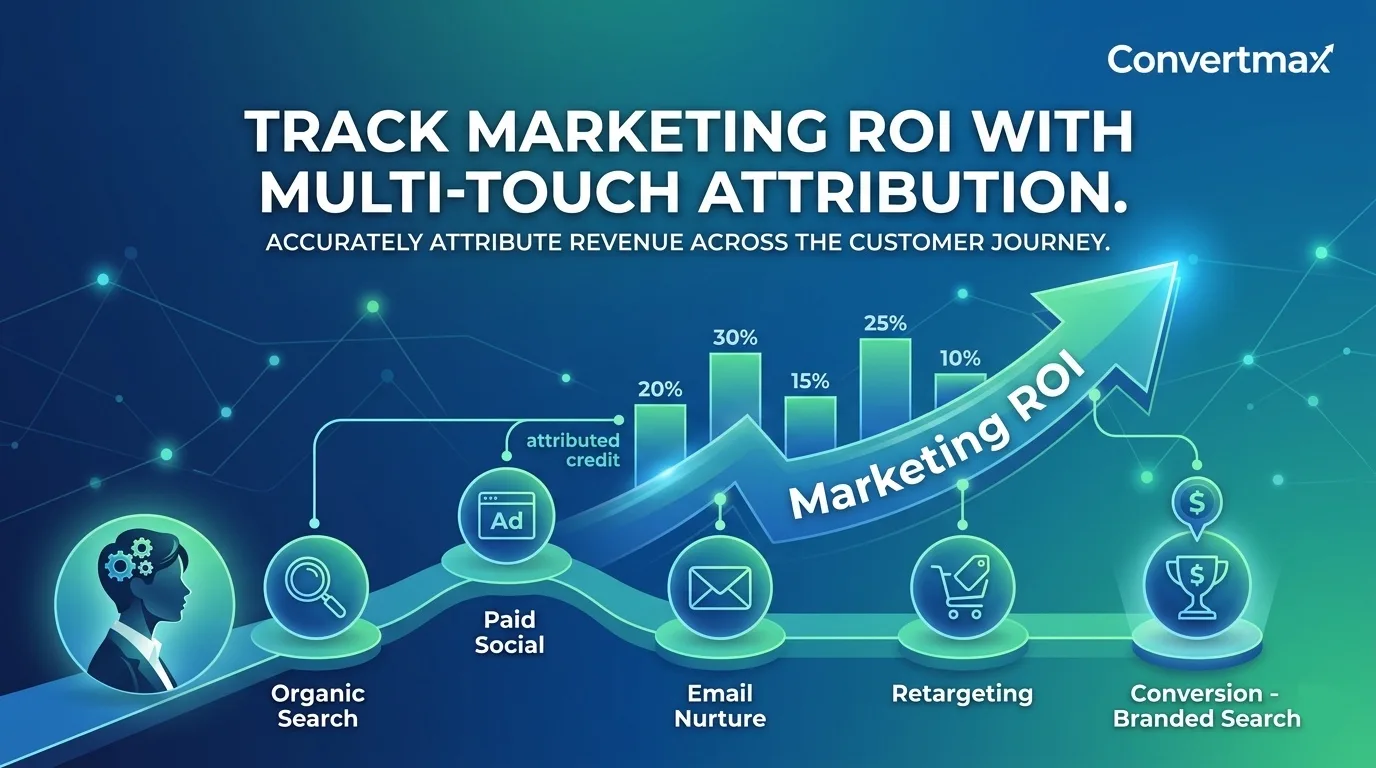
Every revenue tool invents its own idea of a “conversion.” Google Ads counts a click-driven action inside an attribution window. A CRM counts a stage change. Call tracking counts a connected call. Shopify counts an order. Product analytics counts an activation event. Leadership asks a simple question—*what created revenue?*—and receives five incompatible answers.
Convertmax Unified Conversion Protocol (UCP) is the first-party event contract that makes those answers comparable. UCP does not replace your CRM or ad accounts. It standardizes how touchpoints, convert events, and revenue outcomes are expressed so multi-touch attribution, journeys, and agentic commerce measurement share one model on the platform.
The problem: competing conversion dialects
| System | Typical “conversion” | Missing for revenue truth |
|---|---|---|
| Ad platforms | Pixel/API event in a lookback window | Neutral identity; closed revenue; assists outside the window |
| Web analytics | Goal / key event | CRM and billing outcomes; call paths |
| CRM | Lead created / opportunity won | Pre-CRM marketing journey |
| Call tracking | Call connected | Downstream opportunity quality and revenue |
| Commerce | Order paid | Full-funnel assists and anonymous research |
| Product analytics | Signup / activation | Acquisition source and attributed revenue |
Without a shared contract, teams reconcile dialects in spreadsheets—or they pick one vendor’s definition and pretend the others do not matter.
What UCP standardizes
UCP is a convert contract: a consistent way to say *who* did *what*, with *what context*, and optionally *what revenue* followed.
Conceptual fields (methodology-level—not a public OpenAPI for private product APIs):
| Concept | Role |
|---|---|
| Identity keys | Anonymous session ID, person/contact keys, account keys when known |
| Convert type | Form, call, opportunity stage, order, custom business outcome |
| Timestamp & sequence | Ordering for multi-touch models |
| Campaign / channel context | Source, medium, campaign, content, page, click IDs when present |
| Product / offer context | SKU, plan, package when relevant |
| Revenue outcome | Amount, currency, pipeline vs collected revenue semantics |
| Agentic metadata | Flags/context for agent visits vs human AI-assisted demand |
| Provenance | Which system emitted the convert (web, CRM, call, commerce) |
Human conversions stay on the standard path. Agent discovery and AI-assisted demand use explicit fields so crawler noise never silently inflates revenue metrics—see Agentic Commerce.
Data flow: first-party web to systems to attribution graph
Sources that emit into one normalized stream:
- Owned web/app first-party events (including form and checkout converts)
- Call tracking converts
- CRM stage and closed-won converts
- Commerce/billing order and invoice converts
- Product activation and expansion converts
Those UCP-normalized converts land on one identity profile, then feed multi-touch models and Revenue Graph reporting.
Methodology steps
- Inventory convert types that matter for decisions (not every button click).
- Map each system’s native event to a UCP convert type and required context fields.
- Choose identity keys for joins (email, CRM ID, commerce ID, call ID).
- Emit converts at the moment of truth — when the business outcome happens, not when a weekly CSV lands.
- Attach campaign context on the convert when known; otherwise inherit from the resolved journey.
- Separate agentic traffic with protocol fields so discovery ≠ revenue.
- Run attribution models on the unified stream — same events, multiple credit rules.
- Validate with closed-won / paid-order samples end to end.
Convert type comparison
| Convert type | Typical emitter | Identity usually available | Revenue attached? | Attribution role |
|---|---|---|---|---|
| Web form / demo request | Site / form tool | Email/phone often | Rarely (pipeline proxy) | Mid-funnel milestone |
| Phone call | CallRail / CTM | Caller ID + session match | Indirect until CRM | High-intent assist or close path |
| CRM stage change | HubSpot / Close / GHL / etc. | Contact + deal IDs | Pipeline / closed-won | Sales milestone |
| Commerce order | Shopify / Magento / Vendure / Stripe | Customer + order IDs | Yes (collected) | Revenue outcome |
| Product activation | App events | User ID | Expansion later | Quality / retention signal |
| Agentic / AI-assisted | Storefront agent / referral context | Mixed | Must be labeled | Demand signal without polluting human ROAS |
How multi-touch models read the same events
Once converts share a schema and identity:
- First-touch credits the earliest campaign touch on the profile.
- Last-touch credits the final pre-convert touch.
- Linear / U-shaped / time-decay redistribute credit across the ordered path.
- Data-driven (where volume allows) learns from path differences on the same event store.
The model changes *weights*, not *facts*. Facts come from UCP converts and first-party journey history. That is why platform-reported ROAS and UCP-based revenue attribution diverge: they are answering different contracts.
Relationship to first-party analytics and the Revenue Graph
- First-party analytics supplies durable journey capture under ITP and blockers.
- UCP supplies the convert language those journeys speak at decision moments.
- The Revenue Graph stores relationships among people, sessions, campaigns, calls, opportunities, and revenue events so reports query connections—not CSV joins.
Implementation pitfalls
| Pitfall | Symptom | Fix |
|---|---|---|
| Only last-click web goals | CRM revenue unexplained | Emit CRM and commerce converts into UCP |
| No identity keys on converts | Duplicate people | Require email/CRM/commerce IDs on known converts |
| Agent traffic unlabeled | Inflated organic/conversions | Use agentic metadata (Agentic Commerce) |
| Campaign context only in ads UI | Blind assists | Persist UTMs/click IDs in first-party events early |
| Conflicting revenue definitions | Finance distrust | Document pipeline vs collected vs booked semantics |
What UCP is not
- Not a replacement for your CRM, ESP, or ad accounts.
- Not a claim that every vendor will adopt the same public standard tomorrow.
- Not legal advice for consent or data processing agreements.
- Not a guarantee of perfect attribution—only a coherent contract for better decisions.
Worked example: one deal, four convert types
A mid-market SaaS deal might emit:
| Day | Convert type | System | Context carried |
|---|---|---|---|
| 1 | Page/session touchpoints | First-party web | Paid search campaign + landing page |
| 5 | Web form | Marketing site | Email identity + same campaign lineage |
| 12 | Call | Call tracking | High-intent conversation matched to contact |
| 20 | Opportunity created | CRM | Pipeline amount + owner |
| 45 | Closed-won | CRM | Collected/booked revenue semantics as defined |
Without UCP, marketing celebrates the form, sales celebrates the close, and finance asks why ad ROAS does not match cash. With UCP, each row is a typed convert on one identity timeline. Linear attribution might spread credit across paid search, content assists, and the call; last-touch might overweight the final sales activity—but both models argue from the same ledger.
Governance: who owns the contract?
Treat UCP like an internal API contract even when emitters are no-code connectors:
- Marketing owns campaign parameter hygiene and landing-page instrumentation.
- RevOps owns identity keys and CRM field mapping.
- Finance owns revenue definition (pipeline vs collected vs net).
- Product owns activation/expansion convert types if product-led motions matter.
- Leadership owns which model is used for which decision (awareness vs closing vs balanced).
When ownership is unclear, every tool reverts to inventing its own conversion dialect—the failure mode UCP exists to prevent.
Field hygiene rules that keep converts attributable
- Never emit a known convert without at least one join key (email, CRM ID, or commerce ID).
- Prefer server-side or connector-emitted converts for revenue so browser blockers cannot delete the outcome.
- Keep campaign parameters immutable once captured — do not overwrite first-touch fields when a later session arrives.
- Namespace custom convert types (for example
demo_bookedvsnewsletter_signup) so reports stay readable. - Document currency and revenue semantics on money fields so USD pipeline is never mixed with collected cash silently.
- Version mappings when CRM stages change names—historical converts should remain interpretable.
Testing the contract before you scale spend
Before you use UCP-backed attribution to reallocate budget:
- Pick ten recent closed-won or paid-order outcomes.
- Confirm each has a resolved person and at least one marketing touchpoint edge.
- Confirm convert types along the path are labeled consistently (form vs opportunity vs order).
- Compare last-touch vs linear credit on those ten paths—if the stories are nonsense, fix joins before debating models.
- Only then expand lookback windows and channel rollups for executive reporting.
This keeps the protocol honest: a clean contract on dirty identity still produces confident-looking wrong answers.
Teams that skip this step often “prove” a channel is broken when the real issue is a missing CRM convert or an email that never joined the anonymous session. The contract is only as good as the joins behind it.