By Priya Lang
Why Sales and Marketing Have Separate CRMs (And Why Bought Lists Keep It That Way)
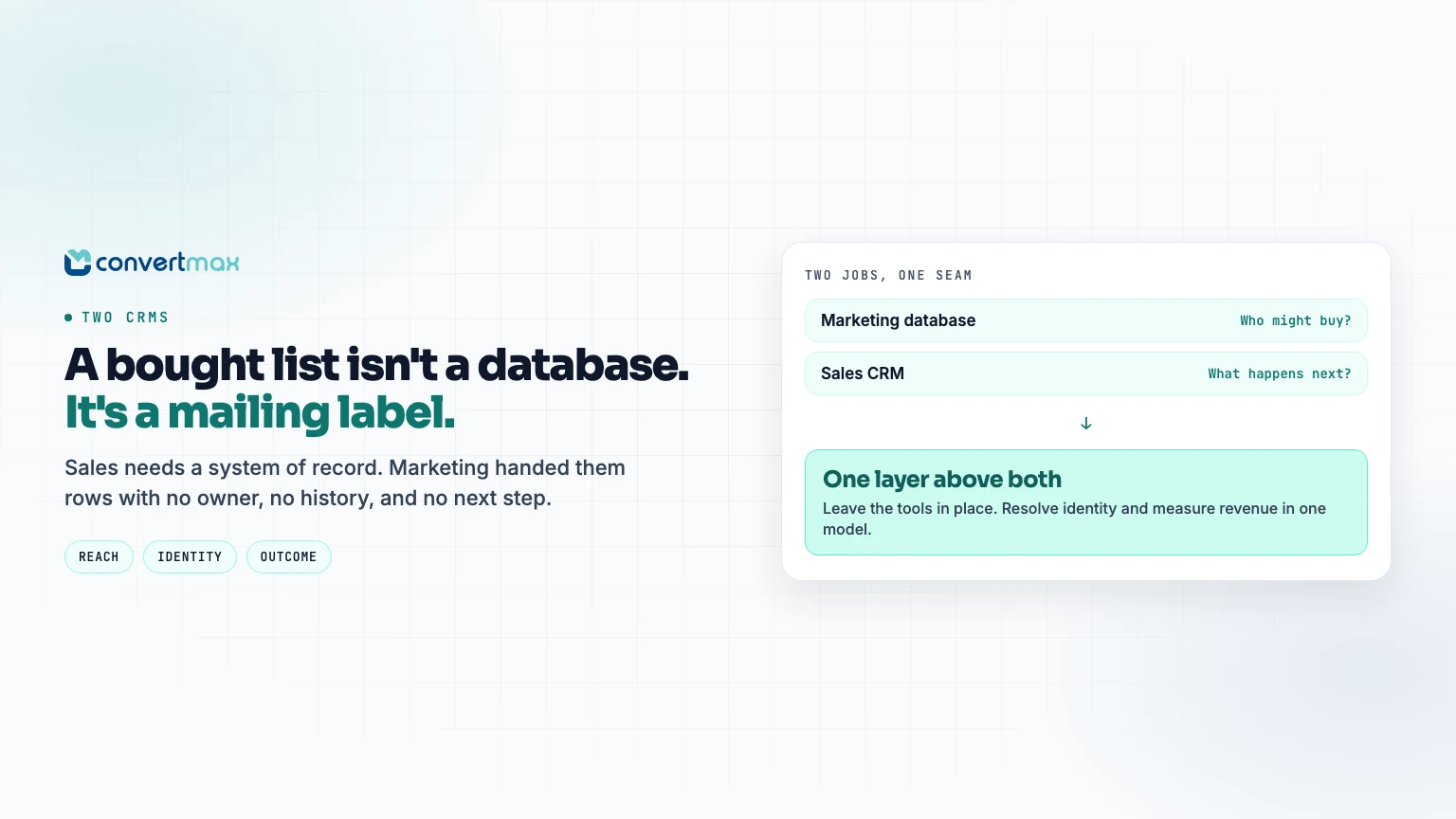
Marketing has its database. Sales has its own. Nobody wants to look at the other team's. Marketing buys a bulk list from a vendor whose name is already forgotten, and sales keeps its own tracker and quietly runs the forecast off that instead. Both sides pay for the duplication. Neither one owns the problem.
The explanation usually offered is that the bought database was too archaic for sales to touch. That's close. But it undersells the mess. "Archaic" describes the symptom. The disease is simpler: a bought list isn't a database at all. It's a stack of rows with no history, no owner, no relationships, and no verifiable legal standing. Sales needs a system of record. Marketing handed them a mailing label.
The short answer
Sales and marketing keep separate systems because they're solving two different problems, and the problems genuinely don't want the same tool.
Marketing needs reach. A big, cheap pool of records, because the job is finding the few hundred that matter out of tens of thousands. Sales needs truth. A small number of records it can trust completely, each one with an owner, a history, and a next step attached.
A bought list can serve the first job. It wrecks the second.
The split usually starts as a design decision. It becomes permanent when the two systems never reconcile. And the bought list is the reason they never do.
Two systems, two jobs
Be precise about what each system is actually for. The requirements diverge more than most people assume.
| Marketing database | Sales CRM | |
|---|---|---|
| Primary question | Who might buy? | Who is buying, and what happens next? |
| Record shape | Person or session | Company, buying group, opportunity |
| Typical volume | Tens of thousands to millions | Hundreds to a few thousand active |
| Pricing model | Per contact | Per seat |
| Tolerance for bad records | High, because you're filtering | Near zero, because you're committing |
| Cost of a wrong record | A wasted send | A wasted call and a dented relationship |
| Ownership model | Shared, unassigned | Named rep, named account |
Those are different enough that separate tools aren't irrational. Marketing automation platforms usually bill by contact. CRMs usually bill by seat. A team holding 400,000 records with twelve reps feels those two models very differently, and the finance conversation alone can force the split.
So the first layer of the answer is structural and a little boring. Different jobs, different billing. That explains why two systems exist.
It doesn't explain why they never talk. That part is about the list.
What "archaic" actually means
Ask a rep why the marketing database is unusable and you'll get the same description every time. The record contains a name, an email address, maybe a job title, and a company name typed as free text.
That's it. That's the whole record.
No owner. No last contact date. No stage. No open deal. No note from whoever spoke to this person six months ago. And no relationship to the four other people at the same company who might be involved in the decision.
Here's the distinction that matters. A CRM record isn't a contact card. It's a container for a working relationship. Who owns it. What happened last. What's supposed to happen next. What the person actually said. Whether there's money on the table.
A bought list gives you the contact card and nothing behind it.
So the rep faces a choice, every morning. Work the list, and spend the day rebuilding context from zero for people who never asked to hear from you. Or work their own pipeline, where the context already exists and the calls are warmer. That's not stubbornness. That's triage.
Now here's what turns triage into a permanent split. Once a rep gets burned by a bad list, they stop trusting anything that arrives from marketing's system. The next list could be excellent. Doesn't matter. They won't open it.
And that's how a second database becomes a second database.
What actually goes wrong, itemized
Here's the specific damage a large bought database does, roughly in the order it lands.
1. You can't verify provenance, so you can't price the risk
Bought lists get assembled in ways the vendor won't describe precisely. Scraped from directories. Harvested off conference attendee lists. Collected through co-registration flows where someone ticked a box agreeing to hear from "partners." Recycled from whoever bought it last.
Under CAN-SPAM, each separate email in violation carries penalties of up to $53,088, and the law makes no exception for business-to-business email. Under GDPR, consent has to be specific, informed, and traceable back to your company. A list reseller can't give you that. So the legal status of every record is unknown the moment you import it, and it stays unknown forever.
You aren't buying data. You're buying an unpriced liability with a row count attached.
2. Spam traps
Anti-spam outfits seed honeypot addresses into lists that circulate on the open market. Those addresses are built never to opt in, never to engage, and never to complain. Their only job is recording who mailed them.
Hit one and you've identified yourself. There's no reliable way to screen them in advance either, because being indistinguishable from a normal address is the entire point.
3. The deliverability damage lands on your domain, not the vendor's
This is the mechanism that makes sales dig in hardest, and they're right to.
A purchased list pushes bounce rates and spam complaints up. Sending reputation is tied to the domain and IP you send from. That's the same domain you use for quotes, contracts, invoices, onboarding emails, and password resets.
Get throttled or blocklisted and it stops being a marketing problem. It becomes an everything problem. Recovery is slow, too. Even after you fix the underlying sending issue, climbing from a bad reputation back to a good one typically takes four to twelve weeks. That's most of a quarter spent on cleanup instead of growth.
4. Decay outruns any refresh cycle
B2B contact data decays at about 2.1% per month, or 22.5% a year. One study tracking business contacts across twelve months found 70.8% experienced at least one change. Job title or function changed for 65.8%. Email address changed for 37.3%.
So a list that was 90% accurate when it was compiled is materially worse a year later. Two years later it's a coin flip. And you usually can't date the list, because the vendor won't say when it was assembled or how many buyers have run through it since.
5. Duplicates, collisions, and people you already know
Duplicate rates of 10% to 30% are normal even in systems a company built itself. A bought list makes it worse, because it arrives with no identifier you control and no relationship to your existing records.
Picture the failure modes. Two reps call the same account on the same morning. A customer who closed last quarter gets a cold pitch as if you've never met. A renewal conversation lands in a lead qualification queue. Each one is a small brand wound, and they add up.
6. Bought data overwrites good data
The damage often isn't the list itself. It's what happens when someone merges it.
Free-text company names break account matching. An enrichment tool appends a stale title over one a rep confirmed on a call. A field gets populated from a source nobody can trace. Six weeks later a report is wrong and nobody can explain why.
Sales defends its own database because it's the last place the numbers are still correct. From the outside that looks territorial. From the inside it's data protection.
7. The economics invert
Raw contact records cost about a dollar each. A marketing lead runs closer to $75. A qualified lead lands around $250. Bought lists look cheap on the invoice and expensive per outcome, because the conversion rate on a cold, unqualified, decaying record sits near the floor.
The commonly cited figure is that 79% of marketing-generated leads never convert. Ask sales reps directly and they report that only about 31% of the leads they receive fit their ideal customer profile. They aren't being difficult. They're reading the same numbers you are.
8. Attribution becomes impossible
This is the quiet one, and it's the most expensive.
When marketing's database and the sales CRM never reconcile, you can answer "how many leads did this campaign produce?" You cannot answer "which campaign produced revenue?"
The first question is about volume. The second one decides next quarter's budget. Two systems, no shared identity layer, and the revenue question goes unanswered. Budget then gets allocated on lead volume, which happens to be the exact metric bought lists are best at inflating. The loop closes on itself.
The second database is usually a shadow CRM
The split isn't only two tools. It's two versions of the truth, and the informal one tends to win.
The survey data is blunt about this. Only 35% of sales professionals completely trust the accuracy of their organization's data. When the official system isn't trusted, people build workarounds. A rep keeps a spreadsheet. A manager keeps a private pipeline view assembled from what reps said in one-to-ones. RevOps keeps a dashboard that starts as a CRM export and then gets manual corrections layered on top.
The visible cost is double entry. Reps update two systems, or they update one and let the other rot. Forecasts run off the spreadsheet, which has no audit trail and no version control, so when the quarter misses you can't diagnose why. You're left with rep recollections and a file nobody can reproduce.
None of that is a tool problem. You don't fix it by switching CRMs or adding more required fields. You fix it by making one system worth trusting. Which is hard to do while a low-quality list keeps flowing into it.
Design choice or symptom?
Not every two-database setup is a mess. Some are deliberate and fine. Here's how to tell which one you're sitting in.
| Signal | Design choice | Symptom |
|---|---|---|
| Why the systems are separate | Different jobs, agreed on purpose | One side doesn't trust the other's data |
| How records move | Clean handoff, agreed definitions | Manual exports, CSV pastes, "I'll send it over" |
| Duplicate handling | Deduplicated on entry, one owner per account | Two reps calling the same account |
| Lead rejection | Reps work most of what they're given | Reps work almost none of it |
| Forecast source | The CRM | A spreadsheet nobody else can see |
| Revenue reporting | One number, agreed on | Both teams report, and they disagree |
If you're in the right-hand column on more than two rows, the split isn't architecture. It's damage control.
What actually fixes it
The instinct is to merge everything into one database. Usually the wrong move, and it's why merge projects stall for a year and then quietly die.
Marketing genuinely needs a large pool of candidates. Sales genuinely needs a small, trustworthy set of working records. Buying one tool instead of two doesn't make those requirements go away. Force them together and you get a system too big for sales to trust and too constrained for marketing to run well.
What works is separating three questions that keep getting bundled into one.
Reach is a volume question. How many candidates can we generate or acquire? That pool can be large, cheap, and imperfect. Just keep it out of the system of record.
Identity is a matching question. Who is this person, which company do they belong to, and how do we know? This has to produce one answer across every system, or nothing downstream reconciles.
Outcome is a revenue question. What did this account actually buy, and what preceded it? Measure it in one place, regardless of which system owns the record.
Most companies try to solve identity and outcome by consolidating tools. The cheaper path is leaving the operational systems alone and building one layer above them that resolves identity and measures outcomes. Your marketing automation stays your marketing automation. Your CRM stays your CRM. The connections between them stop being manual.
That's the architecture Convertmax is built on. CRM agnostic by design, connecting HubSpot, GoHighLevel, Close, Salesforce, CallRail, Stripe, Shopify, ad platforms, and call tracking into a single model instead of asking you to standardize on one vendor. It doesn't replace either database. It makes the gap between them measurable.
Practical rules if you're living in this right now
Quarantine the list. Never import a purchased list into the system of record. Load it somewhere separate, work it from there, and promote a record into the CRM only after a human verifies something real about it.
Never let a list define identity. A list can suggest candidates. It should never be the source of truth about who a customer is. Match against existing records first and reject anything you can't resolve with confidence.
Pick one revenue number and defend it. Marketing and sales reporting different totals is the clearest sign the split has gone bad. One number, one source, published monthly.
Write down what a qualified lead means. Most of the resentment between these teams traces back to two working definitions of the same word. Put it in writing. Revisit it when the motion changes.
Give sales a reason to trust the shared system. Trust follows usefulness. If the CRM tells a rep which account to call next and what happened last time, they'll use it. If it's a compliance obligation, they won't.
FAQ
Is it normal for sales and marketing to have separate CRMs?
Yes, and often reasonable. Marketing automation and sales CRMs are optimized for different jobs and priced on different models, per contact versus per seat. The problem isn't the two systems. It's two systems that never reconcile, which leaves the revenue question unanswerable.
Why won't sales work out of the marketing database?
Usually because the records lack what sales needs: ownership, contact history, deal context, and relationships between people at the same company. A bought list typically arrives with a name, an email, and a free-text company string. That's a mailing label, not a working record.
What's the real risk of buying an email list?
Four risks stack up. Legal exposure under CAN-SPAM (up to $53,088 per email in violation) and GDPR consent rules. Spam traps seeded into lists that circulate on the open market. Sender reputation damage to your primary domain, which can take four to twelve weeks to recover. And data decay that makes the list worse every month you own it.
Can you just merge both databases into one?
You can, but it usually fails. Marketing needs a large pool of candidates; sales needs a small set of records it fully trusts. Merging creates a system too big for sales and too constrained for marketing. Resolving identity and measuring outcomes in a layer above both systems is cheaper and more durable.
How do you measure attribution when two teams use different systems?
You need one identity layer that connects a person and a company across both systems, plus one place where revenue outcomes land. Without that you can report campaign lead volume, but you can't connect campaigns to closed revenue. See how to measure customer journeys and lead source tracking.
The seam isn't free
Every company running two databases pays a tax on the seam between them. The only question is what form the payment takes. Double entry, forecasts nobody believes, and two teams arguing about whose number is real. Or one layer that makes the seam measurable and ends the argument.
Only one of those gets cheaper over time.
Convertmax connects first-party journey data, CRM records, call activity, and revenue events into a single model, whether your teams share a CRM or not. If your marketing and sales systems have never reconciled, explore the platform or request a demo and find out what the gap is actually costing.