By Elena Marsh
Privacy as a Competitive Advantage: Why First-Party Data is the Only Future-Proof Strategy
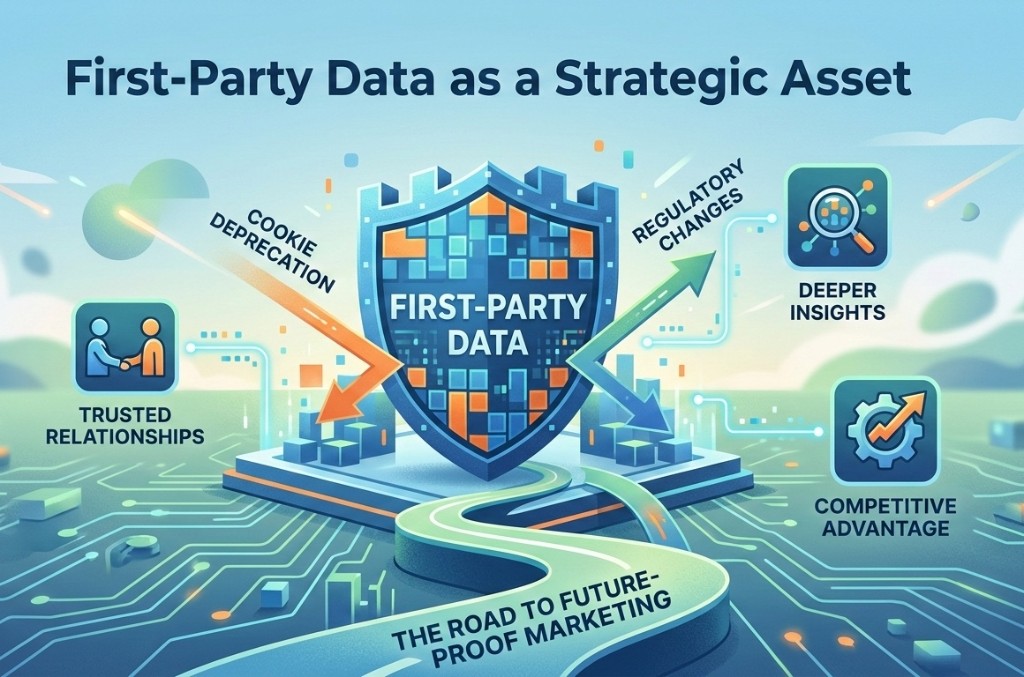
In today's rapidly evolving digital landscape, data privacy has transcended its role as a mere compliance checkbox to become a pivotal competitive differentiator. For B2B marketers, navigating the complexities of stringent regulations and the impending deprecation of third-party cookies necessitates a fundamental shift in data strategy. Embracing first-party data is no longer optional; it is the cornerstone of building trust, cultivating deeper customer insights, and future-proofing marketing efforts in 2026 and beyond.
The Evolving Privacy Landscape: A New Era for B2B Marketing
The year 2026 marks a significant turning point in data privacy. New comprehensive data privacy laws have been introduced in states like Indiana, Kentucky, and Rhode Island, further expanding the regulatory mosaic in the United States. Concurrently, the Global Privacy Control (GPC) is gaining traction, making compliance a legal imperative for U.S. marketers who must now automate the recognition of user privacy signals. This environment demands a higher level of privacy maturity, characterized by jurisdiction-aware governance that dynamically adapts to specific user locations.
This regulatory tightening, coupled with the ongoing deprecation of third-party cookies, has created a challenging environment for traditional marketing approaches. Many businesses are grappling with a potential loss of up to 70% of their marketing data, rendering conventional methods of visitor identification, customer journey tracking, and conversion attribution increasingly ineffective.
The Trust Deficit and the Rise of First-Party Data
In this privacy-first era, B2B buyers are more discerning than ever. They actively seek out organizations that demonstrate a clear commitment to data privacy. As Forbes highlighted, buyers in 2026 are looking for "visible security signs" from the outset, including certifications, transparent data handling policies, and robust incident response mechanisms. This emphasis on trust underscores a critical shift: data quality now hinges on consent, making clean, consent-based first-party data the new gold standard.
First-party data, by definition, is information collected directly from your audience through channels you own—such as your website, mobile app, or CRM. Unlike third-party data, which is often fragmented and subject to external controls, first-party data is inherently accurate, consented, and entirely within your control. This direct relationship with your customers fosters more precise targeting, personalized experiences, and ultimately, a higher return on investment.
Furthermore, the most successful B2B brands in 2026 are those that treat first-party data not merely as something to "collect," but as a relationship to nurture. This relational approach builds brand loyalty and positions privacy as a core value, transforming it into a powerful competitive advantage.
Convertmax: Your Foundation for a Future-Proof Marketing Strategy
Convertmax is engineered from the ground up to thrive in this privacy-first, cookieless world. Our platform is built entirely on first-party data collection, providing a robust and privacy-compliant analytics solution that ensures your marketing efforts remain effective and insightful. By owning your data completely, you gain unfiltered customer insights, immune to ad blockers and browser restrictions.
Here's how Convertmax empowers your B2B marketing strategy:
- Visitor Identification: Turn anonymous website visitors into qualified leads by enriching company and contact information, providing real-time insights into who is engaging with your content.
- Multi-Touch Attribution: Move beyond the limitations of last-click attribution. Our six flexible attribution models (First-Touch, Last-Touch, Linear, U-Shaped, Time-Decay, and Data-Driven) provide a holistic view of the customer journey, accurately crediting every touchpoint and optimizing your marketing spend.
- Conversion Tracking: Capture online and offline conversions with pixel-level accuracy, ensuring you understand what truly drives revenue across all channels.
- Privacy-Compliant Data Foundation: Our first-party data approach ensures compliance with evolving regulations like GDPR and CCPA, giving you peace of mind and building trust with your audience.
- Real-Time Dashboards: Gain instant insights into campaign performance, traffic sources, and funnel performance, enabling data-driven decisions as they happen.
Technical Solutions for Cookieless Attribution
The shift away from third-party cookies necessitates innovative technical solutions for accurate attribution. Even with Google's decision to maintain some third-party cookies, robust identity resolution using first-party signals is essential for comprehensive cross-channel tracking. Convertmax leverages advanced techniques to connect events across sessions using first-party identifiers, providing a unified view of the customer journey.
Furthermore, server-side tracking is emerging as a key method for cookieless attribution. By moving data collection from the browser to the server, marketers can bypass ad blockers and browser restrictions, ensuring more reliable data capture and accurate measurement of marketing performance. Convertmax's architecture is designed to support these modern approaches—see how it works—providing a future-proof solution for your analytics needs.
Conclusion: Embrace Privacy, Unlock Growth
The era of privacy-first marketing is not a hurdle to overcome, but an opportunity to build stronger, more transparent relationships with your audience. By embracing first-party data strategies and leveraging platforms like Convertmax, B2B marketers can transform privacy from a challenge into a powerful competitive advantage. This strategic shift not only ensures compliance and builds trust but also unlocks deeper insights, more effective personalization, and ultimately, sustainable growth in a rapidly changing digital world.