By Mara Quinn
Where Revenue Tracking Actually Breaks
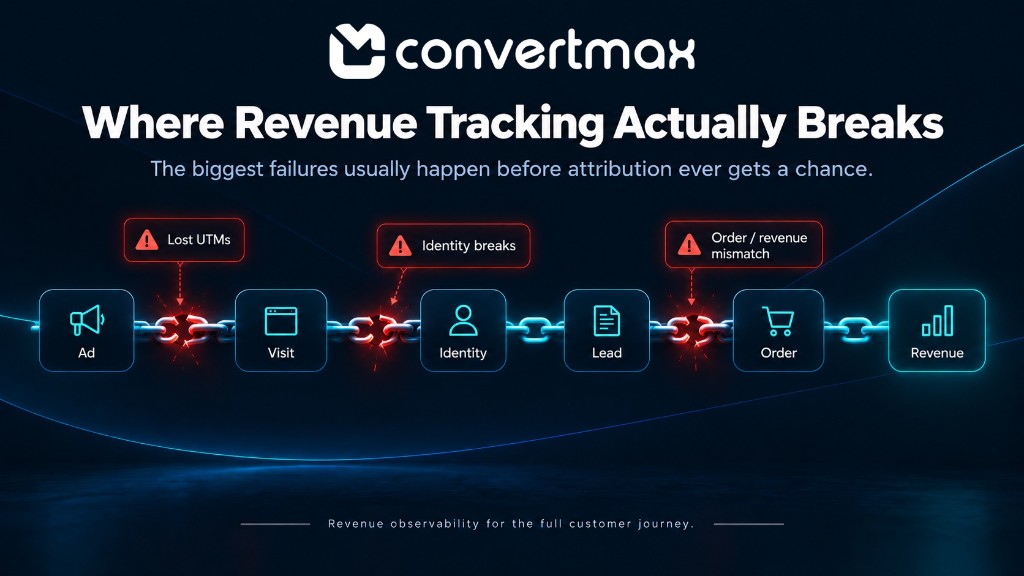
Most teams argue about attribution models. First click or last click. Linear or data-driven. A 30-day window or 90.
That argument happens at the very end of a long chain, and by the time anyone has it, the damage is already in. It happened hours earlier, in places nobody bothered to instrument.
Here's the honest map of those places.
It breaks before the visitor reaches you
Tracking can be compromised before a single pixel fires. Redirects strip query parameters. Shortened links drop them. An HTTP to HTTPS hop loses them. Email platforms rewrite every link in the message, and so do affiliate networks and vanity URLs.
Then there's the messy human layer. utm_source=facebook in one campaign, Facebook in another, fb in a third. Paid campaigns shipped with no UTMs at all. Auto-tagging that quietly quits working, which means gclid and fbclid stop arriving. QR codes with no campaign parameters behind them. And a growing share of traffic from AI assistants and unknown referrers that lands with no campaign metadata whatsoever.
A good system says the quiet part out loud: we received this visitor, but the acquisition information was already incomplete when they got here.
The first page view
This is the big one, and it fails more often than anyone wants to admit. The script never loads, or loads too late. A content security policy blocks it. An ad blocker eats it. A JavaScript error kills it. It doesn't execute inside a single page app. It double-fires because someone installed it directly and through Google Tag Manager. It initializes after the event it was supposed to capture. It runs on the marketing site but not in the app. It's missing from a landing page template that shipped last week, or a subdomain, or a partner's page.
What's useful here isn't another chart. It's a sentence like this: checkout traffic dropped 19% while site traffic held steady, and the tracker stopped appearing on /collections/* after Tuesday's theme deployment.
Now you know where to look. An attribution report won't tell you that.
Consent
Consent tooling punches invisible holes in your data. The CMP never initializes. Consent state never reaches your analytics. Something fires before consent, or nothing fires after consent gets granted. Consent mode differs page to page. A visitor changes their mind mid-session. Regional rules change what's allowed to run. GTM's consent state and your CMP disagree with each other.
Here's the distinction most stacks blur together: no conversion occurred is not the same statement as we weren't allowed to observe the conversion. Those two problems need completely different fixes.
Identity
This is where the revenue graph lives or dies.
Anonymous ID never created, or regenerated on the next visit. Cookie expired. localStorage cleared. Safari's storage rules shortened the persistence window. The visitor switched browsers, or moved from phone to laptop. They logged in, or logged out. Their email finally became known and their anonymous history never merged with it. Two emails turn out to belong to one customer. A shared office computer produced a false merge. The CRM ID changed. Shopify's customer ID only appeared at checkout. The CRM created a duplicate contact.
The chain is easy to describe and brutal to maintain: anonymous visitor, identified person, CRM contact, customer, revenue. Every broken edge is a place where money loses its origin story.
Forms and phone calls
Forms are a graveyard. The form was viewed before tracking loaded. The submit button was clicked and the submission failed. A client-side event fired even though the server rejected it. A successful submission produced no event at all. AJAX forms don't trigger the usual listeners, iframes can't be observed, and HubSpot, GoHighLevel, and custom React forms all behave differently. Calendly replaced the form entirely. Duplicate submits land. Spam becomes a conversion. Hidden fields never receive attribution data, so UTMs never reach the CRM.
Four things get collapsed into one event that shouldn't be: form intent, form attempt, successful submission, CRM lead created.
Calls have the same problem. Dynamic number insertion doesn't swap the number. The pool is exhausted and the visitor gets the default line. The tracking number gets cached or persists between sessions. A tel: click is logged and no call happens. A call happens with no click. CallRail and GoHighLevel both send an event. The caller can't be reconciled to a contact. Repeat callers look like new leads. Missed calls get counted as conversions.
The chain worth tracking runs phone click, call, connected call, qualified call, opportunity, revenue. "37 calls from Google Ads" is not a chain.
When the CRM disagrees
The website says a conversion happened. The CRM says otherwise.
An API call failed. A webhook timed out. A webhook returned 200 while the processing behind it died. The contact got created but the attribution properties didn't. Duplicate matching attached the activity to the wrong person. Lifecycle stage defaulted wrong, nobody owns the record, the subaccount is wrong. A CRM automation overwrote the lead source. A workflow clobbered the values your tracking tool wrote. A salesperson edited the record by hand.
It gets worse over time, too. Deals move backward, reopen, duplicate, change amount, change owner, get their close date moved, get un-won. Contacts merge and disappear. Someone runs a workflow that rewrites ten thousand historical records in one afternoon.
Current state isn't the story. State changes are.
Checkout, orders, refunds
Checkout is where attribution goes to disappear. Shopify checkout, Shop Pay, PayPal, Stripe, a financing partner. Cookies and context don't cross those boundaries. Checkout IDs never map back to sessions. An email shows up for the first time and never gets reconciled. Someone changes their email mid-purchase. Payment retries create duplicates.
Then orders, where even "order created" isn't clean: duplicate webhooks, late webhooks, out-of-order webhooks, API polling that sees the order before the webhook does, test orders, draft orders, POS orders, manual orders, zero-dollar orders, gift cards. Taxes and shipping counted as revenue. Shopify and Stripe both claiming the same money.
And refunds, where ROAS turns into fiction. Partial refunds, full refunds, multiple partial refunds, returns with no refund yet, chargebacks, disputes, exchanges, store credit. Meanwhile the CRM still shows Closed Won after the money went back.
If you take one idea from this section, take this one: attributed revenue is not net revenue, and net revenue is not realized revenue.
Server-side tracking, integrations, normalization
Server-side fixes some problems and invents others. Browser and server send the same event and the dedup ID is missing. Clocks drift between machines. A retry creates a duplicate, a queue delivers twice, an event turns up four hours late, the payload schema changed, a webhook signature failed, a secret rotated, a malformed event landed in the dead-letter queue. These aren't only analytics events. They're state you can watch.
Integrations each fail in their own way. OAuth token expired, refresh token revoked, scopes changed, someone uninstalled the app. API version deprecated, property deleted, field renamed, webhook removed, account swapped, rate limit hit, sync cursor lost, backfill incomplete. A connector that silently stopped syncing six hours ago looks identical to one that's doing fine, if all you show is a green checkmark.
And some of the nastiest errors aren't missing data at all. They're data that looks perfectly valid. google versus Google Ads versus google_ads. facebook versus meta. CPC versus cpc. CAD versus USD. Eastern versus UTC. SKU versus variant ID. Everything technically works while every report built on top of it is wrong.
Attribution is the last chapter
Only after all of that do you reach the model. Direct traffic overwriting known acquisition. Branded search taking credit for demand that something else generated weeks earlier. Retargeting claiming the last click. AI referrals filed as direct. Self-referrals, internal referrals, payment provider referrals. A conversion window that doesn't match how long your deals actually take.
None of this makes attribution models worthless. It means a better model sitting on broken data just produces more confident wrong answers.
What to build instead
Treat the whole path as one graph, and put health checks on every edge:
Ad → Visit → Identity → Lead → Call → Opportunity → Customer → Order → Subscription → Revenue
Then a system can say things a dashboard can't:
- Meta traffic is normal, but fbclid capture fell from 91% to 34% after Thursday's release.
- 18 successful quote requests have no HubSpot contact behind them.
- 23% of this week's calls can't be matched to a visitor. Normal is 6 to 9%.
- Shopify reports $48,219. Attributed order events total $44,870. Somebody needs to explain $3,349.
- Anonymous to customer match rate dropped from 78% to 61%.
- GoHighLevel sync is 47 minutes behind.
That changes what a question like "why did attributed revenue fall yesterday?" even means. The right first response isn't "Google Ads performed worse." It's this: did revenue actually fall, or did our ability to see revenue fall?
That's the gap between attribution and revenue observability. One argues about credit. The other tells you which link broke, and when it broke.
Most of these failure points are boring, and that's exactly why they persist for years. If you'd rather find out where your own chain is broken than read about it again next quarter, start with the tracking health check.