By Elena Marsh
First-Party Identity Resolution: How Convertmax Bypasses ITP and Cookie Restrictions
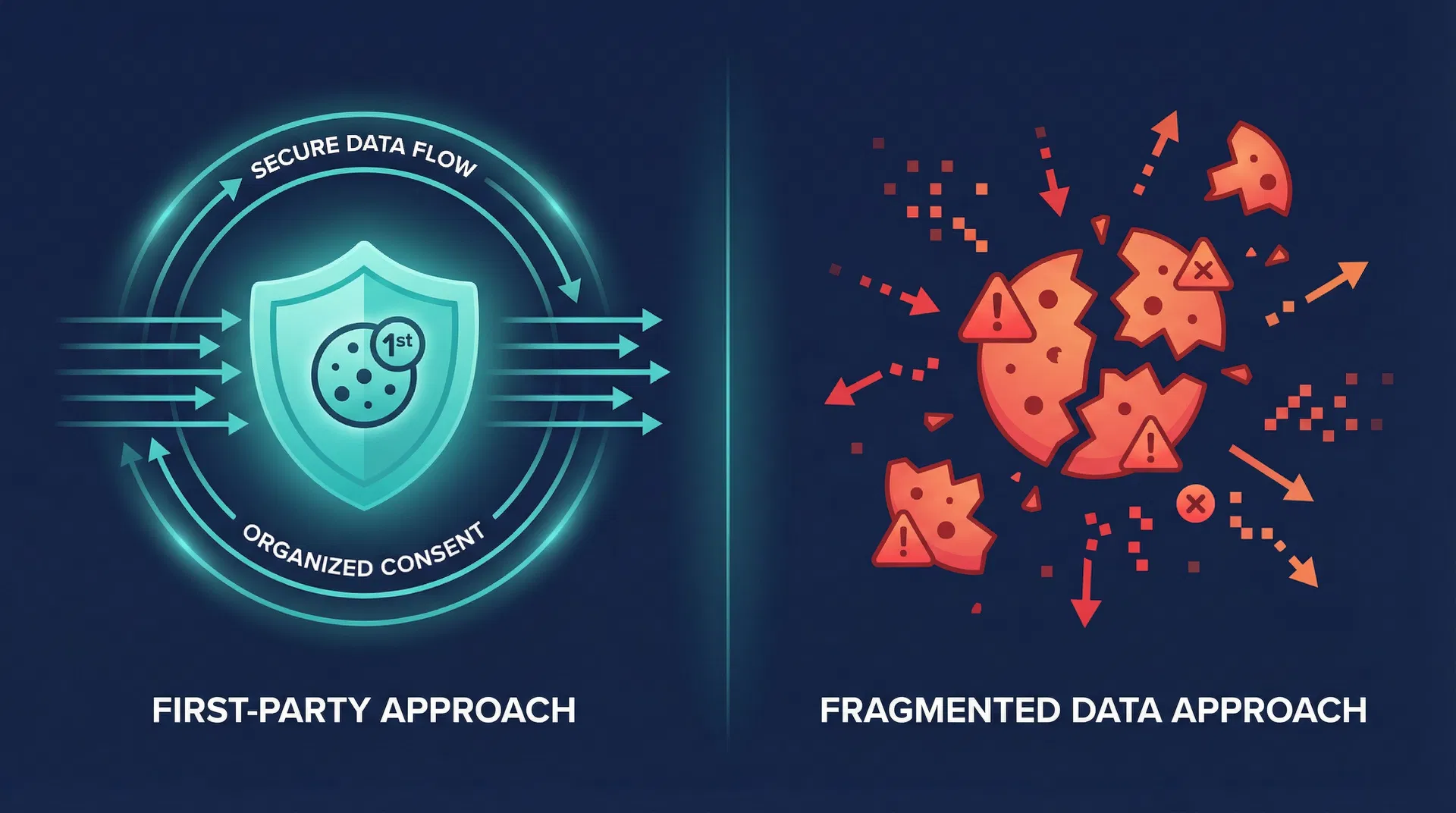
Third-party cookies and cross-site pixels were never a complete measurement stack. Safari Intelligent Tracking Prevention (ITP), Chrome’s third-party cookie restrictions, and ad blockers made that reality impossible to ignore. If your attribution still depends on a script that another company hosts and browsers increasingly reject, you are measuring a shrinking—and biased—slice of demand.
First-party analytics flips the model: collect journey data on domains you own, resolve anonymous sessions into known customers with identifiers you control, and feed that continuous history into multi-touch attribution and the Unified Conversion Protocol (UCP).
This methodology explains how identity resolution works under ITP and cookie restrictions—what fails in third-party stacks, what first-party collection must capture, and how Convertmax stitches anonymous-to-known journeys without pretending privacy rules do not apply.
Why third-party identity fails in 2026
| Failure mode | What breaks | Business impact |
|---|---|---|
| Safari ITP | Third-party cookies capped or partitioned; client storage for trackers limited | Lost returning-visitor continuity on iOS/macOS Safari |
| Chrome third-party cookie restrictions | Cross-site identifiers unavailable or limited | Incomplete retargeting and cross-domain stitching |
| Ad blockers / privacy browsers | Analytics and pixel scripts never execute | Missing sessions from high-intent, privacy-conscious buyers |
| Platform-reported conversions | Each ad network uses its own window and identity rules | Inflated ROAS and double-counted conversions |
| Consent rejection of non-essential trackers | Pixels that depend on marketing cookies stop firing | Blind spots exactly where users opted out of third-party tooling |
Third-party measurement fails at the identity layer: it tries to recognize people *across* sites. First-party measurement succeeds at the journey layer: it recognizes activity *on your properties* and connects later revenue events to that owned history.
What “first-party” means in practice
First-party collection means events are captured in your context—your website, app, or server endpoints you operate—rather than by a third party watching the user across the open web.
In Convertmax, that typically includes:
- Owned-domain event collection — page views, campaigns, and convert events recorded against your site/session model.
- Durable first-party identifiers — cookies or storage scoped to your domain (subject to browser rules and consent), plus server-side identity keys when available.
- Downstream system keys — email, CRM contact IDs, commerce customer IDs, call-tracking IDs—joined when the person becomes known.
- A shared convert contract — so form fills, calls, CRM closes, and orders attach to the same profile via UCP.
First-party does not mean “ignore consent,” “fingerprint users covertly,” or “rebuild third-party tracking on a CNAME.” It means owning the measurement path so Safari, Chrome, and blockers cannot silently delete your entire journey history.
Data flow: from anonymous visit to attributed revenue
- Browser on your domain captures first-party session and campaign context.
- A convert or identity signal appears (form, login, checkout, CRM sync).
- The anonymous journey resolves onto a known person profile.
- UCP converts and revenue outcomes attach (CRM, calls, commerce).
- Multi-touch attribution and Revenue Graph queries run on the connected profile.
Step 1 — Capture the anonymous journey on first-party infrastructure
When someone lands from paid search, organic, email, or an AI referral, Convertmax records the session against your first-party collection path. Campaign parameters, landing page, referrer context, and subsequent page activity stay attached to that session—even when third-party pixels would have been blocked.
Step 2 — Preserve continuity within browser constraints
Browsers treat *your* first-party storage differently from *cross-site* trackers. Continuity still has limits (ITP caps, user clearing data, private browsing), so methodology matters:
- Prefer first-party cookies/storage on the marketing domain over third-party pixels.
- Persist campaign context early (first touch and assisting touches) so later ITP caps do not erase source history already recorded server-side.
- Treat client IDs as *hints*, not sole truth—server-side events and CRM keys complete the picture.
Step 3 — Resolve anonymous → known when identity appears
Identity resolution is the join between early research and later revenue. Common signals:
| Signal | When it appears | What it unlocks |
|---|---|---|
| Form email / phone | Lead convert | Tie prior sessions to a contact |
| Login / account ID | Product or portal use | Cross-device continuity for known users |
| CRM contact sync | Sales creates or updates a record | Pipeline and closed-won linkage |
| Commerce customer ID | Checkout / account | Order and LTV linkage |
| Call-tracking match | Phone convert | Offline-high-intent path into the journey |
Until a signal appears, the person remains anonymous but still measurable as a journey. After resolution, prior assists stay on the same profile instead of becoming “Direct” orphans.
Step 4 — Emit converts with shared context
A form fill is not the same object as a paid invoice, but both must carry campaign, channel, page, and identity keys under one contract—see UCP. That is how attribution avoids “marketing conversion” vs “sales conversion” as incompatible languages.
Step 5 — Attribute and report from the connected profile
Multi-touch attribution reads the ordered touchpoints and converts on the resolved profile. Last-click tools that only saw the final pixelated event cannot reconstruct assists that happened under blockers or ITP.
Comparison: third-party pixel stack vs first-party identity stack
| Dimension | Third-party pixel / cookie stack | First-party identity stack (Convertmax) |
|---|---|---|
| Collection host | Ad / analytics vendor domains | Your domain / first-party endpoints |
| ITP / cookie restriction impact | High — cross-site IDs broken | Lower — owned-context collection |
| Ad blocker impact | Often total loss of session | Reduced; still subject to script blocking, mitigated by first-party + server paths |
| Anonymous → known | Weak or platform-specific | Explicit resolution on owned keys |
| Conversion definition | Per platform | Shared via UCP |
| Revenue truth | Platform-reported | CRM / commerce / billing outcomes on the same profile |
| Privacy posture | Cross-site surveillance model | Owned-data model with consent responsibilities on you |
Methodology checklist (implementation)
- Define the identity keys you will trust — email, phone, CRM ID, commerce ID. Document which systems emit them.
- Install first-party collection on owned properties — marketing site, app, checkout—before optimizing ad pixels.
- Record campaign context at first opportunity — UTM/click IDs and landing pages should land in first-party events immediately.
- Map convert types — form, call, opportunity stage, order—into UCP-compatible converts.
- Connect revenue systems — CRM, Stripe/commerce, call tracking—so closed revenue can attach to the same person.
- Compare attribution models — first/last/linear/U-shaped/time-decay/data-driven on the same first-party graph, not on platform exports.
- Validate with known journeys — pick closed deals and walk anonymous → known → revenue. Gaps are data problems, not model preferences.
- Align consent and retention — first-party ownership does not remove GDPR/CCPA obligations; it clarifies *who* is the controller of the journey data.
What this does *not* claim
- It does not “defeat” Safari or Chrome by spoofing third-party cookies.
- It does not guarantee 100% identity match rates—private browsing, shared devices, and missing emails remain real.
- It does not replace legal counsel for consent copy or DPIAs.
- It does not make ad platforms stop over-claiming; it gives you a neutral ledger to reconcile them.
How this feeds attribution and revenue decisions
Once identity continuity exists, questions that used to require spreadsheets become queryable:
- Which campaigns influenced pipeline *before* the CRM record existed?
- Which channels create high-LTV customers vs lead volume?
- Which paths include calls that last-click analytics never saw?
- Where do AI referrals and agentic discovery appear without polluting human conversion metrics?
Those answers require first-party analytics, a shared convert contract (UCP), and multi-touch attribution on top of connected journeys—not another pixel hoping browsers look the other way.
Worked example: ITP-era journey that still attributes
Imagine a B2B buyer on iPhone Safari:
- Day 1 — Clicks a LinkedIn ad, lands on a comparison page. First-party session stores campaign and landing context. A third-party ad pixel is blocked; the ad platform never sees the visit.
- Day 4 — Returns via organic search on the same device. First-party continuity (where browser policy still allows) keeps the person on one anonymous profile; if client storage was capped, server-side campaign history from Day 1 still exists as prior context once identity resolves.
- Day 9 — Submits a demo form with work email. Identity resolution joins Days 1–9 to the new contact.
- Day 16 — Sales call logged via call tracking, matched to the contact.
- Day 30 — Opportunity closes in the CRM for $36,000.
Last-click analytics that only saw the form page—or saw nothing on Safari—cannot explain LinkedIn’s role. A first-party identity stack plus UCP converts can: LinkedIn assisted, organic assisted, form converted to known, call advanced, CRM closed revenue. Attribution models then distribute credit across that path instead of inventing a Direct/none story.
Cross-device and multi-stakeholder reality
B2B journeys rarely stay on one browser. A researcher on mobile, an economic buyer on desktop, and a champion forwarding links are normal. First-party methodology handles this with progressive identity—not perfect device graphs sold by ad tech:
- Same email across devices after login or form fill merges histories.
- Account-level edges in the Revenue Graph connect multiple people at one company to shared opportunities.
- Unresolved anonymous sessions remain useful for content and UX analysis even when they never join a person.
The goal is decision-grade continuity for revenue outcomes, not surveillance-grade tracking of every incidental visit.