By Priya Lang
Revenue Intelligence When Tracking Is Restricted
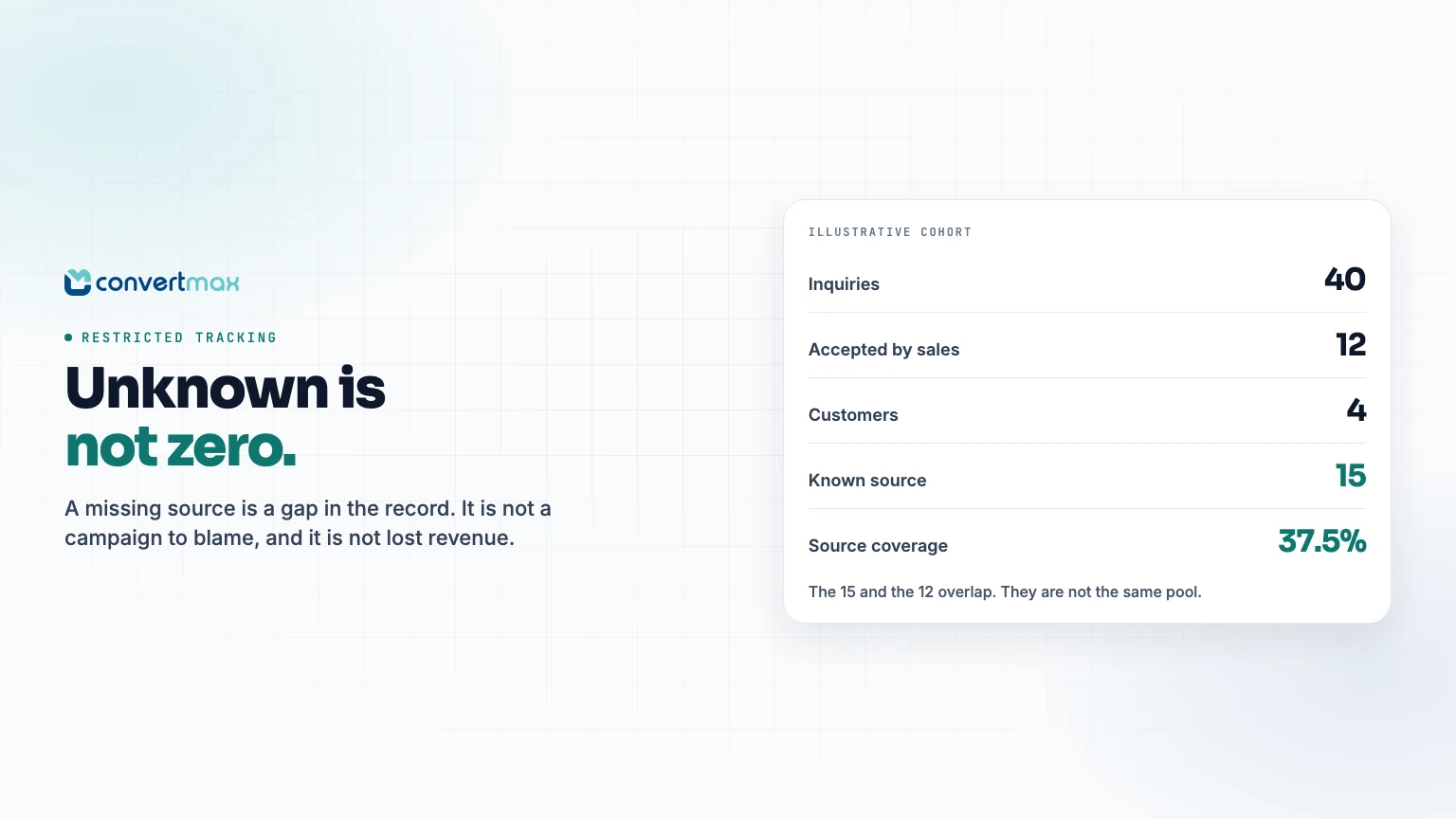
Imagine a business receives 40 inquiries in a month. Sales accepts 12 of them. Four eventually become customers. Only 15 of the original inquiries have a usable, permitted source recorded.
The pressure in the next budget meeting will be to fill in the missing 25. Which campaign deserves the credit? Can another identifier connect the dots? Can a server-side event recover what the browser did not send?
Sometimes the missing source can be explained by a broken integration or an inconsistent CRM field. Sometimes the information was never available, or a person’s privacy choice means it should not be collected or used for that purpose. Those are different problems. Treating all of them as tracking defects is a good way to make a revenue report look more complete while making its evidence less trustworthy.
Revenue intelligence under privacy constraints starts with a more useful question: What can we know, use, and act on legitimately—and what must stay unknown?
Start with the decision, then check the permissions
Suppose a paid campaign generates lots of demo requests but few accepted leads. Marketing wants to know whether the audience is wrong. Sales wants to know whether the form is attracting people who cannot buy. Both teams need a shared definition of an accepted lead and a reliable CRM stage—not necessarily a more detailed browsing history.
Work backward from the decision. List the information needed to evaluate it, where that information comes from, who receives it, and how long it is kept. Then determine the applicable legal basis, notices, consent or opt-out requirements, contracts, and platform rules for each use. A record can be appropriate for one purpose without being available for another.
For example, someone may provide an email address to request a demo. Using it to respond to that request is a different question from using it to link earlier browsing or send a matching identifier to an advertising platform. A form submission is not blanket permission for every downstream use.
The same distinction matters with first-party data. Collecting data on your own website or storing it in your CRM does not automatically make it anonymous, consented, or eligible to share. Server-side collection changes where an event is processed; it does not remove privacy obligations or override a user’s choice.
Québec’s privacy regulator says businesses should assess whether personal information is necessary for the stated purpose before collecting it. Its Law 25 guidance also emphasizes clear information about collection purposes and relevant disclosures. California’s CCPA, as amended by the CPRA, gives consumers rights that include opting out of the sale or sharing of personal information; in this context, “sharing” relates to cross-context behavioral advertising. A user-enabled Global Privacy Control can convey an opt-out request to businesses subject to the requirements. These are not interchangeable systems, and neither summary answers every implementation question.
Make consent signals operational, not decorative
A consent banner is useful only if the systems behind it behave accordingly. Map the user’s choice to each relevant tag, destination, CRM workflow, and offline upload. Check what happens before a choice, after acceptance, after refusal, and when someone changes their mind. Handle applicable opt-out signals separately from consent choices; they may govern different uses.
Google’s consent mode illustrates why those distinctions matter. Its controls include separate settings for analytics storage, advertising storage, sending user data for advertising, and personalized advertising. An “analytics yes” is not automatically an “advertising yes.” Google says denied ad personalization disables personalized advertising in its products, while denied ad user data disables the use of personal data for online advertising, including enhanced conversions.
Basic and advanced consent mode are not the same configuration. In Google’s basic implementation, tags are blocked until consent; if consent is not granted, no data is sent to Google by those blocked tags. In the advanced implementation, tags can load under denied settings and send cookieless measurements. Those pings can contain technical information and, depending on settings, URL or click information. “Cookieless” does not mean “nothing was sent” or automatically mean anonymous. Decide with counsel whether the actual setup and transmissions are appropriate for your jurisdictions and choices.
A practical test uses synthetic records and checks actual browser and server requests, not just the banner display:
- Test the initial state and refusal. Confirm which tags load, what requests leave the browser or server, and which identifiers or URL parameters are present.
- Test analytics acceptance without advertising permission. Confirm that analytics use does not quietly enable ad personalization, user-data uploads, or other unapproved destinations.
- Test a change of choice and, where applicable, an opt-out preference signal. Check later events and queued CRM-to-platform uploads as well as the immediate browser response.
- Document who owns the configuration and how restrictions, deletion requests, and retention rules are handled across vendors. Verify actual behavior rather than assuming every integration inherits a banner setting.
No single consent tool can establish that every subsequent use is permitted. And a privacy-respecting implementation may mean deciding not to collect an event at all.
Keep the revenue record even when the journey is incomplete
If someone declines optional tracking but later asks for a demo, the team may still have a legitimate reason to respond and manage the inquiry in its CRM. Whether and how it can do so depends on the applicable rules and the purpose. What the team should not do is quietly reconstruct a restricted browsing path, infer a specific person’s campaign from weak signals, or send the record for ad matching simply because a CRM entry exists.
You can still build a useful commercial view from records you are allowed to maintain:
- Inquiry: a request, booking, or call received.
- Accepted lead: an inquiry that meets a definition agreed by marketing and sales.
- Opportunity: a sales-qualified deal or equivalent pipeline record.
- Won deal or paid invoice: the actual downstream outcome, labeled according to what your system records.
Those stages are not synonyms. A closed-won deal is not necessarily a paid invoice, and a booked demo is not a qualified lead. Available outcomes can differ by CRM connector, so confirm the actual object and stage your integration supports rather than assuming every system reports the same events.
Keep the source field honest. If there is no permitted, reliable source, use “unknown” or an appropriately documented missing-data category. Do not turn an unknown source into direct traffic, a failed campaign, or zero revenue. A simple optional “How did you hear about us?” question can add context when appropriate, but it is self-reported evidence, not proof of a complete journey. Avoid embedding personal identifiers in campaign URLs to manufacture a join.
Put coverage next to the performance number
Return to the illustrative 40 inquiries. If 15 have a reliable source recorded, source coverage is 15 out of 40 inquiries, or 37.5%. That figure describes the completeness of the source field for this CRM cohort. It is not the website’s consent rate, a conversion rate, or the share of revenue caused by marketing.
The team can report that 12 of the 40 inquiries were accepted by sales and that four eventually became customers, assuming those events belong to that same cohort and their use is permitted. It can also analyze the 15 inquiries with reliable source evidence. Those 15 known sources overlap with the 12 accepted leads, but they are not the same pool. What it cannot do is assume those 15 represent the other 25 or distribute the four wins across campaigns without supporting evidence.
A useful revenue review should make four things visible:
- Observed outcomes: the cohort, the inquiry and qualification definitions, and the won-deal or payment outcome.
- Coverage: how many records have a usable source, plus the unknown portion. Do not collect extra personal data solely to explain every gap.
- Method: whether a source is self-reported, captured from an allowed interaction, or assigned by an attribution model.
- Timing and limits: the cohort dates, sales-cycle lag, late-arriving revenue, and any known changes in tracking or CRM process.
Source-known customers may differ from source-unknown customers. If people who permit measurement behave differently, a campaign ranking built only from observable journeys can be biased. Google’s own consent-mode guidance notes that conversion behavior can vary with consent status. Do not scale a consented sample as though it were necessarily a representative cross-section.
Treat modeled reporting as an estimate, not a recovered journey
Modeling can help answer a question at a level where individual paths are unavailable. It does not reveal exactly which person clicked which ad, and it should not be described as restoring every missing conversion.
Google Analytics, for example, describes behavioral modeling based on observed behavior from users who permit analytics identifiers. Eligibility depends on the implementation and sufficient data; even meeting the listed prerequisites does not guarantee a model, and some reports do not support modeled behavioral data. Google Ads also has its own modeling eligibility requirements and may include modeled conversions in its conversion reporting. Read the product’s data-quality indicators and explain when a number contains estimates.
Keep platform-reported results, observed CRM outcomes, and modeled estimates distinct. They answer different questions and can use different windows, identities, and credit rules. Avoid adding platform conversion totals together as if each represents a unique customer. A multi-touch attribution model is a way to assign credit to recorded interactions; by itself, it does not prove that a particular interaction caused the purchase.
Use aggregate evidence when person-level attribution is unavailable
There are decisions you can make without identifying a visitor.
Compare total inquiries, accepted leads, opportunities, and revenue over consistent periods using business records you are permitted to analyze. Keep campaign spend beside those outcomes, while accounting for sales-cycle delays. A change in spend followed by a change in revenue is a signal to investigate, not proof that the spend caused it. Seasonality, sales capacity, pricing, and other campaigns may have changed too.
Where the business has enough volume and comparable markets, consider a geographic holdout test: randomly assign suitable markets to an additional campaign or a control condition, define the test window and primary outcome in advance, then compare the change in aggregate outcomes. This can inform whether the additional investment helped without joining individual ad exposures to individual customers. Small samples, market differences, spillover, and other changes can still make the result inconclusive. The underlying records and the resulting analysis must both be appropriate for the intended use.
Aggregate is not a synonym for anonymous. A report with one customer in a narrow region and time period may still reveal who that person is. Suppress small cells, limit unnecessary detail and access, and assess re-identification risk in context. Pseudonymized data can remain personal data: a hashed email can still be used for matching, and hashing does not itself grant permission to collect, use, or disclose it. Producing an aggregate from personal information can itself involve regulated processing.
Send qualified outcomes back to ads only when permitted
A form fill tells an ad platform that an inquiry happened. An accepted lead or eventual sale can be a more meaningful business signal. That does not mean every CRM record should be uploaded.
Before any qualified-lead or revenue feedback, check the purpose, applicable legal basis and choices, vendor terms, destination, fields, and retention. Confirm whether an opt-out applies to the proposed disclosure and whether the destination may use the data for measurement, optimization, or personalization. A permission for one purpose does not automatically extend to the others. If the necessary permission or evidence is missing, do not send that record; use internal reporting and aggregate analysis where appropriate instead.
Google’s enhanced conversions for leads, for example, can use hashed first-party information alongside imported offline conversions for matching. That describes a technical method, not a legal exception. Hashing protects data differently from transmitting it in plain text, but it does not make the matching identifier automatically anonymous. Google also treats ad user data and ad personalization as distinct consent types.
When feedback is allowed, start with a clearly defined stage: perhaps “sales accepted” rather than every form submission. Reconcile that stage to the CRM, check the destination and allowed fields, and monitor for rejected or late events. Keep unqualified, duplicate, and unknown records out according to documented rules. If sharing is not allowed, accept the smaller optimization signal rather than recreating it through an unauthorized route.
Build the report you can defend
We connect first-party journeys with CRM and revenue reporting on our platform. That helps when the data and joins are supported by evidence, the applicable permissions, and the actual connector configuration. We do not promise complete journeys or automatic compliance. Confirm the available integrations, event mappings, and privacy controls for your implementation.
The strongest revenue report is not the one with the fewest blanks. It is the one that lets marketing, sales, and leadership see the real outcomes, understand which relationships are supported, and make a decision without pretending the rest is known.
When tracking is restricted, start with the commercial record you are allowed to use. Preserve the unknowns. Test the choices you offer. Use aggregate evidence or a controlled experiment when a person-level path is not available. The result may be less precise than anyone wants, but it gives the next budget decision a more defensible foundation.
Explore our lead attribution and start by mapping the data and permissions your team already has.