By Mara Quinn
Your Next Sales Pipeline May Already Be Watching Your Content
When leadership asks for more pipeline by next week, the default answer is usually more outbound.
Build a new list. Launch a cold-email sequence. Ask SDRs to make more calls. Turn up the pressure.
That approach can create activity, but it often starts from the hardest possible place: people who have no reason to know you, trust you, or respond to you yet.
A better starting point may already be in front of you. Your content is producing signals every day. Someone downloads a guide, revisits a product page, forwards a post internally, answers a poll, or comments on a problem your company solves. Those actions do not automatically make that person a sales opportunity. They do, however, give your team a much better place to look than a completely cold database.
The opportunity is not to stop creating content and “harvest” attention instead. It is to keep creating content while building a smarter way to recognize when the right people are leaning in.
Treat content as a demand signal, not a lead list
Most B2B teams measure content in aggregate: impressions, clicks, downloads, event registrations, and engagement rate. Those numbers are helpful, but they can hide the more useful question:
Which people and accounts are showing signs that a relevant business problem is becoming important to them?
That requires a shift in mindset. Content is not just a marketing output. It is also a quiet, ongoing source of intent data.
A post about improving sales forecasting may attract hundreds of reactions. A guide on reducing onboarding time may get dozens of downloads. An account that repeatedly engages with either could be researching an active problem. If that account also matches your ideal customer profile, there may be a reason to start a thoughtful conversation.
The key word is may. A single interaction is rarely enough.
The mistake: confusing engagement with intent
It is easy to overreact to visible engagement. A comment, like, or repost feels meaningful because it is public and easy to see. But engagement can come from peers, competitors, job seekers, consultants, existing customers, or people who simply enjoy your point of view.
They may be valuable members of your audience without being prospective buyers.
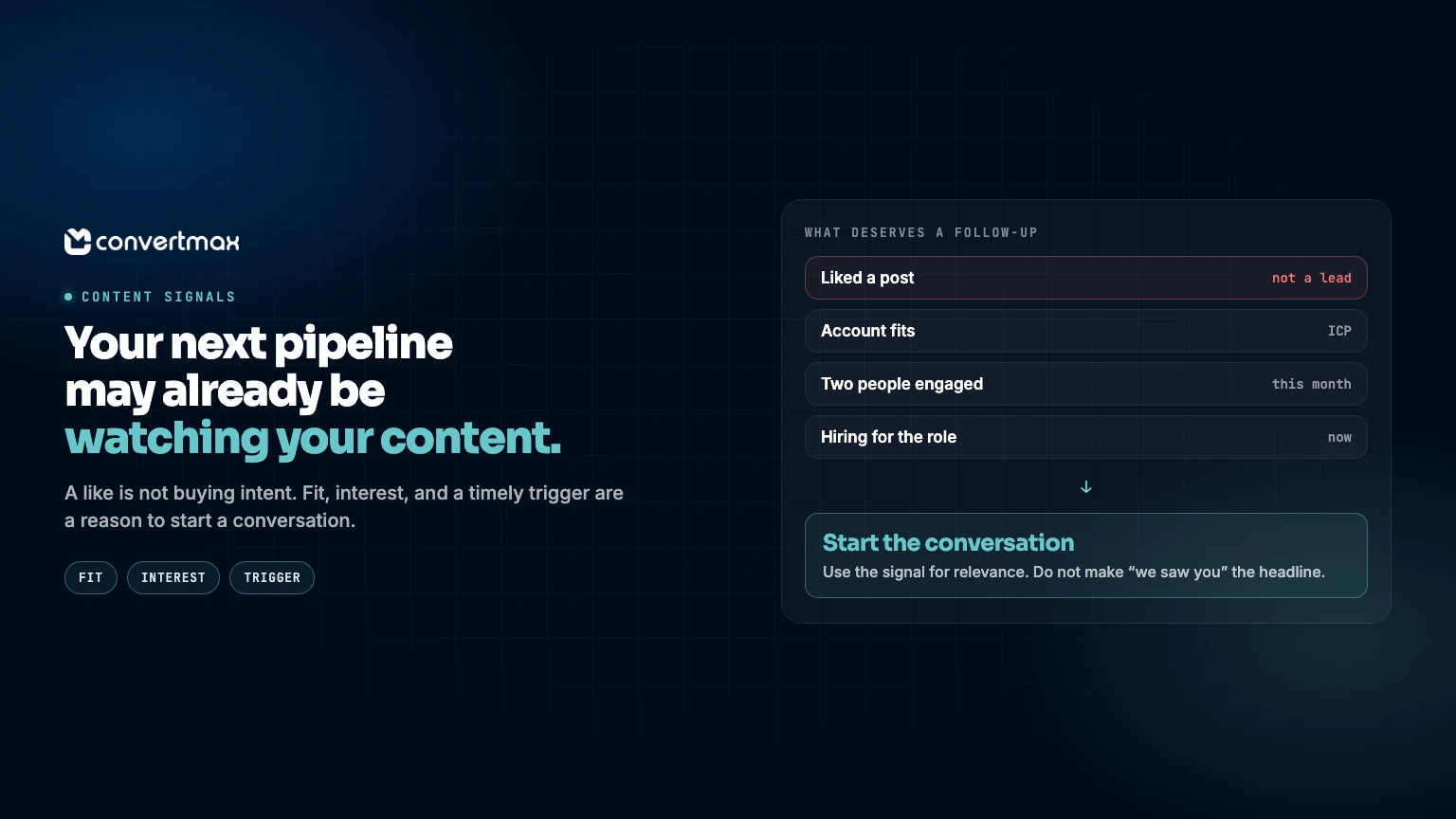
That is why a practical scoring model should not put all its weight on engagement. It should bring together three things:
- Fit: Does the person or account resemble the companies you can genuinely help? Consider company size, industry, geography, team structure, technology, and the stakeholder’s role.
- Interest: What have they actually done? A repeat visit to a pricing page or a download of a decision-stage resource may be more meaningful than one like on a broad thought-leadership post.
- Trigger: Is there evidence that the problem may be timely? A new sales leader, an open hiring plan, a funding event, a market expansion, or a relevant technology change can matter more than a comment alone.
Fit tells you whether the account belongs in your market. Interest tells you whether it is paying attention. A trigger tells you why a conversation might be useful now.
Without all three, teams risk spending time on friendly engagement that will never turn into revenue.
Build a score that helps people make better decisions
Automation and AI can help gather signals from your CRM, website analytics, marketing automation platform, enrichment data, and content channels. But the goal is not to let a scoring model decide who gets an unsolicited pitch.
The goal is to give a salesperson a more informed starting point.
For example, a workflow might flag an account when it meets the following conditions:
- The company fits the target segment.
- Two or more people from the account have engaged with a relevant topic in the past month.
- At least one person has visited a high-intent page or downloaded a practical resource.
- The account has a timely trigger, such as hiring for a role tied to the problem you solve.
That is a much stronger signal than “someone liked a post.” It gives the account owner context: what the company engaged with, who is involved, and why the timing may matter.
Before outreach begins, a person should still review the account. A founder or seller can often spot obvious false positives that an automated workflow cannot: an existing vendor relationship, a competitor, a student project, or a company that is far outside the real buying profile.
Use automation to narrow the field. Use judgment to decide whether a conversation is warranted.
Make outreach feel like a continuation, not an interruption
Once a high-quality signal appears, the next step should not be a generic “Saw you liked our post” message. That line tells the recipient they are being watched, but it does not give them a reason to reply.
A stronger approach is to connect the outreach to a useful, specific observation.
If an operations leader’s team has been reading material about onboarding bottlenecks and the company is hiring rapidly, a message might acknowledge the broader challenge: scaling a new team often exposes gaps in process, visibility, or training. The sender can then offer a relevant perspective, resource, or short conversation—not an immediate product demonstration.
The content signal should guide relevance, not become the headline of the message.
This is also why a warm outbound motion works best across channels. An email may be one touchpoint. A relevant comment, a helpful direct message, a retargeted resource, or an account-specific page can reinforce the same point. The experience should be coordinated, respectful, and easy to ignore if the timing is wrong.
Close the loop between sales and content
The most overlooked part of this approach comes after outreach.
Sales teams learn quickly which conversations are real. They hear the language prospects use, the objections that keep appearing, the business events that create urgency, and the content topics that attract the right accounts rather than just a large audience.
That knowledge should flow back to marketing.
If a particular post consistently starts conversations with qualified companies, it deserves more attention. It may point to a problem your market is actively trying to solve. If another topic drives plenty of engagement but produces no relevant opportunities, that is useful information too. It may still build brand awareness, but it should not be treated as a reliable pipeline signal.
Over time, this feedback loop improves both sides of the system. Marketing publishes more material that speaks to live problems. Sales gets better context for outreach. And the scoring model becomes less dependent on superficial activity.
Keep planting—and get better at recognizing the harvest
There is no shortcut around creating useful content. The strongest warm-outbound programs are built on a real body of work that earns attention over time.
But content should not sit in a dashboard after publication. When you combine engagement with account fit and real-world triggers, it becomes an early-warning system for potential demand.
That does not mean every engaged person needs a follow-up. It means your team can stop treating all prospects the same.
Keep publishing. Keep learning what resonates with the right people. Then use the signals to decide where a timely, relevant conversation might be welcome.
That is a more sustainable way to build pipeline than simply sending more cold messages.
This article was inspired by Pierre Herubel’s LinkedIn post and the discussion it generated around content signals, account fit, and buying triggers. 1