By Jonah Hale
How to Use Convertmax for GoHighLevel Lead Reactivation
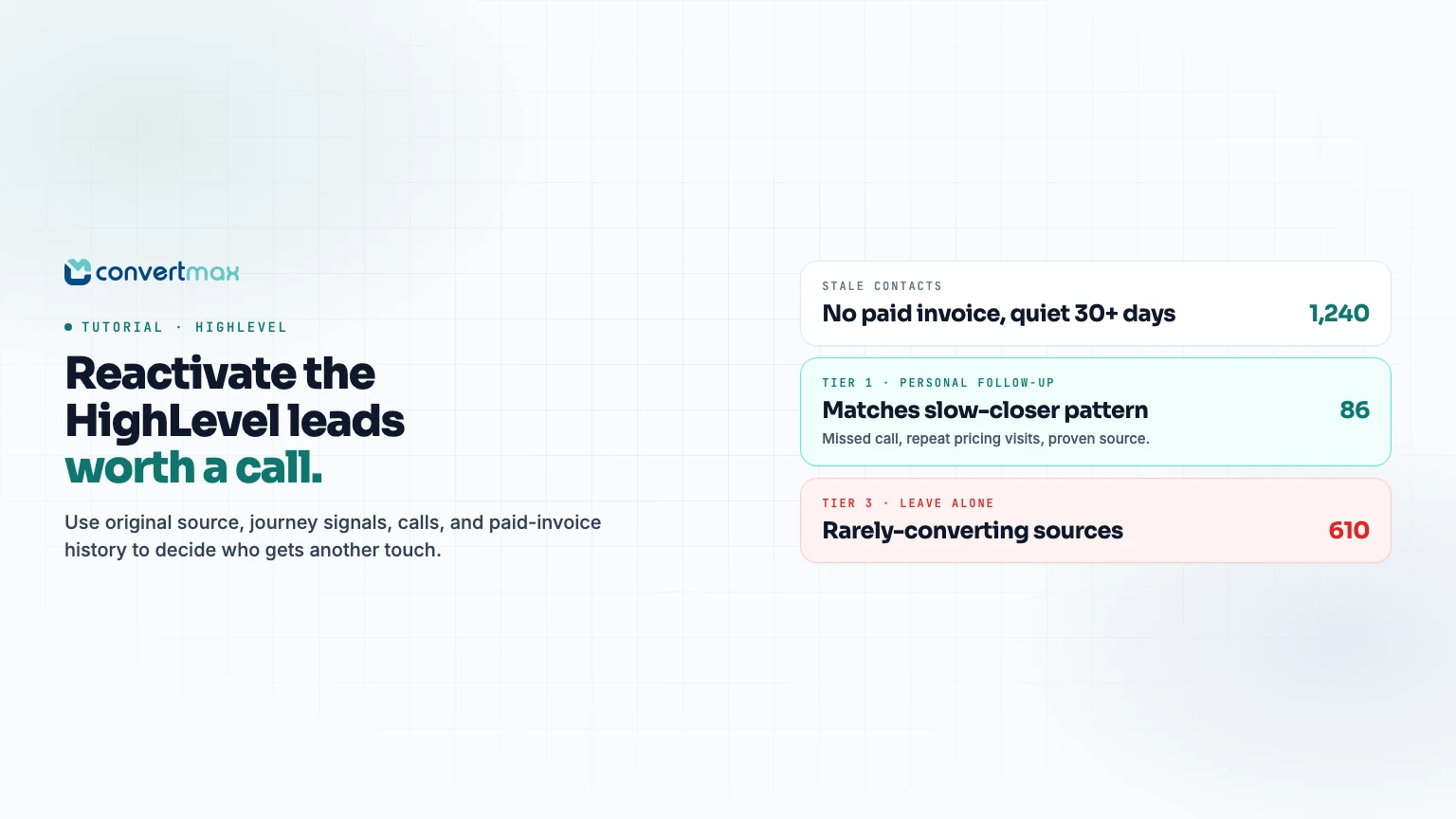
Every HighLevel account has a pile of contacts who went quiet. A quote request that never got a reply. A missed call that nobody returned. Someone who booked, cancelled, and disappeared.
You already paid to acquire those people. Some of them are worth another call. The trouble is that most reactivation campaigns treat the whole list the same way: one SMS blast, one email sequence, every stale contact. That approach burns goodwill with people who were never a fit and gives too little attention to the ones who were close.
This tutorial shows how to use Convertmax to decide which stale HighLevel contacts deserve another touch and in what order, based on where they came from, what they did, and how similar contacts have turned into paid revenue. It is part of our How to Use Convertmax for [Outcome] series.
The decision you are making
The question is not "should we run a reactivation campaign?" It is:
- Which stale contacts are worth a personal call, which are worth an automated sequence, and which should be left alone?
- Which sources and journeys have historically produced paying customers after a slow start?
- How will we know if reactivation created revenue, rather than just catching people who were coming back anyway?
A stale-lead list on its own cannot answer any of those. Attribution context can.
What Convertmax brings from HighLevel, and what it does not
It helps to be precise about the data, because it shapes the playbook.
The Convertmax HighLevel integration syncs contacts, paid invoices, and invoice line items from the HighLevel location you authorize. Contacts are linked to their first-party website journeys. Paid invoices become revenue conversions attributed back across those journeys. Historical contacts and invoices can be backfilled, which matters here, because reactivation is all about older records.
Opportunities and pipeline stages are not synced today. HighLevel stays the place where pipeline is managed and where the reactivation outreach itself runs. Convertmax supplies the context for deciding who to reach out to.
That gives you a clean working definition for this tutorial:
Stale contact: a HighLevel contact created more than 30 days ago with no paid invoice and no recent website or call activity.
Adjust the 30 days to your sales cycle. A roofing company and a med spa will choose different numbers.
Connect the minimum data path
- Install Convertmax from the HighLevel App Marketplace and authorize the location that owns the contacts and invoices. Run the backfill so older contacts and invoices are included.
- Keep the Convertmax pixel on your HighLevel funnels and site pages. That is what records the original source, landing pages, and repeat visits before and after the contact is known.
- Connect call tracking through CallRail or CallTrackingMetrics if phone is a meaningful lead channel. Missed and short calls are some of the most useful reactivation signals.
- Confirm the identity key. Email or phone needs to be present on the HighLevel contact so it can be matched to the journey. Contacts with neither cannot be scored on journey behavior.
Then pay or locate a recent test invoice and confirm it shows up in Convertmax as revenue on the right contact journey. If that check fails, fix it before going further.
Step 1: Learn which sources recover
Before scoring individual contacts, look at your paid customers. Pull every contact with a paid invoice in the last 12 months and split them into two groups:
- Fast closers: paid within your normal cycle.
- Slow closers: went quiet for at least 30 days, then paid.
Now compare the original source, landing page, and journey pattern of the slow closers with everyone else. You are looking for patterns such as:
| Signal | What it might tell you |
|---|---|
| Original source | Some sources produce people who take longer but still buy |
| Landing page or offer | Price-focused pages may produce shoppers, service pages may produce buyers |
| Number of visits before going quiet | Several visits suggests real consideration, not a passing click |
| Pricing or booking page views | A stronger buying signal than a blog visit |
| Call history | A missed or very short call often means intent that was not handled |
| Invoice value of similar customers | Tells you how much a recovered contact is likely to be worth |
This is the step most reactivation programs skip. It turns "everybody who went quiet" into "people who look like customers we have already won back."
Step 2: Build three reactivation tiers
Use the patterns from step 1 to sort stale contacts into three groups:
- Tier 1, personal follow-up. Source and journey match your slow closers, with a strong signal such as a missed call, a pricing-page visit, or several sessions. Give these to a person to call.
- Tier 2, automated sequence. Reasonable source, some engagement, no strong signal. Put these in a short, relevant email or SMS sequence in HighLevel.
- Tier 3, leave alone. Sources that rarely produce customers, single-visit contacts, or obvious poor fits. Do not spend effort or sender reputation on them.
Tag each contact in HighLevel with its tier and build smart lists from the tags. The outreach runs entirely in HighLevel, the same way your team already works.
You can ask Max to speed this up, for example, "Which HighLevel contacts from Google Ads in the last six months visited the pricing page more than once and have no paid invoice?" Use the answer as a starting list, then review it before tagging.
If you use Make.com, Convertmax can send lead-score changes to a Make scenario, which can then update the contact in HighLevel. That is useful for keeping tiers current over time. Treat it as a second step, once the manual version has proved itself.
Step 3: Hold some back so you can measure it
Reactivation is easy to over-credit. Some of the people you contact were going to come back anyway.
Before you start, randomly hold back a slice of Tier 1 and Tier 2, perhaps one in ten, and do not contact them. After your judging window, compare paid-invoice rates and revenue between the contacted group and the held-back group. The difference is a much more honest read of what reactivation produced than "invoices from anyone we contacted."
Convertmax will show reactivated customers with their full journey, so you can see both the original source that brought them in and the reactivation touch that brought them back. That matters when you later decide how much a source is really worth.
Validate before you scale it
- Spot-check ten Tier 1 contacts. Open each in HighLevel and in Convertmax. Does the story make sense? Is there a reason they went quiet, such as a complaint or a quote from someone else, that the data does not show?
- Check for existing customers. Make sure nobody with a recent paid invoice, under a different email or phone number, ends up in a reactivation list.
- Check consent. Only contact people through channels they agreed to. A reactivation campaign is still marketing.
- Watch duplicate contacts. If the same person exists twice in HighLevel, merge them first, or they may get two sequences.
Make it a monthly habit
Reactivation works better as a small monthly routine than as a once-a-year blast:
- Refresh the stale-contact list at the start of each month.
- Re-tier using the same rules.
- Run Tier 1 calls and Tier 2 sequences.
- Compare against the holdout once the judging window has passed.
- Update the rules if a source or signal stops predicting recovery.
Over time, this also feeds back into acquisition. If one source keeps producing contacts who go quiet but buy later, it may deserve more patience, and more budget, than its first-month numbers suggest.
For background on how HighLevel revenue connects to marketing source, read GoHighLevel revenue tracking. If you would like help setting this up on your own HighLevel location, book a Convertmax demo and we will walk through your contacts, invoices, and the sources most likely to recover.