By Elena Marsh
GoHighLevel Revenue Tracking: Connect Pipeline Activity to Money Collected
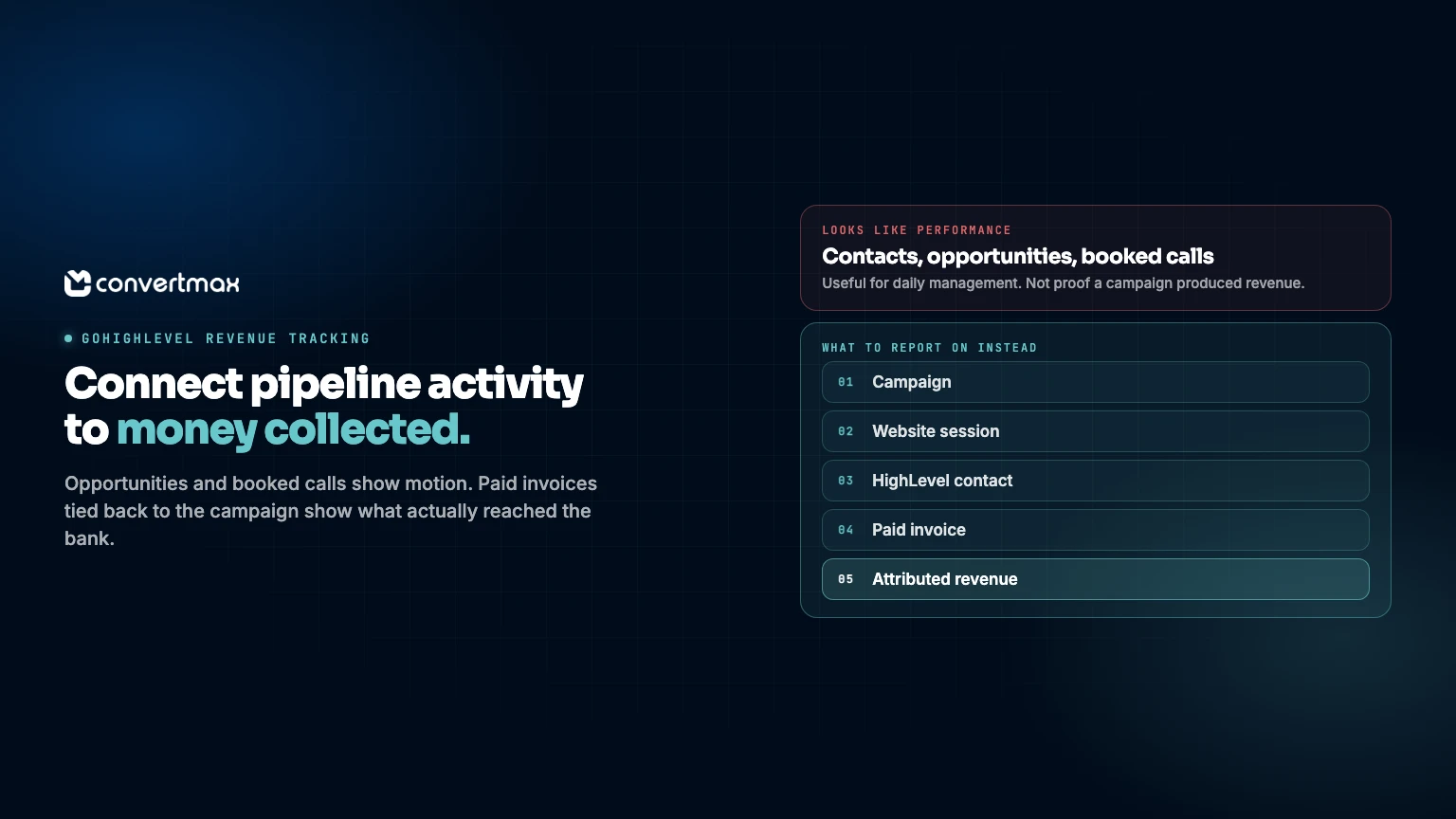
A full pipeline can be encouraging right up until somebody asks what actually reached the bank account. Contacts arrive. Opportunities are created. Follow-up tasks get completed. Appointments fill the calendar. Then comes the question that matters: which channel brought in the money?
That is where GoHighLevel revenue tracking can fall short. GoHighLevel gives agencies and operators a place to manage contacts, opportunities, conversations, and follow-up after a prospect enters the business. But marketing reporting is only as credible as the journey and revenue data connected to it.
When the original source is missing, a phone call is separate from the record, or payment data lives elsewhere, pipeline activity becomes a stand-in for performance. Helpful for daily management. Not enough for deciding where next month's budget belongs.
Now in the HighLevel App Marketplace: Convertmax is free to install from the HighLevel App Marketplace (a Convertmax plan is required). It syncs HighLevel contacts, paid invoices, and invoice line items so invoice-backed revenue can be attributed to the campaigns and journeys that created it. See how the HighLevel integration works.
Pipeline movement is not revenue
A new opportunity, booked call, or later pipeline stage can signal that marketing is doing something right. Those signals show whether leads are receiving attention and whether sales motion is moving. They do not answer whether a campaign produced collected revenue, how much it produced, or what influenced the customer along the way.
Take a common path. Paid search sends someone to a landing page. They return later, call the business, speak with sales, become a contact in GoHighLevel, and pay through a billing or commerce system. Each event may be visible somewhere. Without a connection between records, though, the payment loses its link to the first click and the call that helped move the deal.
Marketing has clicks and forms. Sales has opportunities. Finance or operations has collected money. Everyone has a piece of the story. No one has the whole thing.
Build a revenue record that can be traced
You do not need a sprawling report for every lead. You do need enough context to trace a customer outcome back to the work that created it. Start with a shared view of the route from marketing activity to a closed customer.
| Checkpoint | What to retain | Why it matters |
|---|---|---|
| First visit | Original source, campaign, and landing page | Shows how the person first found you. |
| Lead capture | Form, chat, booking, or call event | Shows how the person became identifiable. |
| GoHighLevel activity | Contact, opportunity, pipeline stage, and owner | Shows how the lead was handled. |
| Customer outcome | Closed status, collected revenue, and repeat value when available | Links the record to the business outcome. |
| Influencing touches | Later campaigns, calls, and visits | Adds context beyond the last interaction. |
Simple on paper. It still calls for consistency across systems. A contact should not become an unrelated person every time they submit another form, click an ad, or call from another device. A deal should not vanish from reporting once it leaves the CRM, either.
That is the practical role of first-party tracking and identity resolution. They help connect activity that belongs to the same person or business using data gathered through the company’s own customer journey. With that thread in place, a team can inspect the route instead of relying on a final lead-source field alone.
Put calls back in the journey
Calls are often the missing piece of GoHighLevel reporting, particularly for higher-consideration services. Someone may first find the business through an ad, return to the site, and call only when they are ready to talk. If the call sits apart from the marketing journey and later customer record, the campaign can appear less valuable than it was.
The point is not simply to count phone calls. It is to see which marketing sources led to conversations and whether those conversations connect to revenue. That separates a channel producing low-intent inquiries from one leading to customers.
Run this quick review with the team:
- Can you see the original source for contacts and opportunities that close?
- Are website leads, appointments, and calls connected to one customer record when they belong together?
- Does collected revenue remain connected to the opportunity and earlier campaign activity?
- Can campaigns be reviewed by revenue, rather than only lead volume or pipeline movement?
- Is repeat purchase activity or customer lifetime value visible when the business has that data?
The answers expose gaps quickly. If nobody can follow a closed customer back to the campaign and journey that produced them, comparing lead-source costs is mostly guesswork.
Make agency reporting easier to defend
For agencies, the issue is sharper in client reporting. A monthly file full of impressions, clicks, and leads shows activity. It does not settle the question a client will eventually ask: “What did our marketing produce?”
A stronger report connects the marketing source to the GoHighLevel contact, then follows the record through to paid revenue. Agency, client, and sales team have the same frame of reference. Campaign ROI discussions can begin with evidence rather than a pile of exports at month-end.
There is another useful result. When marketing and sales look at the same journey, handoff problems are easier to spot. Paid social leads may not be getting follow-up. One location may handle call leads better than another. Reporting will not repair either issue, but it shows the team where to investigate.
A source creating fewer opportunities may still matter if its customers produce more revenue or better lifetime value. A channel with plenty of pipeline movement may deserve less budget if money never follows. Ask the plainer question: what is making us money?
Where Convertmax fits with GoHighLevel
GoHighLevel can remain the system for pipeline management and follow-up. Convertmax does not replace the existing stack. It provides connected revenue context around it.
Convertmax is a done-for-you Revenue Intelligence platform that connects first-party journeys from first click to closed revenue. It combines attribution, CRM intelligence, call tracking, customer journey reporting, first-party tracking, identity resolution, multi-touch attribution, campaign ROI, and customer lifetime value reporting. In a GoHighLevel setup, the Convertmax HighLevel integration syncs contacts, paid invoices, and invoice line items. Paid invoices become attributed revenue conversions, contacts are linked to their first-party website journeys, and historical records can be backfilled so reporting starts with context. Opportunities and pipeline stages are not synced today, so GoHighLevel stays the place to manage pipeline while Convertmax shows which marketing produced invoice-backed revenue.
Convertmax can work with stacks that include GoHighLevel, Google Ads, HubSpot, call platforms, commerce, billing, analytics, and CRM systems. The value lies in connecting those records, not asking a team to trade in tools it already uses. HighLevel users can install Convertmax from the HighLevel App Marketplace.
When phone leads are a big part of the pipeline, see call revenue tracking.
Before moving campaign spend, make sure the route from source to money collected is visible. Book a Convertmax demo or get a free revenue and attribution audit to map that route when the GoHighLevel pipeline is active but revenue reporting still calls for too much guesswork.