By Elena Marsh
The Reality of Connecting Google Analytics to CRM Data (And Why It Keeps Breaking)
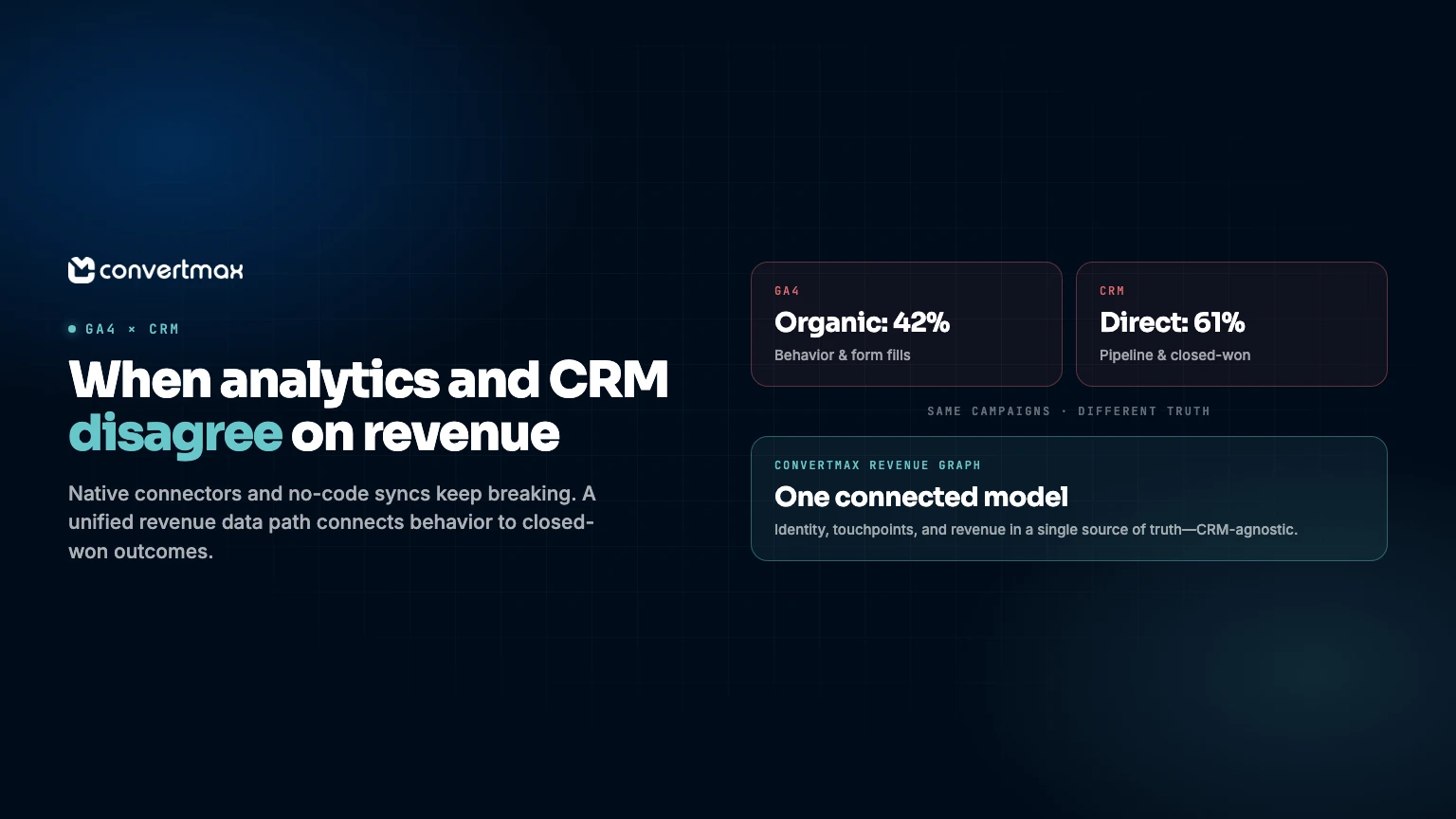
Your Google Analytics 4 (GA4) dashboard shows a surge in conversions from organic search. Your CRM tells a different story, crediting direct referrals for the majority of closed-won revenue. Both systems are looking at the same campaigns during the same timeframe, yet they produce entirely different answers.
When ad platforms, analytics tools, and CRM systems disagree on revenue, marketing teams find themselves defending one set of numbers while sales and finance trust another. This disconnect is not just a reporting annoyance. It leads to misallocated budgets, where real dollars flow into underperforming channels because the attribution data suggested they were working.
Connecting GA4 to your CRM is supposed to solve this problem. The reality of CRM integration is far more complex than simply turning on a native connector. This guide explores why the gap between GA4 and CRM attribution exists, the limitations of standard integration methods, and how revenue teams can build a unified data path that accurately connects marketing activity to closed revenue.
The Fundamental Mismatch Between GA4 and CRM
The conflict between GA4 and CRM attribution stems from a fundamental difference in what they measure and when they measure it. Both platforms observe the same customer, but they look through entirely different lenses.
GA4 Measures Behavior
GA4 is a behavioral analytics platform designed to map how users find and interact with your website. It excels at the top of the funnel, capturing the channels that triggered a website visit and assigning credit through session-scoped and user-scoped attribution models.
GA4's visibility effectively ends when a user submits a form. It records the form submission as a conversion event but has no inherent way of knowing what happens next. It cannot distinguish between a spam submission, an unqualified lead, or a prospect who eventually signs a $50,000 contract. For businesses with sales cycles that span months and involve offline conversations, GA4 remains blind to the actual revenue outcomes unless specific feedback loops are established.
CRMs Measure Revenue
Your CRM tracks the financial reality. It follows a contact from initial entry through pipeline stages to a closed deal with a specific dollar amount attached. The CRM links marketing touchpoints to actual business outcomes, revealing which channels generate high-quality pipeline rather than just high volumes of cheap leads.
The limitation of CRM attribution lies in its inability to see the early, anonymous touchpoints. B2B buyers often complete a significant portion of their research before ever filling out a form. A prospect might engage with your content for weeks, but the CRM only records the source associated with the final conversion event. This collapses a complex, multi-touch journey into a single data point. For a deeper look at that journey problem, see how to measure marketing attribution.
Why Standard Integrations Often Fail
To bridge the gap between behavior and revenue, teams attempt to connect their CRM to GA4. While there are several ways to achieve this, many standard approaches fall short of providing full-funnel attribution.
The Limits of Native Connectors
Most major CRMs offer built-in GA4 integrations. These are quick to set up and provide a basic connection, but they are often limited in scope. Native connectors frequently fail to store the GA4 Client ID within the CRM, preserve the full history of UTM parameters, or send deal stage and revenue data back to GA4. They connect the systems superficially but do not provide the depth required for true closed-loop reporting.
The Fragility of No-Code Automation
No-code tools like Zapier or Make are often used to automate the transfer of data, such as sending a GA4 event when a deal is marked "Closed-Won." While accessible to non-developers, these automations can break silently when API endpoints or custom fields change. They also struggle to maintain the critical GA4 Client ID tracking necessary to stitch offline CRM actions back to the original user journey.
The Complexity of Custom Builds
For teams requiring robust, real-time data flow, Measurement Protocol or BigQuery integrations are the standard paths. These methods allow for offline conversion tracking and custom attribution modeling. They require significant developer resources to build, maintain, and monitor. The data mapping alone can take weeks, and if the GA4 Client ID is not captured perfectly at the point of form submission, the entire attribution model breaks down.
Building a Unified Revenue Data Path
The solution to the GA4-CRM disconnect is not simply finding a better integration tool. It requires fundamentally changing how revenue data is modeled. Instead of trying to force CRM data into GA4 or vice versa, organizations need a unified data path that sits above individual platforms.
This is the core philosophy behind Convertmax. We recognize that businesses do not run on a single platform. Revenue is generated across a complex ecosystem of ad networks, websites, CRMs, billing platforms, and support tools.
Identity Resolution and the Client ID
The critical link in any attribution setup is identity resolution. When a lead submits a form, the GA4 Client ID must be captured and stored on the CRM record along with relevant UTM parameters and click IDs. This identifier acts as the thread that connects anonymous website behavior to known CRM pipeline stages. Convertmax approaches this through first-party analytics and visitor identification that survive beyond a single session or form fill.
Bidirectional Data Flow
A true integration is bidirectional. It is not enough to send website data to the CRM. Revenue signals must flow back to the analytics and advertising platforms.
When offline events like SQL creation and closed-won deals are sent back to GA4 and ad platforms, ad algorithms can optimize against actual revenue rather than top-of-funnel form fills. This feedback loop ensures that automated bidding scales the channels that generate profitable customers, not just the ones that generate the most clicks.
A CRM-Agnostic Revenue Model
Because the customer journey spans multiple systems, your attribution model should not be locked inside a single CRM. A CRM-agnostic approach, like the one built into Convertmax, connects touchpoints, platforms, and revenue events into a single, unified model—the Revenue Graph.
This allows revenue teams to answer complex questions that no single platform can address alone. You can see which campaigns generated the highest lifetime value and which content influenced the most qualified opportunities. By normalizing data across sources, teams gain a clear, cross-system view of what actually drives revenue, regardless of which CRM they happen to use today.
Conclusion
Connecting Google Analytics to your CRM is essential for moving beyond last-click attribution and measuring true marketing ROI. Relying on basic integrations often leaves teams with incomplete data and conflicting reports.
To build trust in revenue reporting, organizations must move away from siloed dashboards and establish a governed data path that connects anonymous behavior to closed-won revenue. By capturing identity identifiers, enabling bidirectional data flow, and adopting a cross-system revenue intelligence model, marketing and sales teams can finally agree on what is working and invest with confidence.
Convertmax connects touchpoints, platforms, and revenue events into a single model so your team can understand how revenue is created. Explore the platform or request a demo to see how a unified revenue data path replaces fragile GA4–CRM syncs.