By Elena Marsh
Your Ad Account Is Optimizing for the Wrong Conversion Event
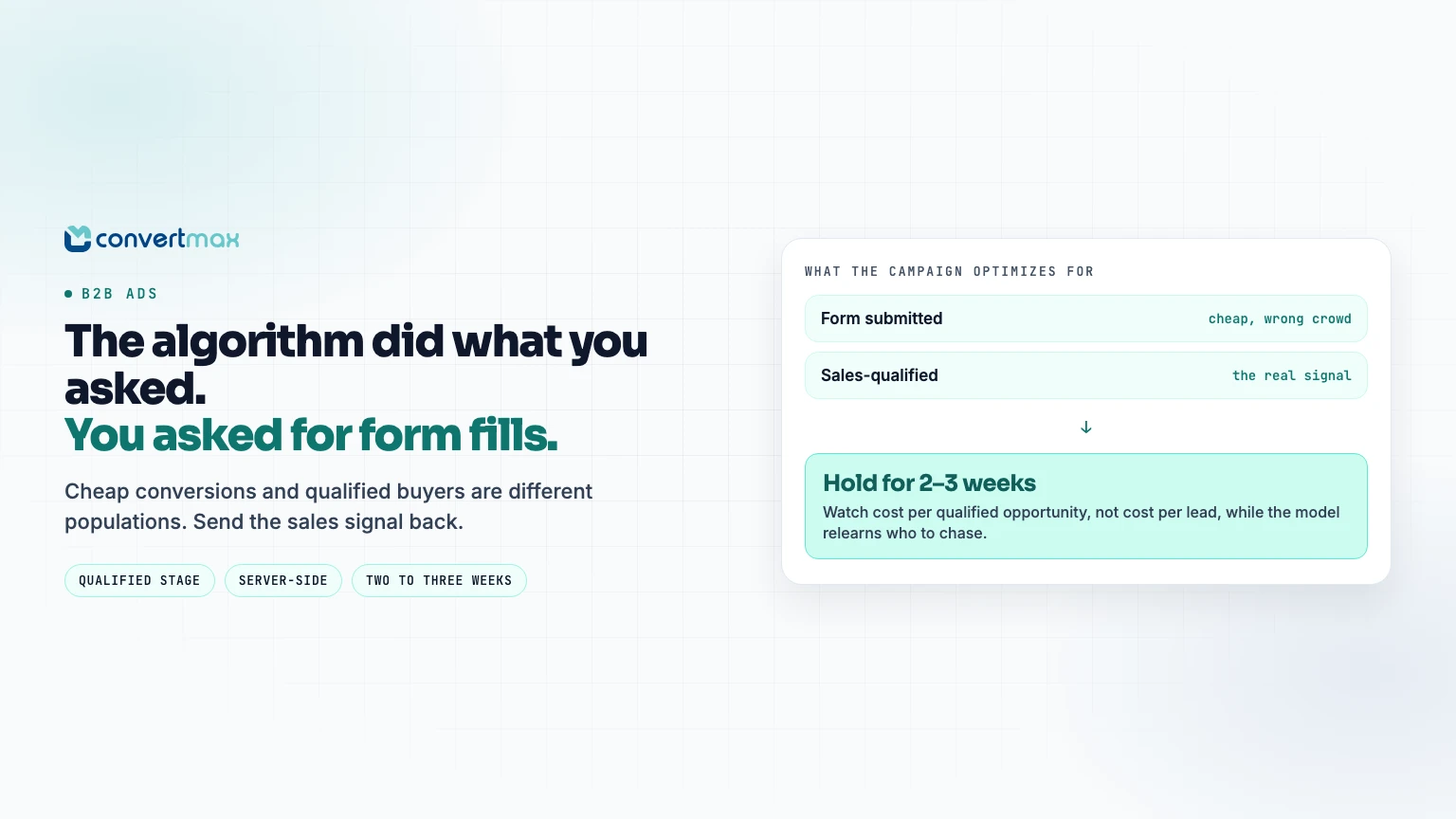
Every algorithmic campaign you run is a feedback loop.
Performance Max. Advantage+. Smart Bidding. LinkedIn's automated bidding. You hand the machine a goal, it finds more people who resemble the last people who hit that goal, and it repeats that process a few million times a day. That's it. That's the whole trick, and it works frighteningly well.
It's also completely indifferent to what you actually meant.
Feed it a weak signal and it optimizes toward whoever is cheapest to convert. Not toward buyers. In B2B those two populations often share nothing but a job title. So the dashboard looks fine. CTR is reasonable. Cost per conversion sits under target. And then somebody opens the CRM and finds a pipeline full of companies your sales team will never call.
The loop does exactly what you tell it
A conversion event isn't a measurement of demand. It's a definition. When you point automated bidding at "form submitted," you've just told the platform that a form submission is the business outcome.
It has no way to know that a VP of Finance and a student downloading the same whitepaper aren't the same thing.
Both count as one. Both get fed into the same learning loop. So the algorithm goes hunting for more people who behave like the average of those two, and the average of a buyer and a non-buyer is a non-buyer. Now you're paying to acquire them at scale.
The damage accumulates quietly:
- Cost per lead looks stable, or even improves.
- Lead volume rises.
- Sales-qualified rate falls.
- Cost per qualified opportunity, which nobody is watching, climbs.
By the time this reaches a budget review, the account has spent months teaching its own algorithms to chase the wrong population. Better targeting won't fix it. Neither will new creative. You need a better signal.
Fix 1: Optimize for qualified leads, not form fills
Stop treating the form fill as the outcome.
A form fill is a hand raise. It isn't a qualification. Somewhere between the hand raise and the sales conversation, a human being applies judgment. Company size. Industry. Title. Budget. Timing. Whether the use case actually fits. That judgment is the real signal. It just lives in your CRM instead of your ad account.
Good news: you can pass it upstream. Meta now offers a qualified leads performance goal that optimizes toward people more likely to convert after submitting, rather than people most likely to submit, and it has tied that goal to Conversions API CRM integration for new campaigns. Meta's own guidance reports meaningfully lower cost per quality lead once the CRM connection is in place. Google and LinkedIn have comparable paths.
The practical version:
- Pick one downstream event that represents real sales acceptance. Usually that's your SQL or sales-accepted stage. Sometimes it's a booked meeting that survives the first call.
- Make that the primary conversion your campaign optimizes toward.
- Demote the form fill. Keep it for reporting and volume context. Stop letting it steer bidding.
- If you sell on contract value, attach revenue or a value tier to the event so the platform optimizes toward bigger deals instead of more of them.
One caveat, and it's a real one: platforms need volume to learn. If your SQLs arrive at twelve a month, a pure SQL-optimized campaign can starve. The usual workaround is a value-based or hybrid setup. Send both the form fill and the qualified event, weight them differently, let the qualified signal carry the actual weight. The goal isn't fewer signals. It's making sure the one that matters is the loudest.
Fix 2: Pass CRM stage back with server-to-server tracking
A better event is useless if it never reaches the platform.
That's the job of server-to-server tracking, and every platform has its own name for it.
| Platform | What it calls it | What it does |
|---|---|---|
| Meta | Conversions API (CAPI) | Sends events from your server, including CRM stage changes |
| Google Ads | Enhanced conversions for leads | The upgraded path for importing CRM and offline conversion data, matched with hashed user-provided data |
| Conversions API | Connects online and offline conversion data to campaigns | |
| TikTok, others | Events API | Same idea, different branding |
Three details decide whether this works or quietly does nothing.
Send the stage, not the lead. The instinct is to send everything and let the platform sort it out. That reintroduces the exact problem you're solving. Send the leads that reach Sales Qualified, and only those. A small clean signal beats a large muddy one every time.
Match on a real identity key. A CRM stage change only attaches to the right ad click if you carried an identifier through the journey. Usually that means a click ID (gclid, fbclid, li_fat_id) or a hashed email captured at the form and stored on the contact record. No key, no match. The offline conversion lands as an orphan and teaches the algorithm nothing. It's the same identity problem that breaks GA4-to-CRM reporting, and it has to be solved before you upload the first stage change.
Send it from the server. Browser tracking loses events to ad blockers, ITP, and iOS restrictions. And CRM stages don't happen in a browser at all. Server-side delivery is the only reliable path for a signal that originates inside your sales pipeline. Our glossary entry on server-side tracking covers the mechanics.
The clean architecture is short. Form submission captures the click ID. The CRM stores it on the contact. The qualified stage fires a server event back to the platform with the matching key. Everything after that is reporting.
Fix 3: Give the algorithm two to three weeks to recalibrate
Here's where most teams break their own fix.
The day you switch the primary conversion from form fill to qualified lead, performance usually gets worse. Cost per conversion spikes. Volume dips. The dashboard, trained to expect a certain number of cheap conversions per day, suddenly looks like it's failing.
That's not failure. That's the algorithm relearning who to chase.
The old model was built around a population that included a lot of people who were never going to buy. The new model has to rebuild its audience assumptions from a different, smaller set of examples. Meta's guidance for value optimization suggests running campaigns at least three weeks and notes that peak performance typically arrives after about two. That lines up with what most B2B accounts see.
So: hold for two to three weeks. Don't switch the event back. And don't rewrite creative, rebuild audiences, and change bids at the same time, because then you won't know which change caused what. One variable. Let it run.
Two things worth watching while you wait.
Week one, judge nothing. Expect worse numbers. Treat them as expected, not diagnostic.
Week two and three, watch cost per qualified opportunity instead of cost per lead. If qualified volume is climbing at a tolerable cost, the recalibration is working even when the headline conversion count looks softer than it used to.
The part nobody budgets for
All three fixes rest on one unglamorous prerequisite. Somebody has to say, precisely, what a qualified lead is, which CRM stage represents it, and which system holds the authoritative version of that event.
In most B2B stacks, that definition is scattered across five places. The ad platform counts its own conversion. The form tool counts a submission. The CRM counts a stage change. Finance counts an invoice. Ask all five what a conversion is and you get five defensible, incompatible answers. You can't confidently feed a signal back to a platform while your own team argues about what the signal means.
This is the problem our Unified Conversion Protocol was built for. One event contract that says who did what, with what context, and what revenue followed, so a form fill, a call, a stage change, and an order are comparable records instead of competing dialects.
Once converts share a schema and an identity, the Revenue Graph holds the relationship between the original click, the CRM stage, and the closed revenue. Two reasons that matters.
First, you can verify the fix. Change your optimization event and never connect it to pipeline outcomes, and you're trusting the platform to grade its own homework. Connect the ad click to the CRM stage to the closed deal and you can measure cost per qualified opportunity and cost per closed-won dollar before and after the change. That's the number that justifies the two uncomfortable weeks.
Second, you can run it again. The right conversion event isn't permanent. It shifts when your ICP moves, when you launch a new motion, when a segment starts producing pipeline that never closes. Teams that treat the conversion event as a living definition, reviewed quarterly against revenue, get compounding returns from it. Teams that set it once in 2022 and forgot are paying for that decision every month.
What to check in your account this week
Open the account. Find the primary conversion action on each algorithmic campaign. Then answer four questions.
- What is this event actually measuring, a hand raise or a qualification?
- What percentage of the people who trigger it become sales-qualified? If you don't know, that's the finding.
- Is the qualified stage going back to the platform, server-side, with a matching identity key?
- When was this event last reviewed against pipeline and closed revenue?
If the answer to the first one is "a form fill," you've found the most common reason a B2B account underperforms. It's rarely the targeting. Rarely the creative. It's a conversion event pointed at the wrong thing, running quietly for months, training the algorithm to do exactly what you asked it to do.
You can see how Convertmax connects ad clicks, CRM stages, and revenue in one model on the platform page, or start with the attribution overview to see where your conversion definitions currently disagree.